£218m Lender, £430m Buyer, One £650m SME Platform
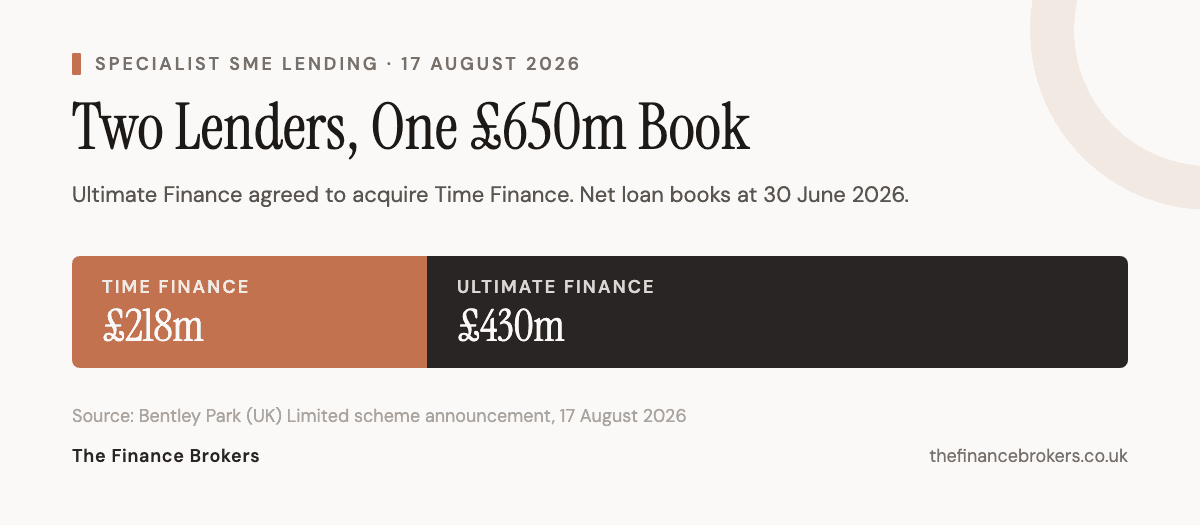
One of the few listed specialist lenders left in UK SME finance is about to stop being listed. This morning, Bentley Park (UK) Limited, the Tavistock Group company that owns Ultimate Finance, agreed a recommended cash acquisition of Time Finance plc at 59.1p a share, valuing it at roughly £55.1m. If the scheme completes as expected in the fourth quarter, the combined business will run a net loan book of close to £650m.
That is the largest single move in independent UK SME lending we have seen this year, and it happened to a business that was not in trouble. Time Finance had just reported its 20th consecutive quarter of loan book growth and a pre-tax profit of £8.4m, up 6%. This is not a rescue. It is a buyer paying a premium for a book that works.
What was actually agreed
The bare facts from the announcement:
- 59.1p per share in cash, valuing Time Finance at approximately £55.1m on a fully diluted basis
- A 12.6% premium to the 52.50p closing price on 14 August, 23.5% to the three-month volume-weighted average and 27.5% to the six-month average
- Time Finance's unaudited net loan book was £218m at 30 June 2026, split roughly £141m asset finance and £77m invoice finance
- Ultimate Finance's own unaudited net loan book was £430m at the same date: about £165m invoice finance, £165m asset finance and £99m bridging
- The Time Finance board is recommending it, and completion is expected in Q4 2026
Ed Rimmer, Time Finance's chief executive, said the board "believes there is a strong strategic fit between the two businesses, the combination of which will create a broader platform, introduce the benefits of additional scale and provide additional resources that can support future growth."
Josh Levy, who runs both Bentley Park and Ultimate Finance, framed it as "an exciting opportunity to bring together two strong specialist lenders with complementary capabilities, shared values and a common focus on supporting UK SMEs."
Why a buyer paid a premium for this particular book
The interesting part is what Time Finance had been doing with its lending mix. We wrote about it in June, when its gross lending book passed £250m for the first time. The engine was not unsecured cash. Invoice finance and the hard-asset end of asset finance accounted for the overwhelming majority of new lending, and the business had deliberately shifted away from the softer, thinner-margin end of the market.
That is a book with collateral behind it. In a market where high-street banks have been retreating from SME lending for years and have walked out of invoice factoring almost entirely, a £218m secured-lending book with 20 quarters of unbroken growth is a scarce asset. Ultimate Finance did not buy a turnaround. It bought capacity in exactly the two products the banks have been vacating.
Look at the product overlap and the logic gets clearer still. Ultimate brings bridging, which Time Finance does not do. Time Finance brings business loans and asset-based lending. Both bring invoice and asset finance at similar scale. Combined, that is a lender able to answer most of what a growing SME asks for from one balance sheet, which is precisely the shape the specialist market has been consolidating toward.
What it means if you borrow
Three practical things, and one of them cuts against the deal.
Nothing changes on your existing facility today. A scheme of arrangement is a change of ownership, not a change of terms. Facilities, covenants and drawdown arrangements sit with the lending entity and carry over. If you have an invoice finance line or a hire purchase agreement with either business, it runs as written.
A bigger balance sheet usually means a bigger appetite. Ultimate Finance has funded over £19bn to UK SMEs since 2002 and supports more than 4,000 businesses. Adding £218m of book and 150 staff gives the combined lender more room on facility size, more sector coverage and more capacity to hold larger exposures. For borrowers who have outgrown a smaller independent, that is genuinely useful.
But the panel just got shorter. This is the part worth being honest about. Every consolidation removes one independent decision-maker from the market. Time Finance and Ultimate Finance were two separate credit committees with two separate risk appetites, and a deal declined by one could go to the other. After completion, that is one appetite. If your business sits at the awkward edge of a lender's criteria, the number of genuinely distinct answers available to you matters more than the size of any single book.
That is not an argument against the deal. It is an argument for not building your funding around a single relationship, which is the same conclusion we reached when Funding 365 was sold in June. The specialist market is getting larger and more concentrated at the same time, and those two facts have opposite effects on a borrower.
The pattern this fits
Consolidation is not happening because specialist lending is struggling. It is happening because it is working. Non-bank lenders provided £34.4bn of new lending in the first half of 2026, and capital has been arriving in the sector steadily: bank funding lines behind bridging lenders, institutional money behind unsecured platforms, and now private investment capital buying a listed lender outright at a premium to its market price.
What that capital wants is scale, and the fastest route to scale in a market of specialists is to buy one. Expect more of it. The lenders most likely to be bought are the ones with the boring characteristics: secured books, long growth records, broker-led distribution and a product set that plugs a gap in the buyer's range. Time Finance had all four.
For an SME owner or a broker, the takeaway is not to track the corporate activity. It is to notice that the market you are borrowing from in 2027 will have fewer names on it than the one you borrowed from in 2024, and each of those names will be bigger. That rewards knowing which lenders genuinely have appetite for your profile, rather than sending the same application to whoever comes up first.
Getting started
If you are financing equipment, funding a cash-flow gap against your sales ledger, or trying to work out whether invoice finance or asset finance is the right shape for your business, get in touch. We work across the specialist market as a whole-of-market broker, with no upfront fees and a soft-search-first approach, so you see indicative terms from the lenders that actually have appetite before anything touches your credit file.
Further reading: Banks Quit Factoring. Close Brothers Grew It 8%. · A Distillery Borrowed £11m Against Unsold Whisky · 20 Straight Quarters of Growth While Banks Pulled Back · £34bn of New Lending Didn't Come From a Bank · The Big Four Walked Out of Invoice Factoring · Funding 365 Sold: What Bridging Consolidation Means · Secured vs Unsecured Business Loans