Goldman Just Put £500m Behind Britain's Small Builders
Goldman Sachs has committed up to £500m to a three-year-old lender that funds small and medium-sized housebuilders. It landed the same week official figures showed planning approvals at their lowest level since 2012, and the day after a new levy started landing on every scheme of ten homes or more.
Read together, those three facts say something the gloomy housing headlines miss. The pipeline is being squeezed. The money to build it is not.
The deal, in the actual numbers
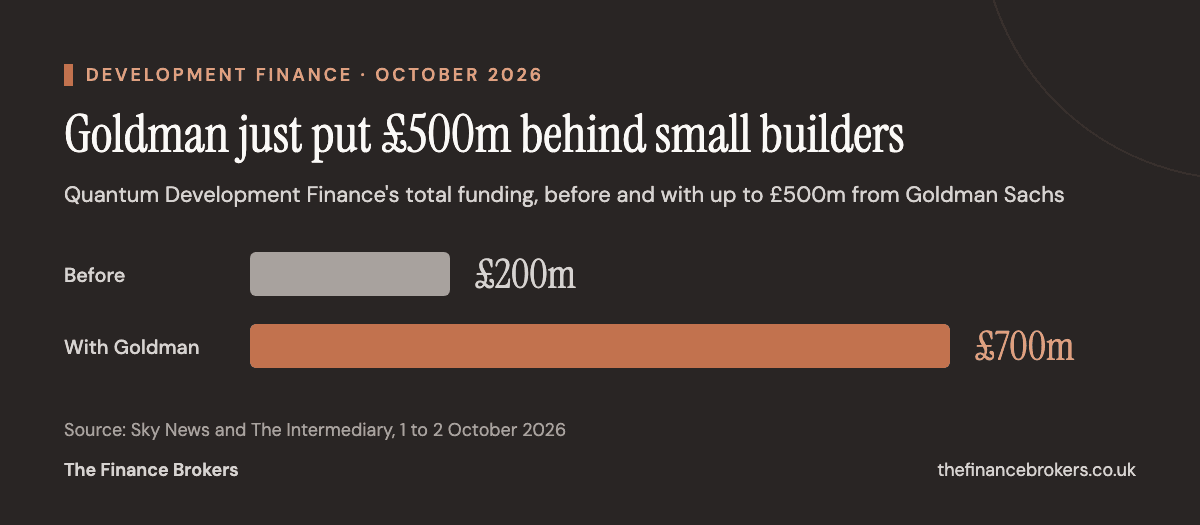
Sky News reported on 1 October that Goldman Sachs is committing up to £500m to Quantum Development Finance, taking the lender's total funding from £200m to £700m. Quantum was founded in 2023, lends up to £35m per deal across England and Wales, has financed around 4,000 new homes, and passed a £1bn funding milestone over the summer.
According to The Intermediary, the facility covers SME housebuilders and property investors from site acquisition through to post-completion, and lets Quantum write larger individual loans. AB CarVal, which has backed Quantum since launch as shareholder and primary funder, is staying in alongside Goldman.
Co-founder and chief executive Oliver Thompson called the approval "a positive signal for the Quantum team as we focus on building an alternative credit platform with bank-level operational rigour."
The figure that stood out to AB CarVal principal Rob Sinclair was a relationship number rather than a volume one: 80% of Quantum's borrowers are repeat or direct clients. For a lender less than three years old, that is the detail worth noticing. Small developers who get funded well tend to come back for the next site.
Why the timing is the story
A £500m line would be notable in any month. This month the backdrop makes it pointed.
Approvals are at a 14-year low. The Home Builders Federation's Q2 figures, published on 30 September, put approvals at 45,315 homes, down 21% on the previous quarter and the lowest since 2012. The number of projects of three or more homes approved fell to 1,234, a record low. HBF chief executive Neil Jefferson described "a housing pipeline being squeezed to historically low levels."
Starts are moving, slowly. The government's own housing supply indicators show 35,910 starts in England between April and June, up 6% on the quarter, while completions slipped 3% to 35,800.
A new cost landed on 1 October. The Building Safety Levy now applies to residential schemes of ten or more dwellings in England, at rates from £12.70 per square metre in County Durham to £100.35 in Kensington and Chelsea, with a 50% discount for qualifying brownfield sites (Mortgage Solutions).
So in a single week the market produced a record-low pipeline, a new tax on that pipeline, and a Wall Street bank committing half a billion pounds to fund it. Those are not contradictory. A firm like Goldman does not commit a long-term facility on next quarter's planning numbers. It commits because it believes the gap between the homes Britain needs and the homes small builders can finance is wide and durable, and that a disciplined specialist lender can earn a return closing it.
The levy is a funding problem, not just a cost
The levy deserves a closer look, because it changes how a development appraisal has to be built.
It is a single upfront charge payable before the first completion or occupation certificate. LendInvest and MDA Consulting's white paper, covered in the same Mortgage Solutions piece, sets out the consequence: if the levy is not budgeted and funded properly, the certificate is withheld, which blocks unit sales, refinancing and loan redemptions.
That last point is the one that catches developers out. A scheme can be built on time and on budget and still fail at the exit, because the lender cannot be repaid until the sign-off arrives. Dan Lohn, relationship manager at LendInvest, put it simply: "With the levy directly impacting scheme viability, cash flow timing and completion sign-offs, proactive partnerships are essential."
In practice, that means the levy belongs in the facility from day one, sized against your gross development value and costed into the loan to cost. If you are unsure how those ratios interact, our explainer on LTC, LTV and GDV walks through it. A scheme that cannot fund the levy at completion has an exit strategy problem, not a cost problem.
Building control applications submitted before 1 October are exempt if substantive works start within three years, so anyone with a consented site in that window has a reason to move.
What the money actually changes for developers
Capital arriving at specialist lenders is a pattern we have tracked all year. In June we wrote about J.P. Morgan and Deutsche Bank backing UK specialist lenders, and in August about Lloyds and NatWest putting £550m behind Lendco. This is the same shift reaching the part of the market where small builders live.
For an SME developer, three things follow.
Larger tickets from non-bank lenders. A lender with a deeper committed facility can hold bigger single loans. Up to £35m from a specialist puts schemes that once needed a clearing bank, or a club of lenders, within reach of a single relationship.
Funding across the whole lifecycle. Quantum's facility runs from acquisition to post-completion. That matters because the riskiest moment in a scheme is often the handover between lenders: land loan to development finance, or build loan to term debt. One lender across those stages removes a refinancing cliff.
Pricing pressure has not gone away. Gilt yields are high, with the 10-year near 5.5% and the 30-year near 6% this week (Mortgage Solutions). New wholesale capital does not make development finance cheap. It makes it available, and availability, not headline rate, is what usually stalls a small scheme.
Where this leaves small builders
The planning pipeline is the government's problem to fix. Funding is the part a developer can actually control, and this week's news says the funding side is getting deeper, not thinner.
The catch is that capacity like this does not reach a scheme on its own. Specialist development lenders differ widely on ticket size, loan to cost, how they treat the levy, and whether they will carry a scheme through to completion. Knowing how development finance works gets you to the table. Knowing which lender has fresh capacity and an appetite for your type of site is what gets the scheme funded.
If you have a consented site, or one stuck between land and build, our development finance team can tell you which lenders are actively writing deals like yours this month, and how to structure the levy into the facility before it becomes an exit problem. Talk to us.