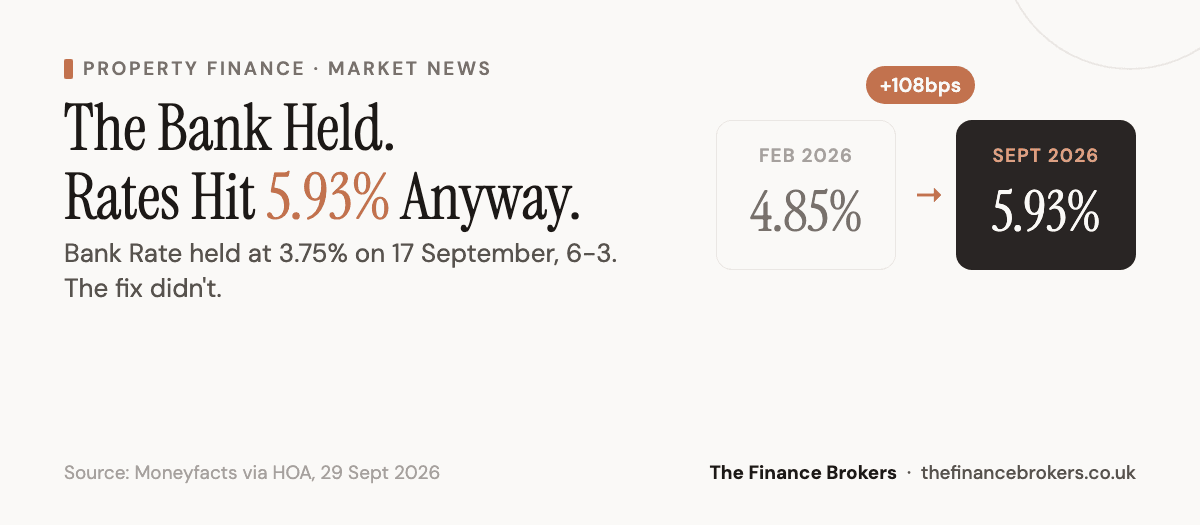
If you are waiting on a held Bank Rate to make refinancing cheaper, the wait already cost you money.
The Monetary Policy Committee held Bank Rate at 3.75% on 17 September, and on the surface that reads as a pause. Underneath it, the vote split 6-3, with three members, Megan Greene, Catherine Mann and Huw Pill, voting to raise Bank Rate a quarter point to 4%. And in the six weeks since, the average two-year fixed mortgage rate has gone to 5.93%, the highest since July 2024, according to Moneyfacts figures reported by the Homeowners Alliance on 29 September. Five-year fixes are at 5.96%, the highest since October 2023.
A held base rate and rising term rates are not a contradiction. They are two different markets, and the one that prices your next fix moved against you while the headline rate stood still.
Why a third of the committee wanted to raise
The Bank's own reasoning explains why fixed rates are not behaving like a held rate would suggest. CPI came in at 3.1% in August, up from 2.9% the month before, according to the ONS release of 16 September, with CPIH at 3.3%. The Bank's own summary said that inflation is "likely to rise further over coming quarters," not ease. That print was significant enough to trigger the formal open-letter exchange between the Governor and the Chancellor, a mechanism reserved for when inflation has moved materially off target.
Energy costs are a large part of why. Prices have been higher and more volatile since the onset of the conflict in the Middle East, feeding straight through into the inflation outlook the Committee is voting against. Three members judged that outlook serious enough to vote for a hike this month, not next.
Markets are reading the same signal. They are now pricing in around four Bank Rate rises by the end of 2027, and all of the big six lenders have raised fixed rates twice in recent weeks, following a sharp rise in swap rates, the market that actually prices a fixed-rate mortgage. A held Bank Rate is not the same commitment it was six months ago. The next decision is 5 November.
The number that matters more than the headline rate
We flagged the first leg of this move in August, when the average two-year fix had gone from 4.85% in February to 5.63%. Since then it has moved another 30 basis points, to 5.93%. Since February, that is a 108 basis point rise on a rate that, for anyone with a bridge or a development loan exiting onto a term product, is not academic.
Take a straightforward £750,000 exit. At February's 4.85% it costs roughly £36,375 a year in interest-only terms. At August's 5.63% it was £42,225, a difference of about £5,850 a year against February. At September's 5.93% it is £44,475, another £2,250 a year on top of August, and £8,100 a year more than the same loan would have cost in February. Across a two-year fix, that is over £16,000 of additional interest for having refinanced in September rather than at the start of the year.
There is one part of the mortgage market that has not followed. Average fixed buy-to-let rates held at 5.47% between August and September, according to Moneyfacts figures reported by Which?. BTL pricing is not immune to the same swap-rate pressure long term, but for now it is the exception rather than the rule, and the gap between BTL and owner-occupier or commercial fixed pricing is worth watching rather than assuming will close on its own.
What this means if you have an exit in the next three to six months
Price the exit now, not at maturity. The last two rate readings both went the wrong way. There is no evidence in the data that waiting for the next MPC meeting improves your position, and the last two updates have shown the opposite.
Don't assume the bridge-to-term route you scoped in the spring is still the cheapest one. Lenders are actively repositioning to compete for bridge exits as term pricing moves, which is worth checking against what's changed since you last compared options. A fee structure that looked unattractive against February's rate card can look different against September's. We covered one live example of that trade-off, a lender waiving a fee while simultaneously raising its rate, in our look at Allica's fee-waiver move: the headline saving and the real cost of borrowing are not always telling you the same story.
Don't plan around a cut that the data no longer supports. Three MPC members already want to raise. Markets are pricing four rises by the end of 2027. The Budget lands on 28 October, and while fiscal policy and monetary policy are not the same lever, a Budget that adds to borrowing tends to add to the same swap-rate pressure that has already moved fixed rates twice this quarter.
None of this is a reason to panic into a decision. It is a reason to know the real number before you need it. If you have a bridge or development facility maturing in the next three to six months, talk to us about the maturity date and the current balance, and we will tell you what today's pricing actually does to the exit, rather than what the headline Bank Rate implies it should.