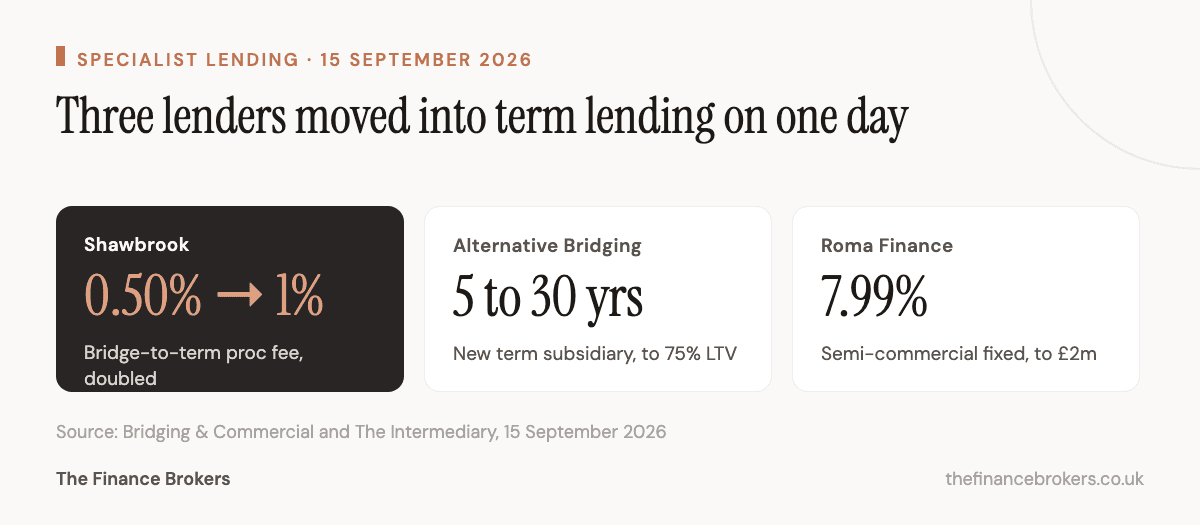
Shawbrook has doubled what it pays a broker for one very specific outcome: bringing a bridging client back to Shawbrook for the term loan. The fee went from 0.50% to 1%, and it only pays when a Shawbrook bridge refinances onto a Shawbrook term product.
On the same day, two more specialist lenders opened long-term lending lines of their own. Read separately, three product notices. Read together, the clearest signal this year that the specialist market has stopped selling bridges and started selling the whole journey.
What actually changed, in a single day
All three landed on 15 September 2026.
Shawbrook cut residential bridging rates by 0.05% on its 75% and 90% LTV products, including light refurbishment. The rate cut is the small part. The structural part is the procuration fee on eligible bridge-to-term cases moving from 0.50% to 1%, alongside an existing 1% discount on the term product arrangement fee that stays in place. Property Reporter led its coverage on exactly that, headlining the doubled bridge-to-term fee rather than the rate. Daryl Norkett, Shawbrook's director of real estate proposition, framed the package around what matters on a bridge: "Price, speed and certainty all matter when a client is using bridging finance."
Alternative Bridging Corporation launched a subsidiary, Alternative Commercial Mortgages, writing terms of 5 to 30 years up to 75% LTV across commercial, semi-commercial and residential buy-to-let, on fixed and discounted variable rates, with interest-only available. A bridging lender did not extend a product. It stood up a separate long-term lending business. Jonathan Rubins, a director at the firm, pitched it at broker friction: "Commercial-term lending doesn't need to be complicated. Brokers can be faced with numerous product options and conditions, which can make it difficult to establish quickly what a lender can and cannot do."
Roma Finance added a semi-commercial mortgage to its long-term suite: up to £2m, up to 70% LTV, 7.99% fixed, across England, Scotland and Wales. Roma had already completed its first £2.4m commercial mortgage four days earlier, on a project it had funded through development finance first. Commercial director Michael Allison pointed at the asset class: "Mixed-use property has always been an important part of the specialist lending market, but these assets can require a more considered approach."
Three lenders, one day, one direction of travel.
The exit was always the risky half
Anyone who has run a bridge knows the loan is not the hard part. The hard part is the exit.
A bridge is priced and underwritten on a promise about the future: the property sells, or it refinances onto something longer. The lender writing the bridge has historically had no stake in whether that second step happens. It gets repaid either way, and if the borrower cannot refinance on time, that is the borrower's problem to solve, usually at speed and usually at a worse price. That gap is precisely why our guide to a missed exit deadline exists at all, and why rebridging is a product category rather than a rare accident.
What changed on 15 September is that three lenders took a commercial position on step two. Alternative Bridging and Roma built somewhere for the borrower to land. Shawbrook did something subtler and, for brokers, louder: it put money behind the landing.
Why doubling a procuration fee is the real tell
Product launches are cheap. A lender can announce a range and quietly never write it. Paying twice the commission is not cheap, and it is not a marketing line. It is a lender moving its own money to change which deals reach it and how they are structured at the outset.
A 0.50% to 1% jump, conditional on the bridge refinancing onto that same lender's term product, tells you three things at once.
The lender believes the term book is worth more than the fee it is giving away, which means it wants duration rather than churn. It expects brokers to respond to price, which they will, because a doubled proc fee on the same case is not a marginal consideration. And it is willing to be judged on the exit, because a fee that only pays on completion of the second step is a bet that the second step completes.
Compare that to how bridging has typically been sold. The commission sat almost entirely at the front end, on the bridge. Nobody was paid to think about month twelve at month zero. When the incentive moves to the back end, the conversation at the start of the deal changes shape.
The part that is genuinely good for borrowers
Exit risk falls when the same balance sheet writes both halves. A lender that already holds the asset, has valued it, has underwritten the borrower and has watched the refurbishment complete is a materially easier refinance than a lender meeting the file cold at month ten. That should mean fewer rushed rebridges, fewer extension fees and fewer deals that work on paper and fail on timing.
It also removes a real source of cost. Two lenders means two valuations, two sets of legals and two underwriting processes. Shawbrook's 1% discount on the term arrangement fee is an explicit acknowledgement that the second step should not be priced as though it were a first meeting. Our breakdown of property finance fees covers how quickly those duplicated costs stack up on a short loan.
For semi-commercial and mixed-use in particular, this matters more than it sounds. Those assets have long been awkward: too commercial for a residential buy-to-let lender, too residential for a pure commercial one. Roma pricing a fixed semi-commercial line at 7.99%, and Alternative Bridging covering offices, industrial, retail, mixed-use and residential investment in one subsidiary, both aim straight at that gap.
And the part to watch
There is a trade here, and it is worth naming plainly.
A bridge-to-term package is convenient precisely because it reduces your options at the moment you refinance. If the incentive is structured so that your broker is paid twice as much when you stay, and the arrangement fee is discounted when you stay, then the path of least resistance is to stay. That is fine when the term rate is competitive. It is expensive when it is not, because the comparison never gets made.
The discipline is simple and it has not changed. Price the exit at the start, not at month ten. When a lender offers a joined-up bridge and term, ask what the term product would cost on its own merits against the rest of the market on the day you actually draw it, and treat the packaged discount as one input rather than the answer. A 1% arrangement-fee discount is worth having. It is not worth 50 basis points on a five-year facility.
The other thing to watch is that a 0.05% rate cut and a doubled proc fee are not the same size of move, and they should not be read as one. The rate cut is competitive noise. The fee change is strategy.
What we are telling clients this week
If you are running a bridge with an exit somewhere in the next six to twelve months, this is a good fortnight to re-open the exit conversation rather than a good fortnight to relax. There are now more places to land than there were, including with your existing lender, and some of them are being actively subsidised. That is genuinely better than the position twelve months ago.
But more routes only help if somebody compares them. The whole point of a bridging refinance is that it should be a decision, not a default. If your current lender has just built a term product and started paying more for you to use it, that is a reason to look at it seriously and also a reason to look at what else would take the case.
If an exit is coming up and you would like to know what the rest of the market would offer against your incumbent's packaged rate, that is the conversation we have every day.