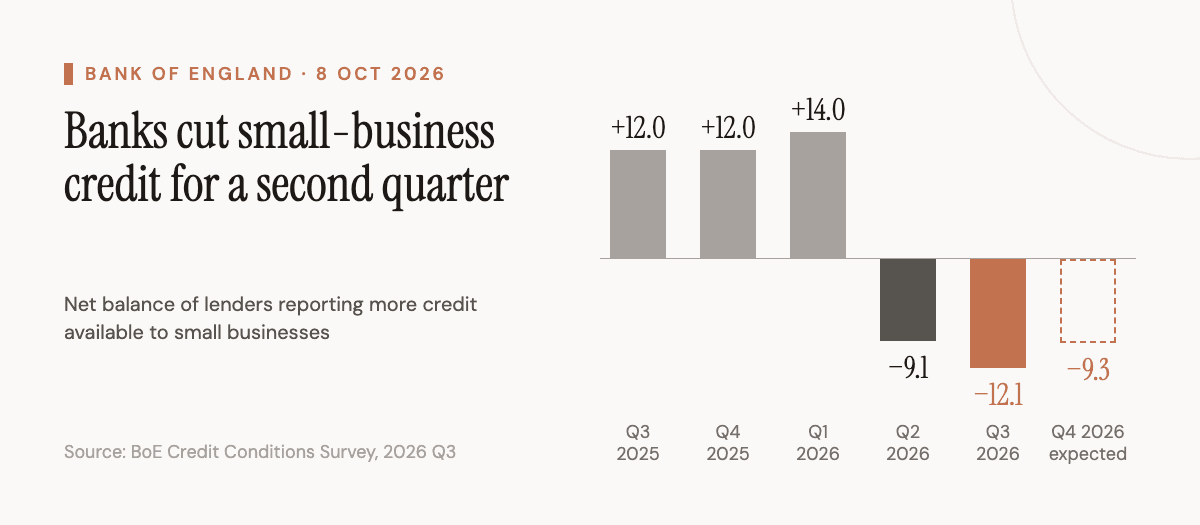
UK banks have cut the credit they make available to small businesses for a second quarter running, and by more than they did the first time. Default rates on those same loans did not move.
That is the headline from the Bank of England's Credit Conditions Survey for Q3 2026, published at 9:30 this morning. Lenders reported that credit availability to small businesses decreased in the three months to the end of August, and they expect it to keep falling through to November.
Three months ago, the same lenders told the Bank they expected small-business availability to hold steady. It did not.
What the survey actually says
The survey asks UK banks and building societies how conditions have changed over the past three months and how they expect them to change over the next three. Answers are weighted by each lender's market share and reported as net percentage balances, so the large high street lenders carry most of the weight.
From the corporate annex, the small-business availability balance has gone:
- +14.0 in Q1 2026
- -9.1 in Q2 2026
- -12.1 in Q3 2026
- -9.3 expected for Q4 2026
Two things make the Q3 number stand out.
First, it is the lowest reading since Q4 2020, when the balance hit -19.3 in the middle of the pandemic. Before that, you have to go back to 2014 to find a quarter below -5.
Second, this is the first time since the Bank's published small-business series begins, in late 2009, that the balance has been below -5 two quarters in a row. Single bad quarters have happened before. Back-to-back cuts, with a third pencilled in, have not.
Medium-sized businesses saw the same pattern (-6.5 in Q2, -10.5 in Q3). Large corporates did not: their availability was unchanged at +4.1. And within corporate lending, availability to the commercial real estate sector actually increased, at +10.2.
So this is not banks pulling back from business lending across the board. It is banks pulling back from the smaller end of it.
Defaults are not the reason
The obvious explanation for a lender tightening is that loans are going bad. The survey says otherwise.
Lenders reported default rates on small-business loans as unchanged in Q3, and they expect them to stay unchanged in Q4. The small-business default balance has read +1.9 for three consecutive quarters. Losses given default were unchanged too. Spreads on small-business lending were unchanged.
So the price of the credit has not moved, the losses on it have not moved, and the amount on offer has fallen. That combination usually points at appetite and capacity rather than at the borrowers themselves.
Demand fell too, and that matters
To be fair to the banks, this is not only a supply story. Lenders also reported that demand for lending from small businesses decreased in Q3 (a balance of -12.1, after -11.1 in Q2), and they expect it to fall slightly again in Q4.
Some of that will be caution on the borrower side, and the familiar habit of sitting on a decision when the outlook feels unclear.
But falling demand and falling availability feed each other. A business owner who hears that banks are tightening is less likely to apply. A bank seeing fewer applications has less reason to compete for them. Neither side is wrong individually, and the result is that viable businesses end up not borrowing for growth they could have funded.
The proportion of small-business applications being approved was broadly unchanged in Q3, after falling in Q2. In plain terms: fewer firms are applying, and the ones that do are being approved at about the same rate as in the spring, against a lender base that is less keen to offer.
How this fits with "record" lending
If this sounds at odds with the recent headlines, it is worth reading the two datasets together.
Last month we wrote about UK Finance's Q2 figures showing SME lending at a post-pandemic high, with gross lending of £5.35bn. That was a measure of money that had already been lent, mostly between April and June. Today's survey is lenders describing their stance in the summer and into the autumn.
Those are different questions. Volume can be high while appetite is turning, especially when some of that volume is existing customers drawing on facilities or refinancing. The same UK Finance release showed overdraft utilisation at its highest since March 2020, which is consistent with businesses leaning on what they already have rather than finding new credit easily.
It also matters who is in each dataset. The Credit Conditions Survey covers banks and building societies only. The specialist, challenger and non-bank lenders that provided £34.4bn of new lending in the first half of 2026 are largely outside it. A tighter high street is a statement about the high street, not about the whole market.
What we would do with this as a business owner
Do not read "availability decreased" as "no one will lend". It means the lenders in the survey, weighted towards the biggest banks, have less appetite for small-business risk this quarter. There are a lot of active lenders outside that group, and plenty of them are trying to grow their small-business books. Knowing how to pick the right lender for your sector and size matters more when the default route is narrowing.
If you need funding in the next six months, start earlier than you think you need to. Lenders expect conditions to tighten again into November. An application made before you are under pressure is a stronger application, and it leaves time to try a second route if the first one says no.
Match the product to the need, not to your bank's menu. A short working capital gap may suit an unsecured business loan. A cash flow problem that sits in your debtor book is often better solved with invoice finance, which lends against money you are already owed. Where there is property or equipment to secure against, a secured business loan can open up larger amounts and better pricing. Our guide to secured versus unsecured borrowing sets out the trade-offs.
Be ready for more questions, not just a higher price. With spreads unchanged, tightening tends to show up in the process: more documents, more scrutiny of management accounts, lower limits. Up-to-date accounts, a clear use of funds and a realistic repayment plan shorten that process considerably.
The bottom line
The Bank of England's own survey now shows lenders cutting credit to small businesses two quarters running, by the most since 2020, and expecting to do it again. Losses are not driving it. Large corporates and commercial property are not seeing it.
For a small business, that is not a reason to stop planning to borrow. It is a reason to stop assuming the first door you knock on is the only one.
If your bank has gone quiet on a facility, or you want to know where the appetite is for a business your size before you apply, talk to us. We work across more than 300 lenders, and part of the job is knowing who is genuinely open for your case this quarter.