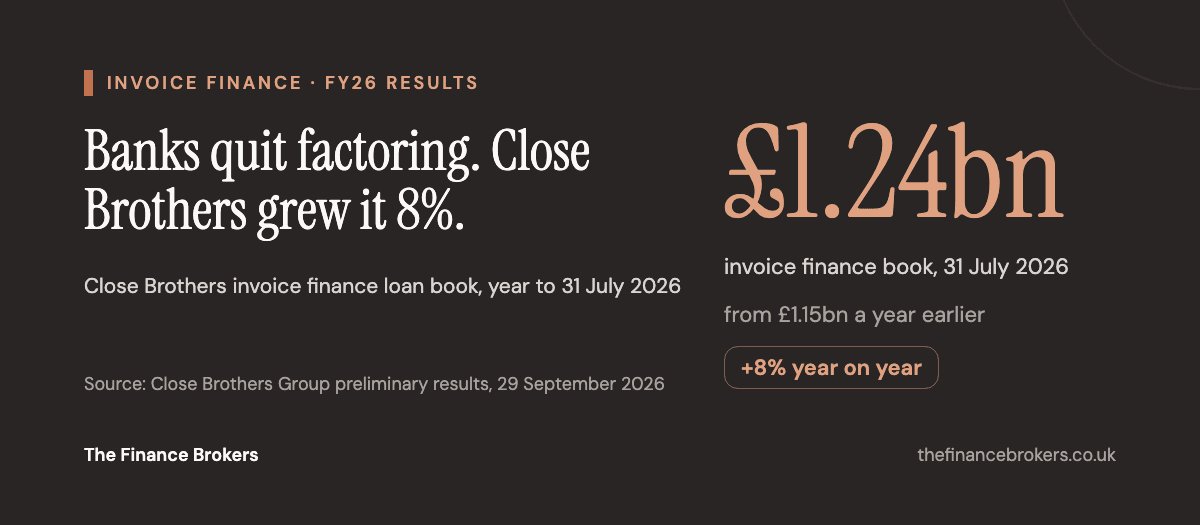
In April, Lloyds closed its invoice factoring service for small businesses and completed the big four banks' exit from the product. This morning, Close Brothers reported that its invoice finance book grew 8% in the year to 31 July, to £1.24bn, with "strong new business volumes, particularly in the second half of the year".
Those two facts belong in the same sentence. The demand for lending against a sales ledger did not leave when the clearing banks did. It moved to lenders who still want to do the work.
What Close Brothers actually reported
Close Brothers published its preliminary results for the year to 31 July 2026 on 29 September. Most of this morning's coverage led on the motor finance redress provision and the absence of a final dividend, which is a consumer-lending story. The part of the results that matters to a business borrower sits in the loan book tables.
| Commercial division | 31 July 2025 | 31 July 2026 | Change |
|---|---|---|---|
| Invoice Finance | £1,148.9m | £1,244.0m | +8% |
| Asset Finance | £3,580.4m | £3,642.2m | +2% |
| Commercial total | £4,729.3m | £4,886.2m | +3% |
Source: Close Brothers Group preliminary results, 29 September 2026.
Invoice finance was the fastest-growing business line in the group apart from motor finance. Close Brothers describes the unit as providing "debt factoring, invoice discounting and asset-based lending to SMEs and corporates", which is exactly the product set the high street has spent two years stepping away from.
Three other lines from the results are worth noting:
- Growth came late in the year. On an underlying basis the group's loan book grew 2% year on year but 4% in the second half, after shrinking in the first. Every division grew in the final quarter.
- The target is 5% to 10% a year. Close Brothers says it enters the new financial year "with confidence to achieve our target of 5-10% p.a. growth through the cycle", having already exceeded its cost-savings target.
- Chief executive Mike Morgan framed the year as a narrowing of focus, describing "sharpening our focus on our specialist lending markets in which we have expertise". Invoice finance is one of those markets.
Why the banks left and the specialists stayed
We set out the economics in May, when Lloyds closed its service. Factoring is labour-intensive. It needs credit control, collections, debtor ledger monitoring and a working relationship with the client's own customers. For a clearing bank whose returns are concentrated in mortgages and large corporate lending, that infrastructure is hard to justify for a product used by a small share of its SME customers.
For a specialist lender the same infrastructure is the business, and the margin reflects it. Close Brothers' Commercial division earned a net interest margin of 6.4% in the year. That is the price of a product that requires people who understand debtor books, and it is why the lenders who have built those teams are the ones growing.
Close Brothers is not alone. Earlier this month Novuna Business Cash Flow launched a £2m to £25m asset-based lending facility that puts receivables, inventory, plant and machinery and commercial property under one limit, one rate and one monthly fee, with invoice finance included as standard. In August, the owner of Ultimate Finance agreed a £55m cash takeover of Time Finance, creating an SME lending platform of close to £650m. And Shawbrook lent £11m against a distillery's maturing whisky. Capital and appetite are flowing into working capital finance, just not from the banks most business owners would call first.
Demand is there too
Today's Bank of England Money and Credit release for August shows UK non-financial businesses borrowed a net £7.7bn of finance in August, of which £5.7bn was bank loans, after net repayments of £0.9bn of bank loans in July. One month is not a trend, and the figure covers businesses of every size. But it is consistent with what Close Brothers describes in its second half: borrowers came back to the market as the year went on.
What it means if you use, or need, invoice finance
If you were a big four factoring client, you have almost certainly been moved already, to a partner provider or off the product entirely. It is worth checking whether the terms you landed on were chosen or simply inherited. A facility migrated in a hurry is rarely the best one available for your debtor book.
If your working capital is tied up in unpaid invoices, the specialist market is growing, not shrinking. That means more competition for good debtor books: lenders with growth targets to hit are pricing to win business, and a clean sales ledger with creditworthy customers is exactly what they are looking for.
If you have more than receivables to borrow against, ask about asset-based lending rather than a pure invoice line. Lenders such as Close Brothers and Novuna now bundle stock, plant and property into the same facility, which can mean materially more headroom than an invoice-only line. Our guide to secured versus unsecured business loans covers how that trade-off works.
Do not judge a lender by whether you have heard of it. The names growing in this product are not the names on the high street. Our guide to picking the right lender sets out what to compare: advance rate, concentration limits, notice periods, and whether the facility is confidential or disclosed to your customers.
The pattern this fits
The high-street retreat from working capital finance has been running for years, and we have tracked it closely: £34bn of new lending in the first half of 2026 came from non-bank lenders. What Close Brothers adds today is a clean, audited number from a single lender showing that the product the banks walked away from is growing in someone else's hands.
For a business owner, that is good news with a catch. The money is there, but it will not find you through your bank relationship any more. You have to know which lenders are writing it, and which of them want your sector and your debtor profile.
Getting started
If you are funding a cash-flow gap against your sales ledger, replacing a facility your bank closed, or trying to work out whether invoice finance or asset finance is the right shape for your business, get in touch. We work across the specialist market as a whole-of-market broker, with no upfront fees and a soft-search-first approach, so you see indicative terms from the lenders that genuinely have appetite before anything touches your credit file.
Further reading: The Big Four Walked Out of Invoice Factoring · £218m Lender, £430m Buyer, One £650m SME Platform · A Distillery Borrowed £11m Against Unsold Whisky · £34bn of New Lending Didn't Come From a Bank · Secured vs Unsecured Business Loans