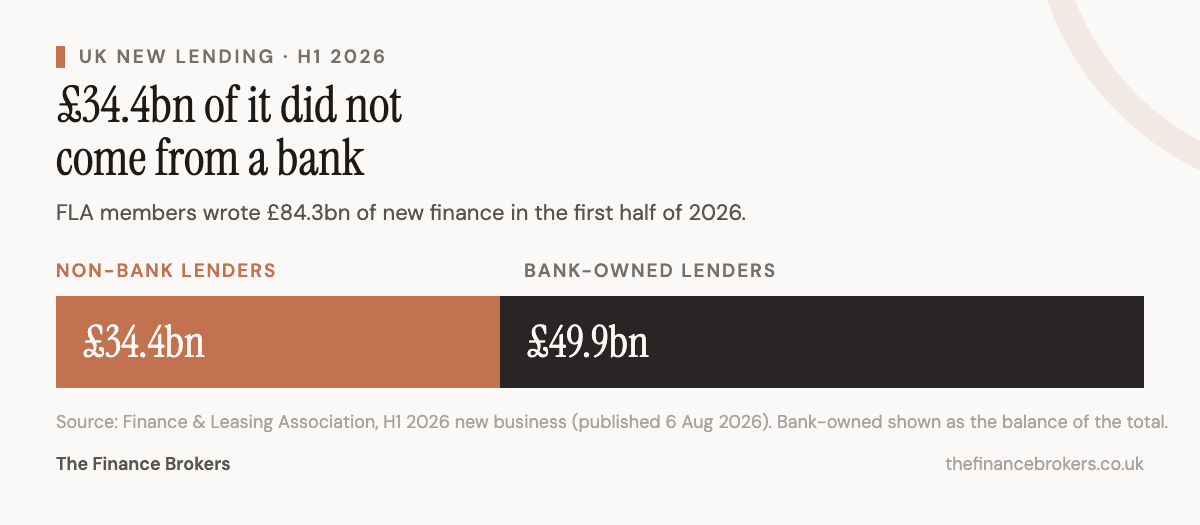
UK finance providers wrote £84.3bn of new lending in the first six months of 2026. £34.4bn of it came from lenders that are not banks.
That is roughly 41 pence in every pound, and it is the single most useful number a business owner could read this month. Because the way most firms still shop for finance assumes the opposite: you ask your bank, and if your bank says no, you assume the answer is no.
The Finance & Leasing Association published the half-year figures on 6 August, with the trade press picking them up through 7 August. Total new lending is up 5% on the same period last year. The headline is growth. The story underneath it is distribution.
What the £84.3bn actually contains
The FLA's members cover asset finance, motor finance and consumer credit, so the total spans households and businesses. Broken out:
- £21.0bn went to businesses to invest in machinery, equipment and vehicles
- £13.0bn of that went specifically to small and medium-sized enterprises
- £63.3bn went to households, of which £22.7bn financed new and used vehicle purchases
- £34.4bn of the overall total came from non-bank lenders
On a rolling twelve-month basis to the end of June, total new business reached £167.5bn, up 5%. Business asset finance within that hit £41.6bn, up 6%. Motor finance reached £56.7bn, up 7%.
Shanika Amarasekara MBE, the FLA's Chief Executive, framed the total in terms of what sits behind each decision: "Behind every one of those £84bn of lending decisions is a business investing for the future or a household making an important purchase." She added that access to finance "helps turn confidence into economic activity."
That last phrase is worth holding on to, because it is precisely where the market is currently leaking.
The £13bn that went to SMEs
Thirteen billion pounds of kit, vehicles and equipment finance to small and medium-sized firms in six months is not a market in retreat. It is the quiet engine we wrote about when the FLA published its first Impact Report in June, and the trend has held.
It also sits oddly against the picture from the banks. Bank lending to SMEs has fallen to a 30-year low as a share of the market. Both things are true at once, and they are not in conflict. Finance to smaller businesses is growing. It is simply growing somewhere other than the place most owners look first.
You can see the same divergence in individual sectors. Britain registered 14.7% fewer HGVs in the second quarter, yet commercial vehicle finance new business rose 7%. Fewer trucks bought, more trucks financed. Firms that are investing are increasingly doing it with someone else's balance sheet, and increasingly that balance sheet is not a bank's.
Why the non-bank share is the number that matters
A 41% non-bank share changes what a rejection means.
If nearly all lending came from the clearing banks, then a bank declining your application would be a reasonable proxy for the market declining it. That was roughly the world of fifteen years ago. It is not this one. Independent asset finance houses, specialist SME lenders, invoice financiers and challenger banks now account for a large enough slice that a single decline tells you almost nothing about whether the deal is fundable.
The catch is distribution. Most non-bank lenders have no branch network, no current-account relationship and no direct marketing to speak of. Many of them write business exclusively through intermediaries and do not accept applications direct at all. So the £34.4bn is genuinely available, and it is genuinely hard to find if you are looking for it on your own.
That is the structural asymmetry in this market. The bank you already have will tell you about the products it sells. Nobody is contractually obliged to tell you about the other forty-one percent.
The gap between supply and confidence
There is a second half to this, and we covered it yesterday. FLA members' own outlook has improved sharply, with the share of providers expecting the economy to deteriorate falling from 81% to 61% and 63% expecting to write more business over the next twelve months. Yet borrower confidence has not moved with it: 30% of SMEs missed a growth opportunity for want of external finance, and 20% never applied at all because they expected to be turned down.
Read the two datasets together and the shape of the problem is uncomfortably clear. Finance firms are bullish and SMEs are not. Capacity is up. Appetite among lenders is up. Volumes are up 5%. And a fifth of small businesses are self-declining before anyone has looked at their numbers.
The £34.4bn is the evidence that the pessimism is misplaced. It is money that was actually deployed, in the last six months, by lenders who were not obliged to deploy it.
What to do with this
Three practical points for anyone weighing an investment decision this quarter.
Do not treat one decline as the market's answer. Different lenders underwrite the same business very differently, particularly on trading history, sector and the asset being financed. A firm declined for an unsecured facility is frequently approved for a secured or asset-backed one at a lower rate, which is the distinction we set out in our guide to secured versus unsecured business loans.
Match the finance to the asset, not to the habit. If the spend is a vehicle, a machine or equipment with a resale value, asset finance is usually cheaper than a general-purpose loan, because the lender's security is the thing you are buying. £21bn of business finance in six months went exactly this way for a reason.
Ask what you are not being shown. If you have only had one conversation about a facility, you have seen a small fraction of the market by construction.
The lending is there. In the first half of 2026, £34.4bn of it came from outside the banking system, and the businesses that found it were mostly the ones who went looking with someone who knew where to look. That tier keeps getting better capitalised, too: Allica Bank has since applied for a banking licence in Sweden, a story we set out in Allica Is Exporting the SME Model UK Banks Quit.
The high street half of that split has since been updated too. UK Finance's Q2 2026 review put gross SME lending at a post-pandemic high while overdraft use reached its highest level since March 2020, which we unpack in SME Lending Hit a Post-Pandemic High. So Did Overdrafts. The Bank of England's lender survey then showed the banks' appetite turning the other way, as banks cut small-business credit for a second quarter running.
If you are planning capital investment and want to see what the whole market will actually offer rather than what one lender will, talk to us. We work with over 300 lenders, and a good number of them will never contact you directly.