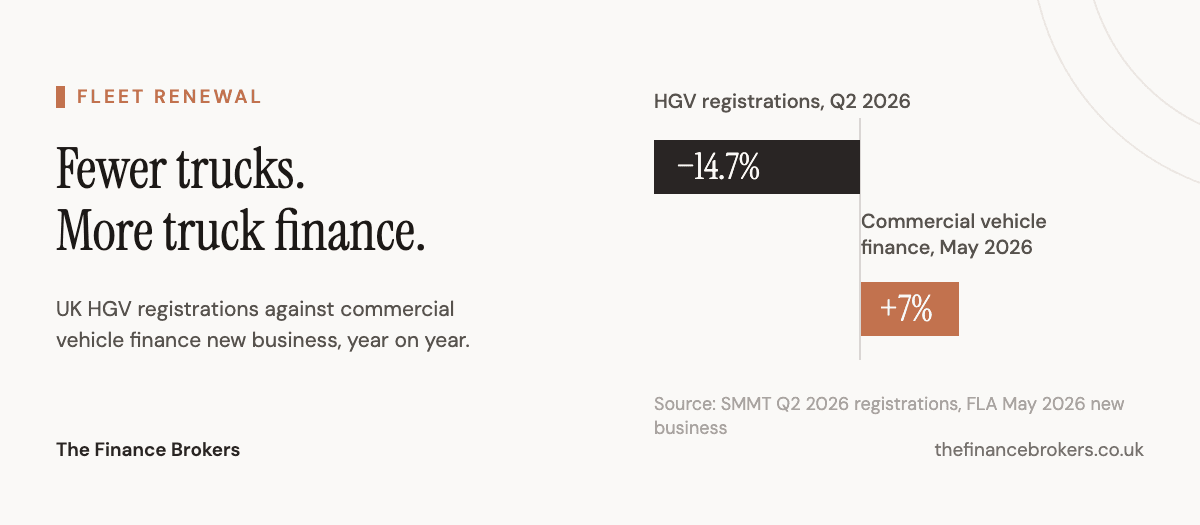
Britain registered 14.7% fewer heavy goods vehicles in the second quarter of 2026. In the most recent month the lenders have reported, new business in commercial vehicle finance was up 7%. Both numbers are accurate, and read together they say something uncomfortable about how fleet renewal is actually being paid for.
Fewer trucks are being bought. A larger share of the ones that are being bought is being financed. That is not a market running out of funding. It is a market running out of cash.
The two numbers that do not agree
The SMMT's quarterly data, published on 12 July, puts Q2 2026 HGV registrations at 8,687 units, down 14.7% on the same quarter of 2025. First-half demand fell 8.9% to 18,158 units.
The decline is broad. Articulated trucks were down 12.4% to 3,832 units, rigids down 16.4% to 4,855. Box vans fell by more than a third (36.6%) and curtain-siders by more than a quarter (26.4%). Only two body types grew: tippers, up 12.7%, and refuse vehicles, up 27%, both of which tend to ride on municipal and construction contracts rather than on general haulage margins.
Mike Hawes, the SMMT's Chief Executive, framed it as a hangover: "After three bumper years of fleet renewal, the HGV market is now under pressure."
Now put the finance data next to it. The Finance & Leasing Association's May figures, reported on 17 July, show total asset finance new business of £3.2bn in the month, up 2% year on year, with commercial vehicle finance up 7% and plant and machinery finance up 9%. Annual new business across the market hit a record £41.1bn.
The split underneath that total is the interesting part. Asset finance to SMEs rose 7%, a ninth consecutive month of growth, while lending to larger businesses fell 6%. Geraldine Kilkelly, the FLA's Director of Research and Chief Economist, noted that new business "remained robust in core sectors including plant and machinery and commercial vehicle finance."
So: the number of trucks entering the fleet is falling sharply, and the amount of money being lent against trucks is rising. The only way both can be true is if operators who do replace are financing rather than buying, and if the operators who would have bought outright are simply not replacing at all.
What is actually stalling replacement
Talk to anyone running a yard and the constraint is not the availability of a hire purchase agreement. It is the monthly number, and what is left after fuel, drivers and insurance.
A Road Haulage Association survey of 550 operators, more than 90% of them SME fleets, found 84.6% had seen reduced margins and 56.8% reported cash-flow pressure, with fuel up around 35% over three months (as reported in June). Fewer than four in ten firms said they were confident they could keep operating under those conditions before the position became unsustainable, according to RHA managing director Richard Smith.
Thin margins do two things to a fleet decision. They delay it, because a replacement that adds £1,200 a month to the cost base is a bigger risk than running an older vehicle for another year. And they narrow it, because a business with a squeezed current account cannot fund a deposit even when it can service the payments.
That is the mechanism behind an 8.9% fall in first-half registrations sitting alongside record asset finance. The demand did not vanish. It got postponed.
Bank money got dearer again this morning
The Bank of England's June Money and Credit release, published this morning, adds the third leg of the story.
SMEs borrowed a net £0.6bn from banks in June, up from £0.1bn in May, so bank appetite is not the problem either. But the effective interest rate on new bank loans to SMEs rose to 6.36%, up from 6.18% a month earlier. Across all non-financial companies, including the large ones, the equivalent rate was 5.42%.
That spread is the SME premium, and it is close to a full percentage point. It shows up in the growth rates too: bank borrowing by large businesses is growing at 10.5% a year, against 4.1% for SMEs.
If you run a fleet of twelve trucks, that is the pricing environment for an unsecured or overdraft-style solution to a fleet problem. It is also the reason the answer usually is not that kind of facility.
Why asset finance held up when purchases fell
Asset finance behaves differently because the security is different. The lender takes a charge over the vehicle or the machine, so the credit decision leans on the asset's value and resale market rather than mainly on the borrower's balance sheet. That tends to mean faster decisions, less weight on trading history, and pricing that does not carry the full unsecured premium. Our guide to secured versus unsecured business loans sets out where each one genuinely fits.
It also means the cost lands across the vehicle's working life rather than in one quarter. For a haulier whose problem is the shape of the cash flow rather than the total cost, that is the entire point.
The capital behind these lenders is still arriving, too. On 29 July, Leumi ABL provided equipment funder Compass Business Finance with a £20m block discounting facility to expand its lending, with Compass director Mark Nelson describing it as a foundation for growth. That is what a funding line into a specialist asset lender means in practice: more capacity for the equipment and vehicle deals a clearing bank would rather not write. We have written before about asset finance hitting a record while banks retreated, and about the trade body's own reframing of the sector as the hidden engine behind UK growth.
The kit you already own is a funding line
The option most operators forget is the one sitting in the yard.
Refinancing assets you already own releases cash against vehicles, trailers, plant or workshop equipment that is paid off or nearly paid off. The asset stays in use. What changes is that its value stops being dead equity and starts being working capital, usable for fuel, a deposit on the next tractor unit, a driver recruitment push, or simply a buffer through a thin quarter.
For a fleet that is postponing replacement because of cash flow rather than because of the price of a truck, this is often the move that unblocks the decision: refinance three older units to fund the deposit on two new ones. Sale and leaseback works the same way where ownership is not the priority.
The other lever is the ledger. Haulage runs on 45 to 60 day payment terms against weekly fuel and wage bills, which is the classic shape invoice finance is built for. Getting paid on despatch rather than on the customer's schedule does not reduce the cost base, but it changes what a business can commit to. The specialists have built real books on exactly this combination: Time Finance reached a record £250m loan book on the back of asset and invoice finance.
What to do before the next replacement cycle
Three practical points fall out of this data.
First, do not read a falling market as a closed one. Registrations are down 14.7% because operators are deferring, not because funders have withdrawn. Appetite in commercial vehicle finance is up, and appetite means competition for well-presented deals.
Second, price the whole panel, not the dealership desk. The same tractor unit, on the same term, carries materially different monthly costs across funders depending on the asset, the residual assumption and your trading profile. The finance offered alongside the vehicle is one quote, not the market. Panels also change without warning: Blue Motor Finance went into administration on 30 July over a redress bill, a reminder that a lender can fail over a bill nobody has paid yet.
Third, look at what you already own before you look at what you need. Refinance capacity in an existing fleet is frequently larger than operators assume, and it is usually the cheapest deposit available.
One caveat on the lighter end of the fleet. The residual assumption a funder uses is not the only tax-sensitive input any more, because the vehicle's own classification can move it: double cab pickups became cars for capital allowances in 2025, and that single change took pickup registrations down 61% while 4x4s rose 166%.
We price asset and vehicle finance across a wide panel of lenders rather than a single balance sheet, which matters most in a market where the headline is a 14.7% fall and the reality underneath is a record year for the funders. If you are weighing a replacement, a refinance of existing kit, or both, talk to us and we will tell you what is genuinely achievable across the panel.