A UK vehicle finance lender with more than 100,000 live agreements went into administration on 30 July, and was sold four days later. The bill that broke it belongs to a compensation scheme that has not paid out a single claim, and which may not survive the courts at all.
That combination is worth sitting with. The motor finance redress scheme is currently partially suspended. No lender has yet had to calculate what it owes. And a lender has already gone.
What happened, and how fast
On 30 July the FCA confirmed that Blue Motor Finance Limited had been placed into administration, appointing Simon Edel, Alan Hudson and Richard Barker of EY as joint administrators. The regulator's reasoning was blunt: the firm had been running at a loss for a number of years and faced significant compensation liabilities it could not meet.
Blue was not a small operator. It funded used vehicle purchases through dealers and finance brokers across the UK, and had over 100,000 customers with active loans on its book.
Four days later, on 3 August, Hodge Bank acquired the business and assets through a pre-pack completed immediately on the administrators' appointment. The brand, operations and staff moved to Hodge MF Limited, protecting 168 jobs. Customers were told to do nothing: same channels, same servicing, no interruption for dealer and broker partners. The Blue brand will be retired after a transitional period expected to run about six months.
The part that matters most is what did not move. Existing liabilities, including anything owed under the motor finance redress scheme, stayed behind with the administrators. Richard Saulet, Hodge Bank's Chief Executive, called the transaction "a pragmatic and responsible solution". Joint administrator Simon Edel confirmed the business "will continue to operate as a going concern".
For the customers owed compensation, the FCA was candid: they are "unlikely to receive all the money they're owed". Consumer credit lenders sit outside the Financial Services Compensation Scheme, so there is no safety net behind that shortfall.
The bill that has not been paid
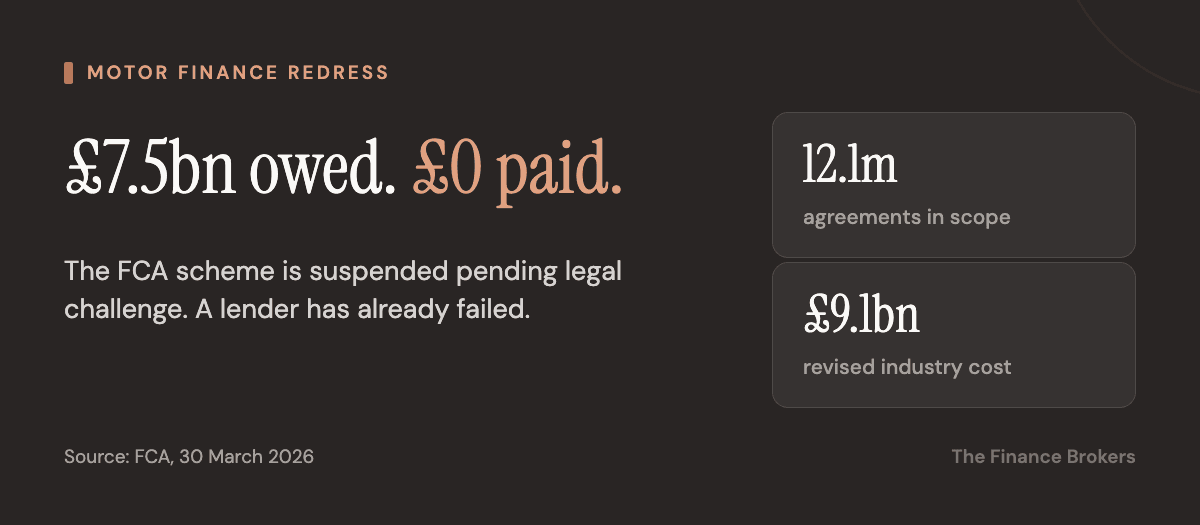
The scale here is the story. The FCA confirmed its motor finance redress scheme on 30 March 2026, covering 12.1 million agreements written between 6 April 2007 and 1 November 2024, with estimated payouts of £7.5bn and an average of roughly £830 per agreement. Industry-wide cost estimates including administration have been revised to around £9.1bn, down from an original £11bn.
Then it stalled. On 2 July the scheme was partially suspended in the face of four separate legal challenges, brought by Volkswagen Financial Services, Mercedes-Benz Financial Services, Crédit Agricole Auto Finance and a consumer omnibus claim. Lenders were told they do not need to calculate or pay compensation while the legal process runs. The FCA has gone as far as instructing firms to plan against a central assumption of no scheme at all.
So the provisions are on balance sheets, the money is ringfenced, and none of it has moved. Lloyds Banking Group has set aside around £2bn, Santander roughly £640m. Blue's own reported redress liability was north of £50m against a business that had been loss-making for years.
A contingent liability does not need to crystallise to kill a lender. It only needs to be large enough that funders stop extending lines and auditors stop signing off going concern. That is the mechanism that took Blue out, and it is a mechanism that works fastest on the smallest, thinnest-capitalised lenders in any market.
Why a used-car lender matters to a business that runs vehicles
We should be honest about the read-across, because it is easy to overstate. Blue was a consumer lender on used cars. If you finance vans, tippers or tractor units for a trading business, Blue was almost certainly not on your panel, and this failure does not directly remove a business lender from the market.
What it does do is three things.
First, it puts a number on how much capital the redress scheme is holding hostage across the motor and asset finance market. Lloyds and Santander are not niche consumer players. They are significant funders of business vehicle finance, both directly and through wholesale lines to the independents who write it. Capital sitting in a provision is capital not underwriting your next truck.
Second, it demonstrates that a legacy conduct liability can end a lender faster than a bad loan book can. Underwriting discipline is not the only thing worth checking about the firm behind your agreement.
Third, it is a live worked example of what actually happens to borrowers when a lender fails, and the answer is more reassuring than the headline suggests.
What happens to your agreement when your lender fails
A performing loan book is an asset. When a lender collapses, that book is usually the most saleable thing it owns, which is why agreements tend to survive their originator. Blue's 100,000-plus customers kept the same servicing on the same terms because a buyer wanted the book.
The pattern does not always run that cleanly. When Market Financial Solutions collapsed in the bridging market, the issue was the integrity of the security itself, not just the balance sheet, and borrowers had a far messier path. We wrote up what the MFS collapse should change about vetting a lender, and the checklist holds here.
Two practical points for anyone running financed assets. Know who legally holds your agreement, not just whose name is on the direct debit, because after a pre-pack those can differ. And separate the two questions that get conflated in a lender failure: your existing agreement is usually fine, while the ability to write you a new facility is the thing that disappears overnight.
Where the funding capacity actually is
The wider picture is not one of scarcity. Independent asset finance has been setting records while the high street has been distracted, which is the theme we covered in asset finance as the hidden engine behind UK SME growth. And the constraint on fleet renewal right now is not lender appetite: as we set out when truck buying fell 14.7% while truck finance grew 7%, operators are short of cash, not short of funders.
That is the practical resolution. Vehicle finance capacity for trading businesses is deep, but it is spread across specialists rather than concentrated in a handful of names, and the composition of that panel changes. A business that built its replacement cycle around one relationship is exposed to a lender-level event it has no visibility into. A business with access across the market is not.
Where the pressure shows up first is usually working capital rather than the asset itself, which is why invoice finance and asset finance so often get arranged together. If you are weighing how a facility should be secured in the first place, our guide to secured versus unsecured business loans covers the trade-offs.
If your fleet plan for the next twelve months rests on one lender saying yes, this is a good week to find out who else would. We can tell you in a conversation, not a credit search.