The trade body for the lenders that fund Britain's vans, machinery and electric fleets has just put a name to what it does: the hidden engine behind UK growth. Look at the numbers underneath the report and it is hard to argue with the billing.
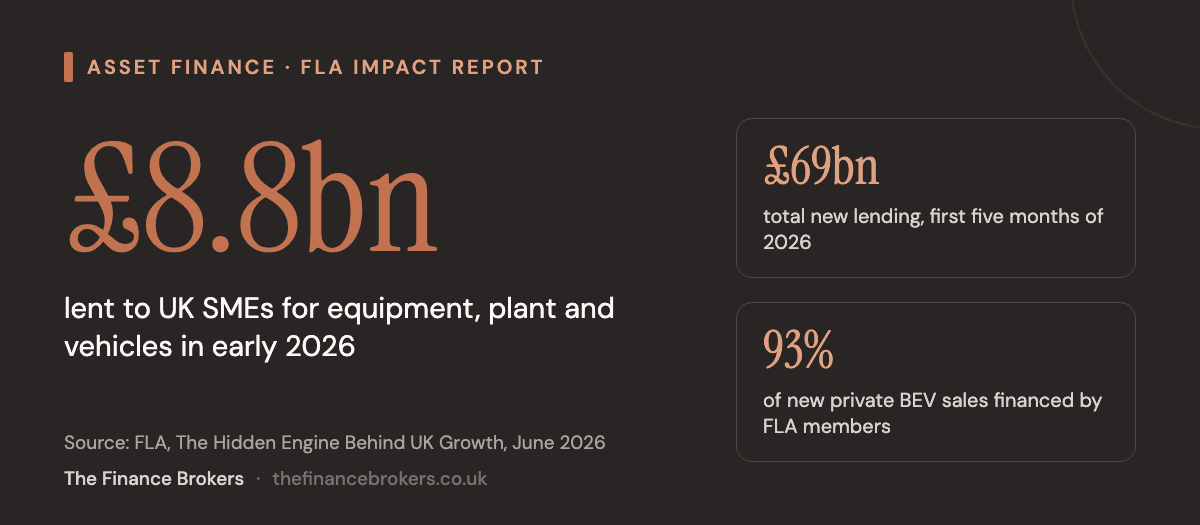
Finance & Leasing Association members provided £69 billion of new lending in the first five months of 2026, up 4% on the same period last year, according to the FLA's first-ever Impact Report, launched on 29 June. Strip out the household and motor lending and a large slice of that is asset finance: the funding that puts equipment, plant and vehicles into the hands of businesses that could not, or would not, pay cash for them.
For any SME that runs kit, this is the quiet counter-story to the headlines about banks pulling back. While the high street has tightened, the market that funds the assets your business actually depends on is setting records.
A first-ever report, and a deliberate reframe
The FLA has published monthly lending statistics for years. What is new is the framing. Its first Impact Report, titled The Hidden Engine Behind UK Growth, was launched to an audience of industry leaders, politicians and the media, and its whole purpose is to show how invisible this finance has become to the people it powers.
"Behind business investment, job creation and many of the purchases households make every day is finance that enables economic activity to happen," said Shanika Amarasekara MBE, the FLA's Chief Executive, on the report's launch.
Paragon Bank was the report's founding impact partner. Its Chief Executive, Nigel Terrington CBE, put it more bluntly: "Finance is central to determining whether businesses can invest, grow and take the next step." When a lender and its trade body both go out of their way to make the case in public, it usually means they think policymakers have stopped noticing.
Where the money is actually going
The detail matters more than the headline. In the first four months of 2026, FLA members lent £14 billion to businesses to fund investment in machinery, equipment and vehicles, of which £8.8 billion went to SMEs. That is the number worth holding on to: smaller businesses are the single largest customer for this kind of finance, not an afterthought to it.
The momentum has been building all year. Asset finance new business rose 14% year on year in April 2026 alone, to £3.7 billion, and the rolling twelve-month total reached £41.1 billion. This is a market that topped £40 billion for the first time in 2025 and has kept climbing since.
We covered the supply side of this story when lending to UK SMEs hit a 30-year low. Mainstream banks have grown cautious with overdrafts and unsecured term loans. Asset finance answers that in a way a working-capital loan cannot: the lending is secured against the asset itself, so the lender's risk is lower, decisions tend to be faster, and trading history matters less. You spread the cost over the useful life of the equipment rather than paying up front, which keeps cash where it belongs, in the business. If you are weighing that trade-off, our guide to secured versus unsecured business loans sets out where each one fits.
The electric shift is being funded by asset finance
The most striking figure in the report is about vehicles. Finance for battery electric vehicles rose 69% in the first five months of 2026, on top of a 56% jump across 2025. More telling still, FLA members financed 93% of all private new battery electric vehicle sales in the period.
Read that back slowly. The transition to electric that dominates every fleet conversation is not happening on the back of cash purchases. It is happening on finance, almost entirely. For operators staring down the zero-emission mandate and the cost of replacing diesel vans and trucks, the practical route to a cleaner fleet runs straight through the asset finance market.
It is not only vehicles. Agricultural equipment finance grew 12% in the same five months, reaching £1.2 billion, as farms funded the machinery a hard season demands. The pattern is consistent: where a sector needs to invest in physical assets, it is asset finance carrying the load.
What it means if you run vehicles or equipment
Three things follow from this data for any business with a yard, a fleet or a workshop.
You can fund the next vehicle or machine without draining reserves, at a moment when lenders in this market are competing for good business rather than turning it away. Growth in new lending means appetite, and appetite means better terms for borrowers who shop around.
You can also refinance assets you already own to release working capital, an option many operators forget they have. Kit that is paid off, or nearly paid off, can be refinanced to free up cash for hiring, fuel, stock, or simply a buffer, without selling anything or taking on an unsecured facility.
And because rates and terms vary widely from one lender to the next, the deal offered by the first funder you call is rarely the best one available. The same van, financed across different lenders, can carry materially different monthly costs depending on the asset, the term and your trading profile.
The whole-of-market point
This is where a broker earns its keep. We price asset and vehicle finance across a wide panel of lenders rather than a single balance sheet, so the rate you see reflects the market, not one funder's appetite this week. With the sector growing and specialists actively competing, that spread is worth shopping. The specialists keep compounding, too: Time Finance recently posted a record £250m loan book on the back of asset and invoice finance, and the March figures showed asset finance hitting a record while banks retreated.
Nowhere is the split clearer than in trucks. HGV registrations fell 14.7% in the second quarter of 2026 while commercial vehicle finance new business grew 7%, which is what happens when fleet renewal stalls on cash flow rather than on funding.
Breadth of panel matters for a second reason, too. Individual funders can disappear for reasons that have nothing to do with their lending: Blue Motor Finance was tipped into administration in July by a conduct liability, showing how a lender can fail over a bill nobody has paid yet.
Panel is only half of it, though. The structure matters as much as the price, and tax can move which structure wins: the 2025 reclassification of double cab pickups cut their first-year capital allowance from 100% to 6%, which is why pickups fell 61% while 4x4s rose 166% in August.
The half-year update in August made the point sharper still. FLA members wrote £84.3bn of new lending between January and June, £21bn of it to businesses buying machinery, equipment and vehicles, and £34.4bn of the total came from non-bank lenders rather than from the banks.
The trade body has since put a share figure on the same idea. In its September 2026 Budget submission it said FLA members finance 34.3% of all UK investment in machinery, equipment and vehicles, and asked the Treasury to widen the supply of capital reaching specialist lenders rather than to stimulate demand.
The FLA calls it the hidden engine for a reason. Most of the businesses relying on it never think about the market behind their vans and machines until they need to. If you are weighing up a vehicle, a piece of equipment, or refinancing assets you already own, talk to a broker and we will tell you what is genuinely achievable across the panel.