Bank Lending to UK SMEs Just Hit a 30-Year Low
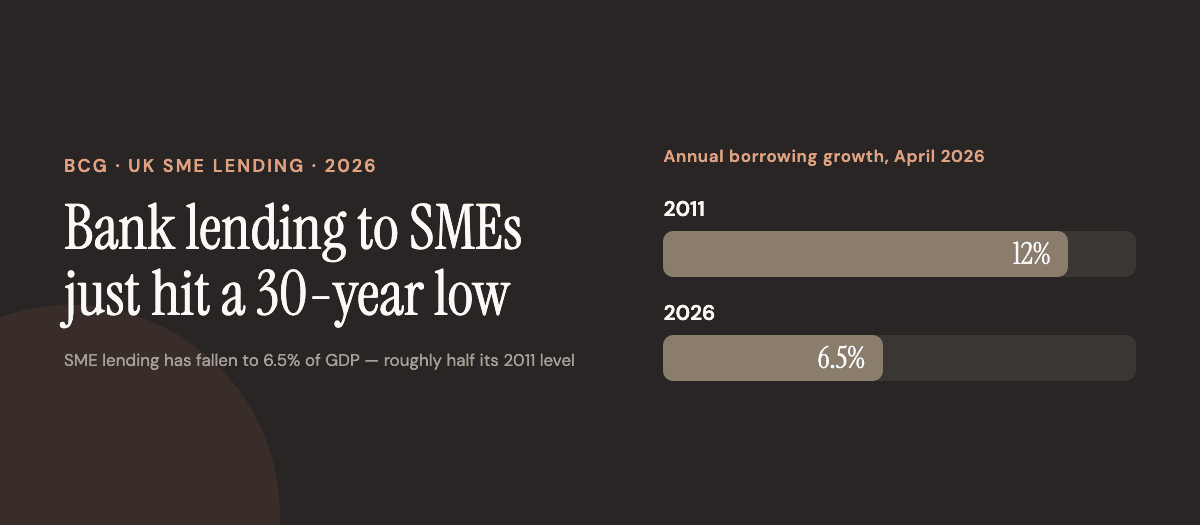
UK bank lending to business has fallen to its lowest level since 1998. According to research from Boston Consulting Group, bank loans to non-financial companies stood at just 59% of GDP in the third quarter of 2025, down from roughly 90% at the time of the 2008 financial crisis. For small businesses specifically, the picture is starker still: SME lending has dropped to 6.5% of GDP in 2026, a 30-year low, roughly half what it was in 2011.
That is not a blip. It is a structural retreat. And it is the single most important context for any UK business owner trying to raise finance right now, because it explains why the funding hasn't disappeared, it has moved.
The number that should worry every founder
Strip out the macro framing and here is what it means on the ground. In 2011, SME loans were worth about 12% of UK GDP. By 2026 that figure is 6.5%. The banks didn't just slow their lending to small firms: they cut it roughly in half over fifteen years.
BCG puts total business credit around 17% below its long-run historical trend. Raoul Ruparel, who leads the firm's Centre for Growth, was blunt about what that represents: "That is a structural problem for the UK economy, not a sector issue." Bank credit, he argued, "has shifted from supporting productivity growth to dragging on it."
For a developer, a manufacturer, or a services business that grew up assuming the bank would always be the first port of call, that is a fundamental change in the rules, and most owners haven't been told.
Where the money actually went
Here's the part that flips the usual "banks won't lend" narrative on its head. The money is still being lent. It's just being lent against bricks.
Real estate SMEs now receive 51% of all small-business loans, up from 39% a decade ago, according to BCG. In other words, more than half of every pound banks lend to small firms now goes to property-backed deals. If your business owns a building, you're fine. If your value sits in people, contracts, software, or stock, you are increasingly on the wrong side of the bank's risk model.
The reason is mechanical, not personal. Post-crisis capital rules make unsecured and early-stage lending expensive to hold. Michael Roberts, who heads HSBC's Corporate and Institutional Bank, told the House of Lords that capital requirements for direct SME lending can run around five times higher than for the same money routed through private credit funds. Faced with that maths, banks gravitate to what they can repossess, and away from the knowledge-based, asset-light businesses the government keeps telling us will drive growth.
Conor McDermott, Director of SME Lending at LHV Bank, made a similar point in a piece published this week titled, tellingly, "When good businesses stop looking bankable". His framing is the one that matters for borrowers: "SME lending is resource heavy," and "regulation has undoubtedly pushed lenders towards greater consistency around underwriting." Translation: the box got narrower, and plenty of perfectly healthy businesses no longer fit inside it, not because they're bad credits, but because the high-street model has stopped being built for them.
This is the same story we keep writing, from a different angle
If you've read this blog before, this should feel familiar. We've covered high-street banks rejecting 56% of SME applications while Allica grew its book 23%. We've covered every big four bank exiting invoice factoring. We've even covered the BoE's own data showing SME borrowing actually accelerated in April.
Those aren't contradictions. They're two halves of the same shift. Demand for finance is there, and it's even growing month to month, but the high-street share of supply has been shrinking for fifteen years. The BCG figures are the long-run backdrop; the monthly BoE numbers are the demand still knocking. The gap between them is being filled by someone else.
Who's filling the gap
Challenger and specialist banks now account for roughly 60% of all UK business lending, a near-complete reversal from a decade ago when the big four dominated. Names like Allica, OakNorth, Shawbrook and LHV have built their entire models around the customers the high street now prices out. Independent specialists have done the same: Time Finance has grown its lending book for 20 consecutive quarters, every quarter for five years, by lending against assets and invoices rather than writing the unsecured cash the banks have rationed. And the capital behind them isn't drying up: as we explore in the lenders global banks like JPMorgan are now funding, institutional money is pouring into exactly these specialists.
The trouble is access. These lenders rarely have branches, and their criteria differ wildly: one will love a deal another won't touch. That's why the intermediated route has exploded. The National Association of Commercial Finance Brokers reports that broker-originated SME lending reached £33bn in 2025, up 25% year-on-year. One in four of those clients had already been declined elsewhere before a broker placed their deal. NACFB chief executive Jim Higginbotham put it plainly: "the central role of brokers in SME finance has long been understood through experience." On average, his data shows, a broker considers around six lenders per deal.
That last number is the whole point. If the bank that says no is one of forty or fifty lenders who might say yes, hearing "no" from your bank tells you almost nothing about whether your business is fundable.
What this means for your next raise
Three practical takeaways from the BCG numbers:
- Stop treating your bank as the benchmark. A high-street decline in 2026 is a statement about that bank's capital model, not your creditworthiness. The 56% rejection rate isn't 56% of bad businesses.
- Know which "shape" of money fits you. If you're property-backed, the market is still deep, but you should be testing it against commercial mortgage and specialist lenders, not just your incumbent. If your value is asset-light, look hard at unsecured business loans, asset finance against equipment and vehicles, and invoice finance against your debtor book: these are exactly the routes built for businesses the high street now overlooks. Our guide on how to get an unsecured business loan in the UK walks through what those lenders actually want to see.
- Search the market, don't apply blind. With six-plus lenders potentially in play per deal, the difference between a good rate and a decline is often which lenders you approach and in what order, not whether finance exists.
The headline is grim: bank lending to small businesses at a 30-year low. But the more useful reading is that the high street stopped being the market a long time ago. The capital is still out there: it just isn't sitting where it used to.
If you've been told no by your bank, or you simply want to know what the wider market would offer, we'll search it for you. The right lender for your business is probably out there. It's just not the one you've always banked with.
Further reading: with consumer demand surprising to the upside, retail sales beat every forecast in May 2026, and we look at the working-capital options for businesses trying to fund the rebound. For the latest read on where SME funding is actually flowing, see why SMEs repaid the banks in May 2026 without funding drying up. And on why the speed of that funding now matters as much as the rate, see how slow finance is costing firms real deals. For the policy response to exactly this finance gap, see why the government just doubled its flagship SME lending scheme. And for where the gap is widening fastest right now, see how iwoca raised £250m because the £50k-£100k loan has taken over. On the other side of the same coin, lenders' own confidence has recovered sharply while borrowers' has not: finance firms are bullish again, SMEs are not. And for the clearest measure of how far the market has moved away from the high street, £34bn of new lending in the first half of 2026 did not come from a bank.