The Real Cost of Slow Funding Isn't the Rate. It's the Deal You Lost.
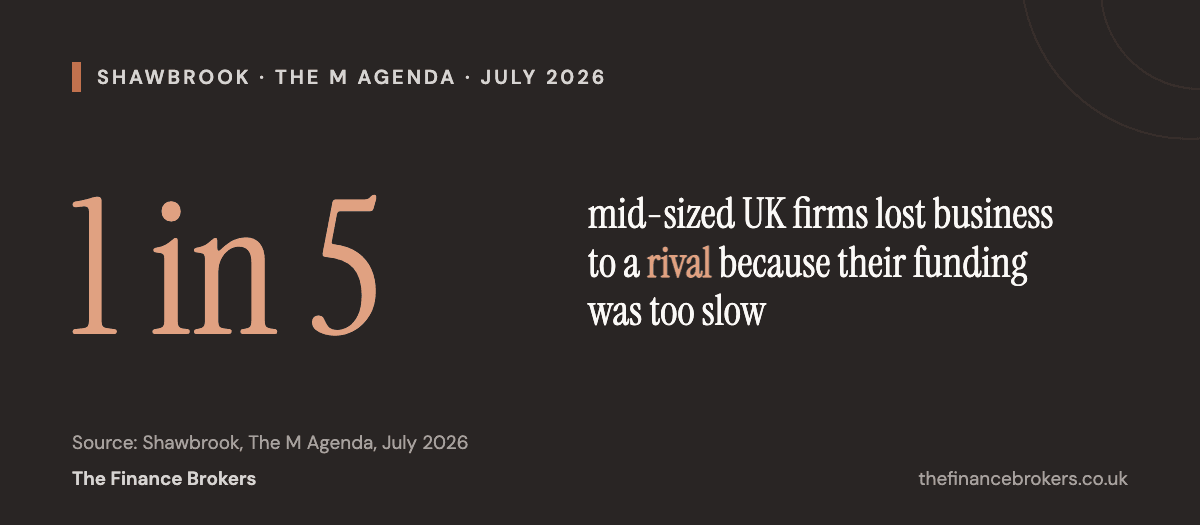
More than one in five mid-sized UK firms have watched a competitor win business they wanted, for one reason: their own funding took too long to arrive. Not because the deal was declined. Because the money moved too slowly.
That is the standout finding from new research by Shawbrook, published at the start of July in a report it calls The M Agenda: The Medium-Sized Business Gap. Most funding coverage obsesses over the headline rate. Shawbrook's numbers point somewhere else entirely: for a lot of businesses, the expensive part of finance is not what it costs. It is what it costs you to wait.
What the research actually found
Shawbrook surveyed 1,000 funding decision-makers at UK businesses with 50 to 249 employees and turnover between £5m and £100m. The picture that came back is not about firms being turned down. It is about firms being slowed down.
A quarter (25%) said they had experienced delays with a funding application, and 22% said the approval process simply took too long. The consequences were not abstract:
- 22% lost business opportunities to competitors because finance did not arrive in time
- 22% had to postpone a significant investment
- 20% could not purchase new equipment when they needed it
- 18% were unable to recruit the staff they had planned to hire
- 19% could not complete a planned business exit or transaction
- 21% said their professional credibility took a hit from being unable to move at pace
- 18% lost partners or clients entirely
And when the wait became untenable, the fix was rarely free. More than a fifth (21%) told Shawbrook they had turned to faster but more expensive finance just to get the deal done. In other words, slow money does not stay cheap. It quietly converts into dear money the moment a real opportunity is on the line.
Speed is the price nobody quotes
Here is the reframe we think every business owner should sit with. When you compare finance offers, you compare rates. That is the number on the term sheet, and it feels like the whole cost. But Shawbrook's data shows a second price that never appears on any quote: the cost of the days you spend waiting.
That price is invisible until it isn't. It shows up as the tender you could not fund, the equipment order that slipped a quarter, the hire who took another job, the acquisition a rival closed first. None of those land on your interest bill. All of them land on your P&L.
"In the mid-market, timing is critical," said Neil Rudge, Chief Banking Officer at Shawbrook. "Whether it's upgrading equipment, a new hire, or the leap into a new market, these opportunities often have a narrow window of opportunity." That window is the real product. A funding line that arrives after it closes is not cheaper. It is worthless for the thing you wanted it for.
Why capable businesses keep hitting this wall
The frustrating part is that the firms in Shawbrook's survey are not fragile. They are established, revenue-generating businesses with tens of employees. They are exactly the companies a healthy lending market should serve quickly. So why the wait?
Part of it is structural. The high-street banks have spent years stepping back from this kind of lending, a shift we covered when bank lending to SMEs hit a 30-year low. What is left inside the big banks is often a slower, more centralised credit process that was not built for a business that needs an answer this month, not next quarter.
At the same time, a mid-sized firm can be an awkward fit at both ends of the market. It is too large and too complex for the instant, algorithm-driven decisions that suit a small working-capital top-up, but it does not always get the white-glove speed reserved for the biggest corporate clients. It falls into the gap Shawbrook named its report after.
The result is a market that looks well-supplied on paper and feels sluggish in practice. As we wrote when SMEs net-repaid the banks in May, specialist and non-bank lenders now provide the majority of SME lending, and that breadth is genuinely good news. But breadth only helps if you can navigate it fast. Twenty-plus lenders who might say yes in three weeks is not much use against a deadline that lands in ten days.
What actually closes the gap
If the problem is speed, the fix is not a lower rate. It is a faster, better-aimed route to the right lender first time. Three things make the difference in practice.
Ask the right lender, not every lender. Most of the delay Shawbrook describes comes from applying in the wrong place and finding out slowly. A working-capital gap, an equipment purchase and a growth acquisition are three different problems with three different natural lenders. Sending all three to your incumbent bank and waiting is how weeks disappear. Matching each to the lender built for it is how days are saved.
Match the finance type to the timeline. A short-term cash-flow squeeze does not need a drawn-out secured facility. It may be far better served by an unsecured business loan that can be arranged in days, or by invoice finance that turns money you are already owed into cash now, without new debt. Capital equipment is usually quicker and cleaner through asset finance, secured against the asset itself rather than queued behind your general borrowing. If you are weighing which shape fits, our guide to secured versus unsecured business loans lays out the trade-offs, and our guide to getting an unsecured business loan covers what lenders want to see to say yes quickly.
Package the application once, properly. A lot of the "approval took too long" story is really "we kept going back for more documents." A well-prepared application, with the numbers and the story a lender needs on day one, is the single biggest lever on speed. This is the part a broker earns their keep on: knowing exactly what a given lender will ask before they ask it.
The takeaway for anyone running a business
Shawbrook's research is a useful correction to a lazy habit. We have all been trained to shop finance on rate, and rate matters. But the firms in this survey did not lose because they paid a fraction of a percent too much. They lost because the money showed up after the moment had passed, or because they paid a premium to avoid exactly that.
So the question worth asking before your next big move is not only "what will this cost?" It is "how fast can I actually have it, and from whom?" Getting that answer right is most of the job, and it is the job we do every day.
There is a quieter version of the same loss, too. Separate research has since put a £54bn price tag on the deals that were never even applied for, because the business assumed the answer would be no: finance firms are bullish again, SMEs are not.
Facing a deadline and not sure which lender can move in time? Talk to The Finance Brokers. We place deals across 300+ lenders and match each one to the funding that can actually arrive when you need it.