Retail Sales Beat Every Forecast. Now Fund the Demand.
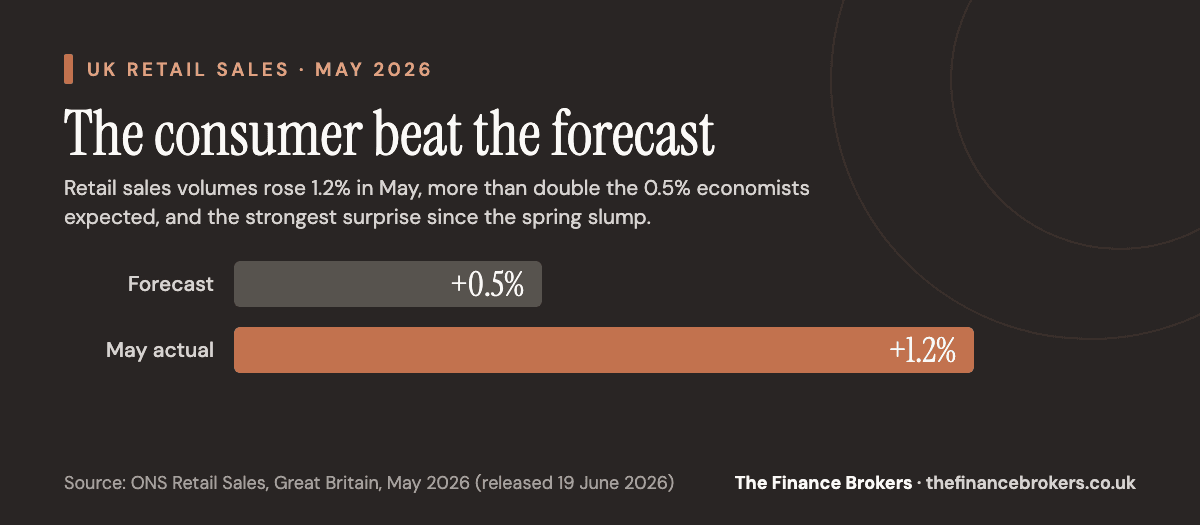
UK retail sales volumes rose 1.2% in May, the Office for National Statistics reported this morning. Economists had pencilled in 0.5%. So the consumer everyone had written off after April's slump just outspent the forecast by more than two to one.
The annual number is louder still. Volumes were 3.2% higher than a year ago, against an expected 1.9% (Reuters via Investing.com). Strip out petrol and the annual figure climbs to 4.6%. For any business that sells to the public, that is the most important sentence you will read this week: demand did not disappear, it came back.
The number nobody forecast
Rewind a month and the mood was grim. April retail volumes fell (revised this morning to -1.0% from the original -1.3%), hiring hit a multi-year low, and the services economy was contracting. The narrative was "the cautious consumer is staying home."
May broke it. Department stores posted their largest three-month rise since September 2024, non-store retailers (mostly online) jumped 6.1% on the month, and clothing rebounded hard. The BRC-KPMG Retail Sales Monitor told the same story from the till side, with total sales up 3.7% year-on-year against just 1.0% a year earlier.
Yes, the weather helped. May was the joint-third warmest on record, and fans, paddling pools and garden furniture flew off shelves. But warm weather only converts into sales if people are willing to spend. As Rob Wood, chief UK economist at Pantheon Macroeconomics, put it, the rebound "was helped by the weather but also shows consumers have been surprisingly resilient to higher energy prices."
Why this matters more to you than to the headline writers
A 1.2% monthly print is a line in the business pages. For a café owner, a salon, a homeware shop or an e-commerce operator, it is something far more concrete: customers are back through the door, and the question is whether you have the stock, staff and space to serve them before the moment passes.
That is the trap of a demand rebound. Sales rise faster than cash. You sold through the stock you bought when you were being cautious, the supplier wants paying for the reorder up front, and the card receipts for what you have already sold are still days away from clearing. Growth, counterintuitively, drains your bank account before it fills it.
It is also why retailers are working so hard to hold the line on price. Sandra Prince, head of consumer at Lloyds Bank, noted that "retailers are trying to keep prices low for customers despite ongoing cost pressures, using promotions." Promotions win the sale but compress the margin, which makes the cash-flow gap between buying stock and banking the proceeds wider, not narrower.
The funding that actually fits a demand spike
This is the part most owners get wrong. A surge in consumer demand is a short, seasonal, sales-linked event, and it should be funded with short, flexible, sales-linked money. A rigid five-year loan to buy three months of summer stock is a mismatch.
For consumer-facing businesses, three products fit the moment:
- Merchant cash advance. You borrow against your future card takings and repay as a percentage of each day's sales. When trade is busy you pay down faster; on a quiet day you pay less. For a retailer or hospitality business riding a demand wave, repayment that flexes with the till is the closest thing to funding that pays for itself. Lenders such as Liberis, YouLend and 365 Business Finance built their books on exactly this model.
- Unsecured working-capital loans. A lump sum to buy stock or fund a fit-out, with no asset put up as security and decisions often inside 24 to 48 hours. iwoca and Funding Circle are among the lenders competing hard in this space. If you are weighing this against putting property on the line, our guide to secured versus unsecured business loans walks through the trade-off.
- Asset finance. If the demand is exposing a capacity ceiling (a second coffee machine, more chillers, an extra delivery van, EPOS upgrades), spread the cost of the kit over its working life rather than paying cash up front and starving the rest of the business.
The common thread: match the term of the finance to the life of the demand. Fund a three-month stock cycle with three-month money, and fund a five-year machine with five-year money.
Don't fund a spike with the wrong product
A word of caution, because the flip side of a demand rebound is over-trading. The fastest way to turn a good summer into a cash-flow crisis is to read one strong month as a permanent trend and load up on long-term, fixed commitments to chase it.
May was strong, but it followed a weak April, and the swing owes something to weather that will not repeat every month. The sensible move is to fund the opportunity in front of you on terms you can unwind if the autumn is softer, not to bet the balance sheet on the rebound continuing. That is the whole point of sales-linked and short-term facilities: they scale down as quickly as they scaled up.
If you are not sure which product matches your situation, that is precisely the call worth making before you commit. Our guide on how to get an unsecured business loan in the UK covers what lenders look for and how to present a clean application.
The window, not the headline
The headline will be old news by next month. The opportunity it describes is live right now. Consumer demand has surprised to the upside, your competitors are reading the same figures, and the businesses that capture the summer are the ones that can fund the stock and capacity to meet it without choking their cash flow.
If you run a consumer-facing business and you can feel the demand but not yet the cash, talk to us. We work across more than 300 lenders, and the right facility for a demand spike looks very different from the one your bank will offer by default. The sooner the funding is in place, the more of this rebound you actually get to keep.