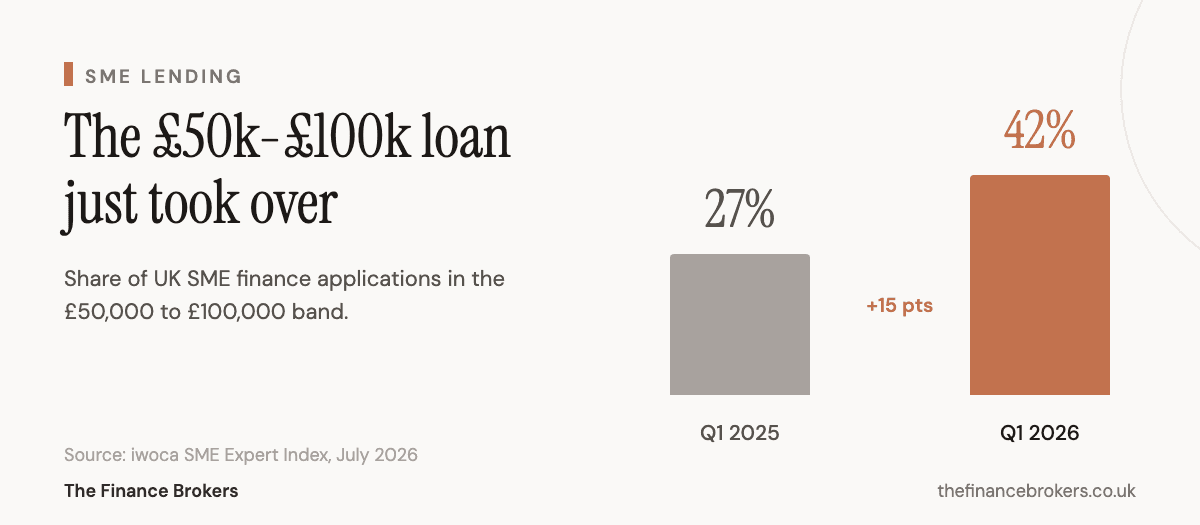
A year ago, loans between £50,000 and £100,000 made up 27% of SME finance applications. In the first quarter of 2026 they made up 42%. That is the fastest-moving number in UK small business finance right now, and almost nobody is talking about it.
iwoca is. On 27 July the lender closed a £250m funding structure with Waterfall Asset Management and an unnamed UK bank, and the reason it gave was that exact band of borrowing. The money is not chasing more £15,000 quick loans. It is chasing the ticket size the high street quietly stopped serving properly.
The band nobody is built for
There is a gap in UK business lending that has very little to do with credit risk and a lot to do with operating cost.
Below roughly £50,000, the market works. Applications are largely automated, decisions land in a day or two, and a dozen lenders compete on speed. Above roughly £250,000, the market also works, because a deal that size justifies a human underwriter, a site visit and a relationship manager.
In between sits the awkward middle. A £75,000 raise is too large to be waved through on an automated scorecard alone, and too small to be worth a clearing bank's full credit process. It is the amount a business asks for when it is genuinely growing: a second premises, a hire of four people, a stock build ahead of a contract, a VAT bill that collided with a slow-paying customer.
The iwoca SME Expert Index data published alongside the facility shows that band going from just over a quarter of applications to well over four in ten in twelve months. It also found 57% of brokers expect demand for mid-sized loans to keep rising over the next six months. That is not a blip in one lender's pipeline. That is the shape of demand changing.
Why the capital is arriving now
Specialist lenders cannot lend money they have not raised. So the honest tell for where a market is heading is not what a lender says, it is what its funding lines are structured to do.
iwoca's new facility is deliberately built to scale with demand rather than sitting as a fixed pot. Romain Guilleminet, the firm's Head of Capital Markets, framed the raise around scale reached rather than ambition announced: the business has now funded 96,000 SMEs since 2012, up from 60,000 as recently as 2024, and issued 58,000 loans worth £1.3bn in 2025 alone, a 60% increase on the year before.
James Cuby, Partner and Head of Europe at Waterfall Asset Management, pointed at credit performance rather than growth in his own comment, noting the lender had delivered growth "year after year, whilst maintaining strong credit performance and expanding its product offering." That is the part that matters for borrowers. Institutional money extends into a lending band when the loss data says it can, not when the marketing says it should.
It is worth noting the context, too. City AM reported on the same day that iwoca has engaged advisers to test appetite for a sale that could value it north of £1bn, while cautioning that the process is early and may go nowhere. Either way, the direction of travel is the same: capital is being priced into UK SME lending at valuations the banks walked away from.
What it costs to borrow in the middle right now
The other half of the picture came from the Bank of England yesterday morning.
The June Money and Credit release shows SMEs borrowed a net £0.6bn from banks in June, up from £0.1bn in May. Appetite is not the constraint. Price still is. The effective interest rate on new bank loans to SMEs rose to 6.36%, from 6.18% a month earlier, while the equivalent rate across all non-financial companies, large ones included, sat at 5.42%.
That gap of nearly a full percentage point is the SME premium, and it is paid by exactly the businesses in the £50k to £100k band. The growth rates say the same thing from another angle: bank borrowing by large businesses is expanding at 10.5% a year against 4.1% for SMEs.
So the mid-sized borrower faces a market where bank money is available, dearer than it looks, and slower than the decision usually needs to be. That combination is precisely why the specialist share keeps climbing, a pattern we set out when bank lending to SMEs hit a 30-year low.
What this changes for a business raising £75,000
Three practical consequences fall out of the data.
First, the band you are borrowing in now has competition, so use it. Twelve months ago a £75,000 unsecured raise was a thin market where the first yes tended to become the only yes. With mid-sized applications up to 42% of volume and lenders raising capital specifically against that band, the same request now draws materially different offers on rate, term and personal guarantee terms. Taking the first approval is an expensive habit in a market that has changed underneath it.
Second, the structure matters more than the headline rate at this size. A £75,000 facility can be an unsecured term loan, a revolving facility you draw and repay, an advance against your sales ledger, or a refinance of equipment you already own. Those look similar on a monthly cost basis and behave completely differently when trading is lumpy. Our guide to secured versus unsecured business loans covers the trade-off properly, and the glossary entry on unsecured business loans is the short version.
Third, do not assume unsecured is the answer just because it is the fastest route. If your money is genuinely tied up in unpaid invoices, invoice finance solves the actual problem at a lower cost than borrowing against it. If it is tied up in vehicles or equipment, refinancing those assets usually prices better than an unsecured loan of the same size. Speed is worth paying for. It is not worth paying for twice.
The signal underneath the headline
A £250m funding line is a lender story. The 27% to 42% shift is a borrower story, and it is the more interesting one.
UK SMEs are not asking for survival money in larger numbers. They are asking for growth money in larger amounts, at a size the high street has spent a decade making awkward to access. The capital markets have noticed before most business owners have.
That lag is measurable. The lenders' own outlook has brightened sharply while borrower confidence has not moved with it, which is why finance firms are bullish again and SMEs are not.
The follow-up data has since arrived, and it sharpens the point: in the next quarter's Index, cash flow fell from 42% to 18% of large SME loan applications while expansion rose to 32%. The money is not just getting bigger, it is changing job.
The distribution side has moved too. In September the same lender put that £1,000 to £1m range inside a card-payments provider's merchant portal, so business lending moved into the card machine and the first offer a business sees now arrives before it goes looking.
If you are weighing a raise in that band, the useful first step is not picking a lender. It is seeing what the whole panel will actually do with your numbers, because in a market this fast-moving the spread between the best and the median offer is where the money is. Our guide to getting an unsecured business loan in the UK walks through what lenders want to see, and we price unsecured business loans across 300+ lenders rather than a single balance sheet. If a £50,000 to £100,000 raise is on your list this quarter, talk to us and we will tell you what is genuinely achievable.