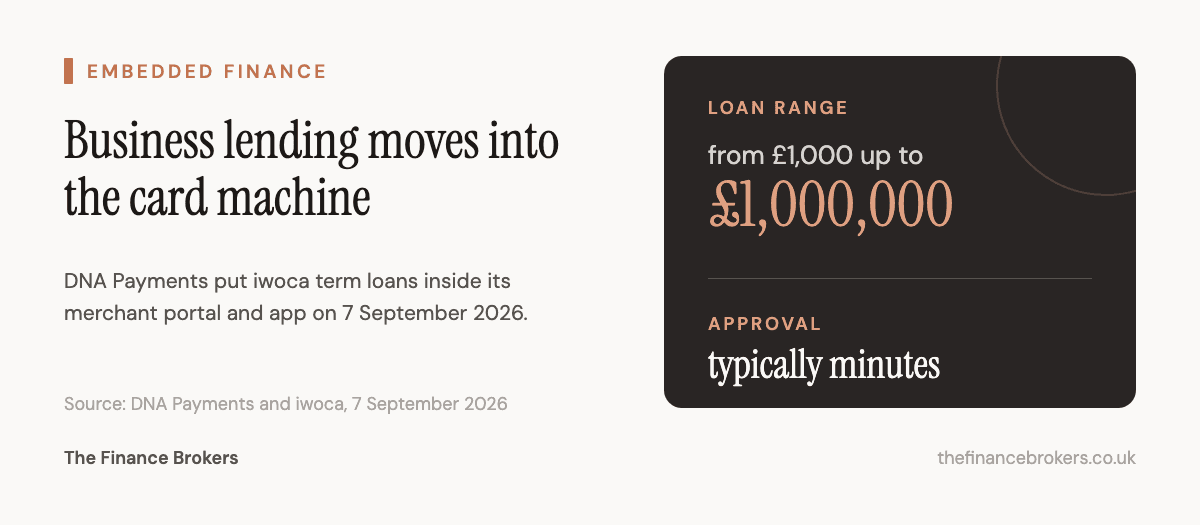
Your card machine provider can now approve a £1 million business loan in minutes.
That is not a figure of speech. On 7 September, DNA Payments announced a partnership with iwoca that puts iwoca Flexi Loans of £1,000 to £1 million directly inside DNA Payments' Merchant Portal and app. The application is fully digital and, per both companies, approvals typically land within minutes.
No new lender launched. No rate moved. What changed is where the offer sits, and that turns out to matter more than either.
What was actually announced
DNA Payments is a UK payments provider, describing itself as one of the country's largest independent, fully vertically integrated omnichannel payments providers, built through eight acquisitions and serving thousands of UK merchants. It sells card terminals and checkout pages. Until now, funding was not really its business.
From today, a merchant logging into that portal to check yesterday's takings can also apply for a term loan without leaving the screen. Colin Neil, DNA Payments' chief executive, framed it as adding to what the company already does: "By adding term loans to our funding options, we can better support our clients when they need it most." Harry Cranfield, iwoca's head of partnerships, put the logic more plainly: "This partnership means more businesses can access funding exactly where they already are, inside the tools they use every day."
He is describing the strategy accurately, and it is worth taking seriously rather than reading as launch copy.
This is a pattern, not a one-off
iwoca has been assembling this distribution for a while. In October 2025 it struck a comparable deal with Zempler Bank, putting the same £1,000 to £1 million range inside Zempler's digital banking marketplace, again with decisions in minutes. The DNA Payments tie-up applies the identical playbook to a payments processor instead of a bank.
Look at those two together and the shape becomes clear. iwoca is not primarily competing on price. It is competing on being present at the moment the need appears, and it is buying that presence by embedding itself in the software a business already opens every day. Its own £250m funding structure, which we covered when iwoca went after mid-sized SME loans, gave it the balance sheet to serve that demand. Deals like this are how the demand reaches it.
That is a genuinely strong position. It is also a narrow one, and the narrowness is the part borrowers should understand.
Why speed is real value, and where it stops being enough
Start with the honest case for it. A minutes-long approval is not a gimmick. When a supplier wants paying on Friday, or a van goes off the road mid-contract, the difference between money on Tuesday and money in three weeks is the difference between a solved problem and a lost customer. For a straightforward £15,000 working capital top-up on a trading business with clean card receipts, an embedded offer is often the right answer, and going anywhere else may cost more in delay than it saves in rate.
The limit is structural rather than a failing of the lender. A single-panel offer can only present what that panel has. Inside a merchant portal, the answer to "I need £40,000" is a term loan, because a term loan is what is plumbed in. It is not able to tell you that:
- the £40,000 is going on a vehicle, and asset finance secured on that vehicle will usually price below an unsecured term loan over the same period
- your ledger already contains the money, and invoice finance would release it without adding debt at all
- the pressure is a quarterly VAT bill, which is a VAT or tax loan shaped around one payment date rather than a general-purpose facility
- the business could support a secured business loan at a materially lower rate, if the timeline allows for security to be taken
None of those are exotic. They are the ordinary alternatives to a term loan, and the reason the secured versus unsecured decision is worth five minutes of thought rather than one click.
The change worth watching is the default, not the product
Here is the part we think the trade coverage will under-read. Distribution decides defaults, and defaults decide outcomes far more reliably than pricing does.
For most of the last two decades, an SME wanting money started with its bank, and the bank's answer set the reference point. That reference point was frequently poor, which is the whole reason the specialist market grew. What is happening now is that the starting point is moving again, from the bank to the software layer: the payments provider, the accounting package, the neobank marketplace. The offer arrives before the search does.
That is an improvement on being declined by a high-street bank and told to try again next year. It is not the same thing as knowing what the market would have offered. Convenience at the point of need is a powerful thing, and it quietly removes the moment where a business would otherwise have compared anything.
None of this is an argument against taking the fast money. It is an argument for knowing what you are choosing. The embedded offer competes on speed and it wins on speed. Whole-of-market competes on shape and price, and it needs a few days to do so. Those are different products for different problems, and plenty of businesses genuinely need the first one.
What we would tell a client this week
Three practical steps, in order.
Check the shape before the rate. Ask what the money is actually for. If it maps onto an asset, an invoice book, a property or a specific tax bill, there is very likely a cheaper structure than a general-purpose term loan, and the difference over three years is usually larger than any rate haggling would have achieved.
Use the fast route when speed is the binding constraint. If the deadline is days away and the sum is modest, an in-portal approval is a good outcome. Take it and move on. Just do not let a fast facility become the permanent funding structure by accident.
Do not let one panel be the whole market. A single lender's offer is information, not a benchmark. Understanding how to get an unsecured business loan and what an unsecured business loan actually costs is what turns one quote into a decision.
The distribution of UK business lending is being rebuilt inside software this year, and on balance that is good news for borrowers who would previously have been turned away at a branch. It just means the question has changed. It used to be "can I get funded?" It is increasingly "is this the funding I should have taken?"
If you would like that second question answered across the whole market rather than one panel, talk to us. We will tell you when the fast offer in your portal is already the right answer, which happens more often than you might expect.