A UK Small-Business Bank Just Applied to Lend in Sweden
A British bank has applied for a licence to lend to small businesses in Sweden, and the reason it gave is the same complaint UK firms have been making for a decade: established companies are underserved by their big banks.
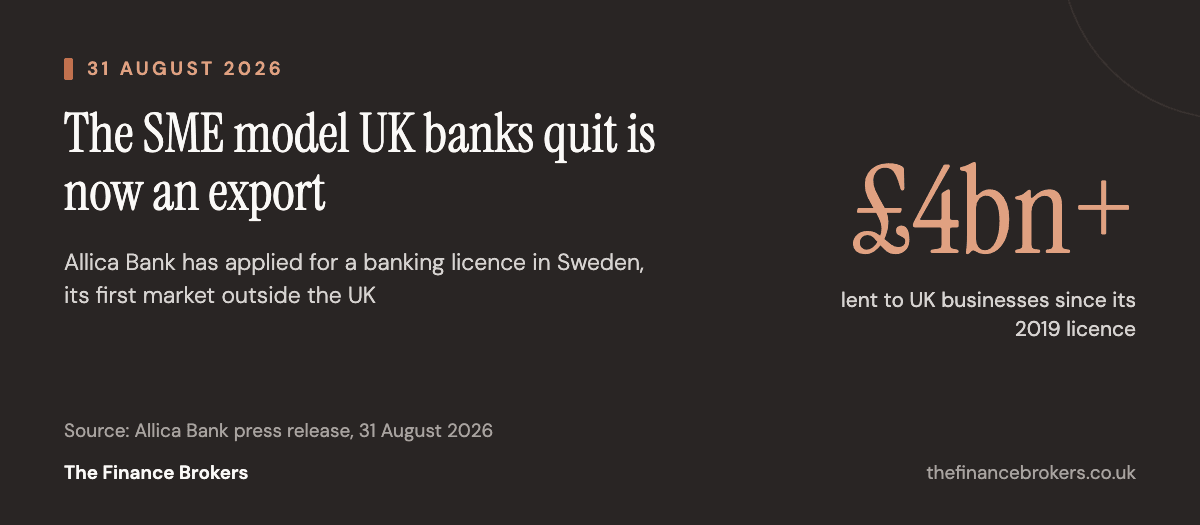
Allica Bank confirmed this morning that it has submitted an application to Finansinspektionen, the Swedish financial regulator, for a banking licence. It is the bank's first move outside the UK. A Swedish legal entity is already registered, and an executive team is in place, led by Rickard Westlund as Sweden CEO.
The detail worth pausing on is not the geography. It is what is being exported. Allica has lent over £4bn to UK businesses since it got its UK licence in 2019, almost all of it to the kind of established, unglamorous, 5 to 250 employee company that the high street quietly de-prioritised. That segment was described as uneconomic for years. It is now profitable enough to fund an international expansion.
What Allica actually filed
The application is with Finansinspektionen and it is subject to approval, so nothing has been granted. What has happened is that a UK bank has committed capital, hired a country leadership team and started a regulatory process that typically runs for many months.
The strategic logic is straightforward. A Swedish licence is not just a Swedish licence. Once authorised in an EU member state, a bank has a route to passport into other EU markets, and Allica has already named the Netherlands and Ireland as later targets, according to reporting on the application. Sweden is the door, not the destination.
The funding behind it is recent. Allica raised $155m in a Series D round in February, which took the bank to a valuation of close to $1.2bn. We covered Allica's record year in April, when it reported a 23% rise in lending and a 34% jump in underlying pre-tax profit. That was the year that made this filing possible.
Why Sweden, and what the choice says about the UK
Allica's stated reason for choosing Sweden is worth reading carefully, because it is a description of the UK market as much as the Swedish one.
Chief Executive Richard Davies said Sweden's "established businesses face many of the same challenges we have seen in the UK, where firms that make a major contribution to the economy have too often been underserved by traditional banks."
That is a UK bank saying, in public, that the gap it built its business on is not a British quirk. Sweden has a digital economy, a respected regulator, and a business banking market concentrated in a handful of incumbents. Change three words and you have a description of Britain.
Davies also said the bank would not be "taking this step without the proven model we have built in the UK". The claim is not that Sweden is a better market. The claim is that the UK model works and travels.
What this means if you are borrowing in the UK
There are three practical readings for a UK business owner or their broker.
The first is competitive. A lender expanding abroad is not a lender retreating at home. Allica's UK proposition, commercial mortgages and asset finance for trading businesses, is the thing being copied out, which means it has to keep working here. Expansion funded by UK profits depends on UK profits continuing.
The second is about where capital is actually going. This is not an isolated event. We wrote earlier this month about £34bn of new lending that did not come from a bank, and last week about two Big Four banks putting £550m behind a single specialist lender. The specialist and challenger tier is not scraping by on the edges of the market. It is raising equity at unicorn valuations, buying rivals, taking wholesale funding lines from the clearing banks, and now opening in other countries.
The third is the one that costs money if you ignore it. If you are an established UK business and your finance search still starts and ends at your business bank, you are shopping in the part of the market that has been shrinking its appetite for you, while the part that has been growing does not have a branch on your high street. It has brokers instead. That is not a marketing line, it is how the distribution actually works: challenger and specialist lenders reach established SMEs largely through intermediaries, so the route in is not obvious unless you go looking.
The pattern this fits
Step back and 2026 looks less like a recovery in SME lending and more like a handover.
The high street has not stopped lending to small business, but its share of the interesting cases keeps falling, and the lenders picking those cases up are better capitalised every quarter. A bank that started lending in 2019 has passed £4bn of UK lending, turned a profit, raised at a $1.2bn valuation, and is now applying to do the same thing in another country. Seven years.
For borrowers this is genuinely good news, with one catch. More lenders means more competition on price, structure and speed, and the differences between them are large. It also means the market is harder to see. Comparing a challenger bank's commercial mortgage against a specialist's asset finance package against a secured or unsecured business loan is not a like-for-like exercise, and the cheapest headline rate is regularly not the cheapest deal once fees, term and security are in.
The short version
A UK bank built a business on the customers the high street left behind, and that business is now good enough to export. If you are one of those customers, the useful conclusion is not about Sweden. It is that the lenders competing hardest for your business are increasingly not the ones you already bank with, and finding them is the part most business owners skip.
If you want to know which lenders are actually competing for a business like yours right now, that is the conversation we have every day. Talk to us and we will tell you what the market looks like for your deal, not for the average one.