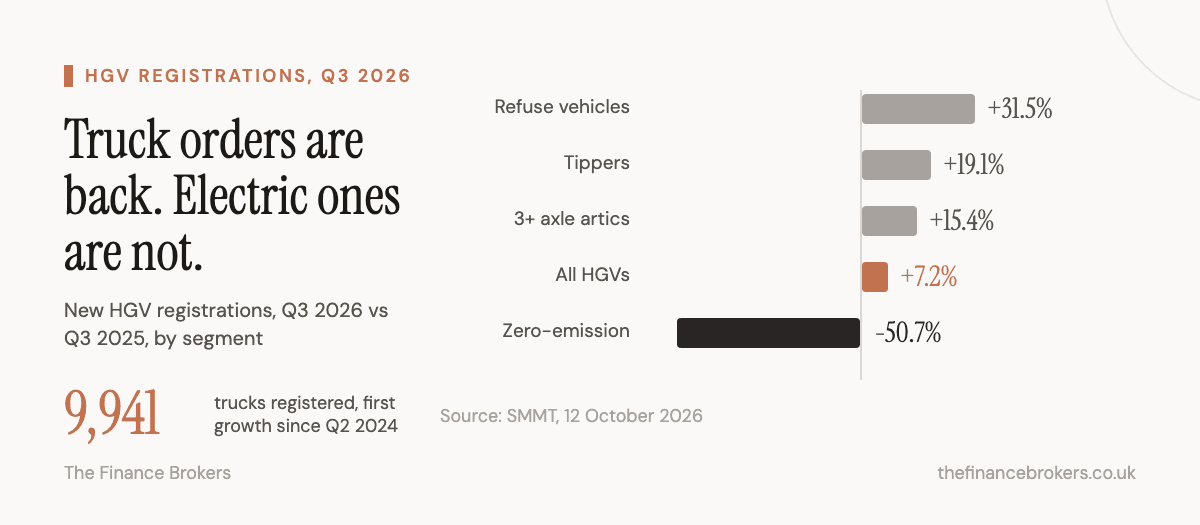
Britain registered 7.2% more heavy goods vehicles in the third quarter than a year earlier. It is the first quarter of growth since the spring of 2024, and it arrived two weeks before a Budget at which the Chancellor decides whether the first fuel duty rise since 2011 goes ahead in January.
Read those two facts together and the picture for a haulier is not a recovery. It is a replacement cycle restarting into a cost base that is about to get heavier, which makes how the next truck is paid for a more important decision than whether it is bought at all.
What the SMMT figures say
The Society of Motor Manufacturers and Traders published its Q3 registration data on 12 October. The total market rose to 9,941 units from 9,272 in Q3 2025, the strongest quarter since Q3 2023. The year to date is still 3.8% down, at 28,099 units against 29,197, because the first half was weak.
The growth is concentrated in the heavy end of the fleet, which is where the money sits:
- Three-plus-axle artics up 15.4% to 3,882 units, while two-axle artics fell 8.6%
- Tractor units up 12.3% to 4,453
- Tippers up 19.1% to 847 and refuse vehicles up 31.5% to 760
- Rigids up 4.1% overall, though they remain 8.4% down for the year
- Box vans down 11.8% to 793
Northern Ireland registered 45.8% more trucks; Scotland registered 7.9% fewer. The South East of England added 319 units, the largest volume rise of any region.
Mike Hawes, the SMMT's chief executive, called it a "welcome boost for the sector" after two years of falling demand, while noting that the rise comes from a low base. The comparison quarter, Q3 2025, had fallen 14.5%.
The electric truck went the other way
The part of the release that did not make the headline is the one with the biggest financing consequence. Zero-emission HGV registrations fell 50.7% in the quarter, to a 1.1% share of the market. A year earlier they had quadrupled to a 2.4% share. For the year to date they are down 30.9%, with a 1.0% share, which Hawes described as "still stuck at just one in 100 new trucks" and said "underlines the volatility and fragility of the transition."
The SMMT named purchase cost and the lack of depot charging as the barriers, and said the Plug-in Truck Grant and the Depot Charging Scheme had only partly addressed them, according to coverage of the release.
There is a third barrier that sits with the funders rather than the government, and it was the subject of an event eleven days before the figures came out. The BVRLA and the Green Finance Institute held an HGV Finance Innovation Summit on 1 October, reported by FleetPoint, built around a single problem: nobody knows what an electric truck will be worth in five years. BVRLA chief executive Toby Poston said that "decarbonising road freight is a very different proposition to making the transition with cars or vans" and that residual values are central to the economics. The Green Finance Institute's Ryan Jude put HGVs at 16% of UK domestic transport emissions.
Residual value is the number that sets the monthly payment on a lease or a balloon hire purchase. When a funder cannot price it, the vehicle is either financed on a flat hire purchase with the operator carrying all the risk, or not financed at all. That, as much as the grant, is why 99 in every 100 trucks registered this quarter were not zero-emission.
The cost base those trucks are driving into
The operators placing these orders are doing it against a backdrop we wrote about a fortnight ago, when diesel passed its 2022 record at above 199p a litre. Since then the attention has moved from the pump to the Treasury.
Fuel duty currently stands at 52.95p a litre, held down by the 5p cut introduced in 2022. Under the government's default timetable it rises by 3p on 1 January 2027 and a further 2p on 1 March, back to 57.95p, unless the Chancellor says otherwise on 28 October. The Road Haulage Association's estimate, reported by Trans.info, is that each 5p of duty costs around £2,325 a year per truck, or about £46,500 for a 20-vehicle fleet. The same RHA operator survey found 84.6% of hauliers saying higher fuel costs were already cutting their margins, and only 10% able to pass fuel increases on to customers in full.
The RHA has asked for an Essential User Rebate for lorry, coach and van operators and for the planned rises to be scrapped. On 13 October its managing director Richard Smith wrote that the association had put a 15p a litre support proposal to ministers. Whether any of that lands is a Budget-day question. What an operator can plan for today is the default: duty up 5p by March, on top of fuel that already costs nearly 40% more than it did in February.
So the trucks are being ordered, and the running cost per truck is going up. Fuel is roughly a third of an HGV's operating cost, on the RHA's figures. A vehicle financed over five years from this autumn will spend its whole term in that environment.
What this changes about funding the next vehicle
We covered the first half of this story in July, when truck buying fell 14.7% while truck finance grew 7%. The point then was that funding was not the blocker; commitment was. The third quarter suggests the commitment has come back, at least for the heavy artic and tipper fleets whose vehicles have aged past the point where repairs are cheaper than replacement. Four things follow.
Cash is worth more than it was. With fuel duty rising and only one in ten operators able to pass cost increases on, the working capital a business keeps in the bank matters more than the interest it saves by paying cash for a vehicle. Across the whole UK market, a third of equipment and vehicle investment is now financed rather than bought outright. For a haulier facing a 2027 duty rise, financing the truck and keeping the cash is usually the right order.
Diesel residuals are the known quantity. The same residual value problem that is holding back electric trucks is what makes a diesel artic easy to fund. Lenders have decades of second-hand data on a DAF or a Scania tractor unit. That shows up as a lower monthly cost on a lease or a balloon hire purchase, because the funder is comfortable carrying a larger end-of-term value. If you are replacing diesel with diesel this year, use that. Price the balloon structure against the flat hire purchase and see what the residual is worth to you in monthly cash.
Refinance is a working capital tool, not just a replacement tool. A fleet that bought its trucks in 2021 and 2022 and has paid most of them down is sitting on unencumbered assets. Asset refinance against those vehicles releases cash without selling them, and that cash can fund the fuel bill through a winter when duty is rising. It is one of the few routes to five- or six-figure working capital that does not depend on the strength of the debtor book. Our guide to secured versus unsecured business borrowing sets out where it fits.
Fix the term, not just the vehicle. Hire purchase and leasing rates are normally fixed for the agreement, which means a truck financed now carries a known monthly cost for the next four or five years regardless of what happens to Bank Rate. In a year when the diesel price has moved nearly 40% and the duty on it is about to change, a fixed cost line on the biggest capital item in the business is worth having.
Where the fuel bill itself gets funded
The cost of the duty rise does not arrive as a lump; it arrives on every fill-up, weeks before the customer pays for the load. Haulage runs on 45 to 60 day terms against a fuel and wage bill that is weekly. That gap is what invoice finance exists for, and for a transport business it is often the cheaper answer to a fuel-driven cash squeeze than a term loan, because the facility grows with the sales ledger rather than being sized once.
Where the debtor book is thin or concentrated, a secured business loan against property or plant can do the same job on a fixed term. Either way, the time to arrange it is before the January rise, not after the first quarter in which the margin has gone.
The bottom line
Nine thousand nine hundred and forty-one trucks were registered in the third quarter, the first growth in two years, almost all of them diesel, and almost all of them financed into a market where the fuel they run on is about to be taxed more heavily. The replacement cycle has restarted. The cost of running the fleet has not stopped rising.
That combination rewards operators who treat the funding structure as carefully as the vehicle spec: use the diesel residual while it is strong, keep the cash in the business, and get the working capital line in place before the Budget confirms the duty timetable.
If you are replacing vehicles this quarter, or want to know what your existing fleet could release, our asset finance team can price the options across the funders who are actively writing HGV business this month. Talk to us.