When a UK business puts a new truck, a CNC machine or a fleet of vans to work, there is roughly a one in three chance it never bought the thing at all.
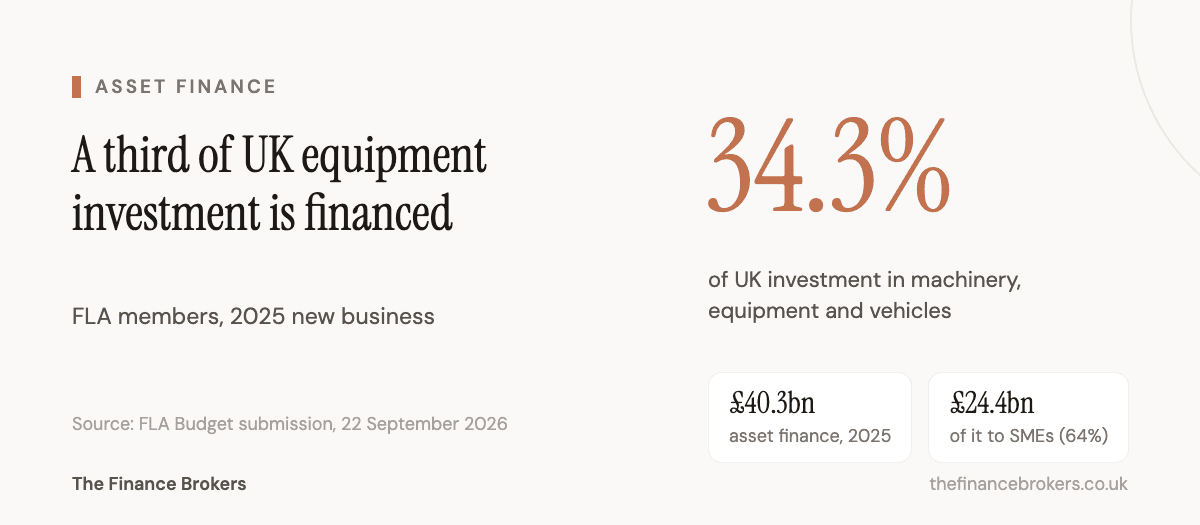
That is the claim underneath the Finance and Leasing Association's Budget submission, published on 22 September: its members financed 34.3% of all UK investment in machinery, equipment and vehicles. Not a third of the small-business share, and not a third of the deals the banks turned down. A third of the national total.
For anyone running kit, that number reframes what asset finance actually is. It is not the fallback you reach for when the bank says no. It is the default funding mechanism for a large and growing slice of the productive economy, and the industry has just gone to the Treasury to argue that the constraint on it is supply, not demand.
The numbers behind the submission
The FLA's 2025 totals are the part worth holding on to, and they are corroborated outside the submission itself.
Members provided £163 billion of new lending to UK households and businesses in 2025. Of that, £40.3 billion was asset finance: the funding that puts equipment, plant and vehicles into the hands of businesses that will not, or cannot, pay cash.
The split inside that figure is the surprising one. £24.4 billion went to SMEs, a record, up 4% on the previous year and 64% of all asset finance new business. 2025 was the fifth consecutive year of growth and the first time the market cleared £40 billion.
So smaller businesses are not a minority customer in this market. They are close to two thirds of it. That is the inverse of the picture in mainstream business lending, where we have tracked the high street pulling back from SMEs even as headline volumes recover.
"FLA members already finance more than a third of UK investment in machinery, equipment and vehicles," said Shanika Amarasekara MBE, the FLA's Chief Executive, in the submission. "With public finances constrained, the question is how we get more private capital flowing into that productive investment."
The asks are about the pipe, not the pump
Read the five requests and a pattern shows up: almost none of them are about persuading businesses to invest. They are about widening the channel the money travels through.
The headline ask is a Productive Finance Partnership, led by the British Business Bank, to connect institutional and private capital with the specialist lenders that fund machinery, vehicles and technology. In plain terms: get pension and institutional money onto the balance sheets of the non-bank lenders that already do most of this work, so they can write more of it.
That matters more than it sounds. The specialist asset lenders a haulier or a groundworks contractor actually borrows from are, for the most part, funded wholesale. Their appetite in any given quarter is a function of what funding lines they have available, not of how many good applications land on the desk. We have seen the same mechanism in property, where a bank committing a funding line to a specialist lender is what visibly changes what that lender can do for borrowers.
The second ask is a "Ready for Finance" service, industry-funded, to help SMEs work out what they need and where to get it. That is a demand-side ask, but it is an awareness one rather than an appetite one, and it lines up with what the British Business Bank found this month: plenty of lenders exist, and a large share of owners do not know how to find them.
The remaining three are a coherent approach to electric vehicle taxation to protect the affordability of the EV transition, greater use of private finance in the Warm Homes Plan, and measures giving lenders certainty about their capacity to lend and invest.
Why the EV line is the one fleet operators should read twice
Of the five, the EV taxation ask is the one with the most direct line to a funding decision you might be making this year.
Fleet renewal maths is unusually sensitive to tax treatment, because the asset is held for years and the tax position is baked in at the point of purchase. We have already watched this play out in the light commercial market: after double cab pickups were reclassified as cars for tax, pickup registrations fell 61.2% in August while 4x4s rose 165.6%. Nothing about the work those vehicles do changed. The tax treatment did, and buyers moved.
The FLA's point is that the same sensitivity applies to electrification, and that an incoherent EV tax position will show up as deferred fleet decisions rather than as a policy debate. For an operator weighing a replacement cycle, that is a reason to get the funding structure right now rather than wait for clarity that may move again.
What this changes for a business borrowing today
Nothing in a Budget submission is policy. The Treasury may take none of it. But the numbers inside it are useful whether or not the asks land.
Asset finance is a mainstream funding route, not a distress signal. If a third of national equipment investment runs through it, the question for your own capital plan is not whether financing an asset looks weak, but whether tying up cash in something that depreciates looks strong.
The market's capacity is set upstream. When a specialist lender's terms tighten or loosen, it usually reflects its own funding position rather than a view about your business. That is the argument for having a view of the whole market rather than one relationship, which is the case we make in our guide on how to pick the right lender.
The structure choice is doing real work. Hire purchase, finance lease and contract hire put the tax, ownership and balance sheet treatment in different places, and the right answer moves with the asset and the operator. Our explainer on secured versus unsecured business loans covers where asset-backed structures sit against the alternatives.
The FLA is lobbying, and lobbying bodies pick the numbers that help them. But the 34.3% is not a projection or a survey. It is a description of how UK businesses already fund the things they work with, and it has been true for longer than most balance sheets admit.
If you are planning a fleet renewal or an equipment purchase into next year, we can look at what the specialist market will actually offer on it. Talk to us about the asset and we will tell you where the appetite is.