A Bank Just Put Another £50m Behind a Bridging Lender
Two banks and an investment manager now stand behind one Liverpool bridging lender, to the tune of £160m. That is not a story about one lender. It is the clearest available answer to a question most borrowers never think to ask: where does the money actually come from when a specialist lender says yes?
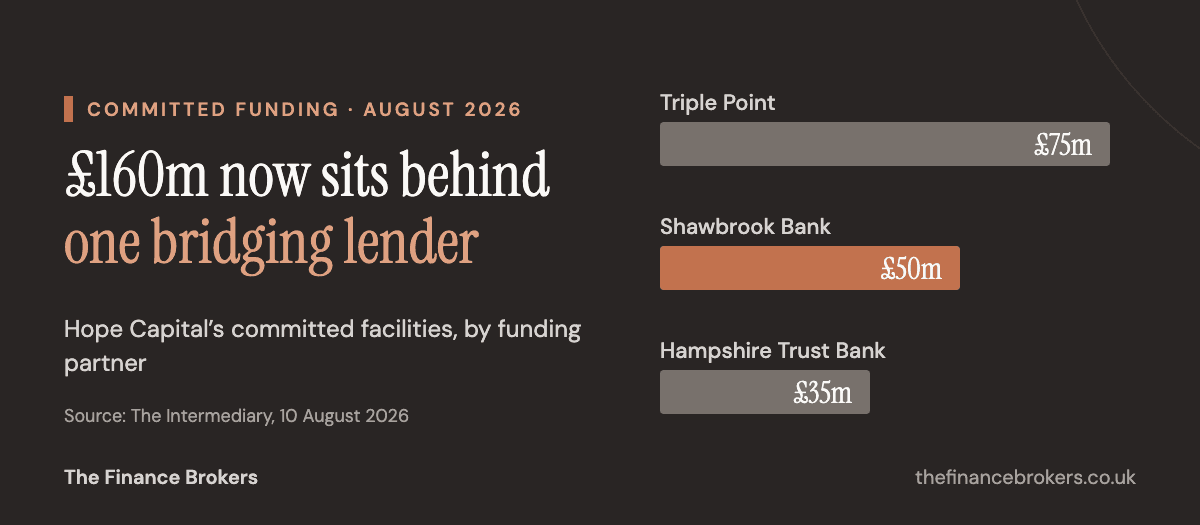
On 10 August, Shawbrook increased its committed funding facility to Hope Capital Property Finance to £50m. It is the third increase in a relationship that started with £15m in 2023, with rises in 2024 and 2025 in between. Alongside a £75m facility from Triple Point and a £35m line from Hampshire Trust Bank secured in June, Hope Capital now has £160m of committed funding across three partners.
The high street has spent five years being written up as absent from small business and specialist property lending. Here is a high-street-adjacent bank quietly writing the cheque that lets a bridging lender complete your deal.
What the numbers say about Hope Capital
Funders do not triple a facility on sentiment. The lender's own reported figures explain the decision. Across 2025, Hope Capital grew its loan book by 61%, saw applications rise 86%, and increased funded facilities by 46%. Into 2026, enquiries are up 45% year on year and applications up 30%.
The number we find most interesting is the one that never makes a headline: a 49% reduction in loans running beyond their agreed term. In bridging, that is the number that matters to a funder. A short-term loan that overstays is a loan whose exit did not happen, and a book full of them is how a bridging lender gets into trouble. Cutting that figure by half while nearly doubling application volume is the underwriting discipline that earns a bigger facility.
Warren Mutch, Shawbrook's head of speciality and fund finance, made exactly that point, describing "consistent and sustainable growth, underpinned by disciplined underwriting." Jonathan Sealey, Hope Capital's chief executive, called the continued support "a significant endorsement of both our performance and our long-term strategy."
Why a bank funds a bridging lender instead of the borrower
This is the part worth slowing down on, because it reframes what a high-street decline actually means.
A bank lending directly into bridging has to build the thing it is worst at: fast credit decisions on unusual property, a valuation panel that turns around in days, and legal machinery geared to a two-week completion. A bank lending to a bridging lender does none of that. It takes a senior, secured position against a diversified book of short-term loans, at a conservative advance rate, and lets the specialist do the underwriting, the servicing and the chasing.
Shawbrook has built a business out of this. In May 2025 Mutch put the speciality finance book at around £1.2bn of limits across roughly 85 non-bank lenders, up from £1bn to just over 80 customers the year before. Those 85 lenders are the ones brokers place deals with every day. Behind a meaningful slice of the UK specialist market sits one bank's wholesale team.
So when a high-street lender declines a refurbishment purchase and a specialist funds it a fortnight later, the money has not necessarily come from a different pool. It has often come through a different pipe, with the credit risk priced and managed by someone built to price and manage it.
This is a pattern, not a press release
We have now watched the same structural shift from four angles in three months.
- In June, JPMorgan and Deutsche Bank wrote cheques to two UK specialist lenders in a fortnight, while bank-to-SME lending sat near a 30-year low.
- Later that month, Balbec Capital bought Funding 365 outright, moving from funding an originator to owning one.
- Last week, FLA members reported £84.3bn of new lending in H1 2026, £34.4bn of it from non-bank lenders.
- And now a mid-sized UK bank has tripled a facility to a specialist bridging lender for the third time in as many years.
Wholesale funding lines, platform acquisitions, non-bank market share and now repeat facility increases all point the same way. Capital has not left UK property lending. It has moved one step back in the chain, from originating loans to funding the people who originate them.
What this means if you are the one borrowing
Three practical consequences follow, and they change how you should choose a lender.
A decline is a distribution problem more often than a credit problem. The same deal that a branch cannot process is frequently exactly what a Shawbrook-funded specialist is set up to write. If your only test of the market has been your own bank, you have tested one distribution channel, not the market. That gap is what a whole-of-market bridging broker exists to close.
Capacity is real, and it is committed. A committed facility is not a line of credit that can be withdrawn on a bad Tuesday. £160m of committed funding means a lender can price with confidence and hold its terms between offer and completion. Ask whether a facility is committed or uncommitted before you rely on it, because that distinction determines whether your offer survives the legal process.
The funding question belongs on your due diligence list. The MFS collapse taught the market that a lender's stability is the borrower's problem, not just the lender's. A deal that stalls because a funding line was pulled mid-transaction costs you the property, the fees and the timeline. Knowing which lenders are well funded, which have just raised, and which are quietly tightening is part of the job. It is a large part of ours.
The question worth asking your broker
For years the sensible question at the start of a bridging deal has been "what is the rate?" Rate still matters, but on a nine-month facility a 0.1% monthly difference is rarely what decides the outcome. The exit decides the outcome, and so does whether the lender is still lending when you get there.
So add a second question: who funds this lender, and is that funding committed? Hope Capital can answer it in one line. Not every lender can, and the ones that cannot are not automatically a problem. But you should know the answer before you exchange, not after. A month later the same question answered itself from the other direction, when a bridging lender cut to 0.75% with no bank involved because its private backer simply put in more money.
Understanding what bridging finance actually is and what criteria lenders apply puts you in a much stronger position to ask. So does a broker who watches the funding stacks as closely as the rate cards.
Two weeks after this facility increase, the same pattern turned up a tier higher: two big four banks put £550m behind one lender, when Lloyds committed a new £300m buy-to-let line and NatWest extended a £250m bridging facility to Lendco.
Weighing a bridge, a development facility, or a refinance of an existing short-term loan? Talk to The Finance Brokers. We place deals across 300+ lenders, and we know which of them have money committed and which are between funding rounds.