Two Big Four Banks Just Put £550m Behind One Lender
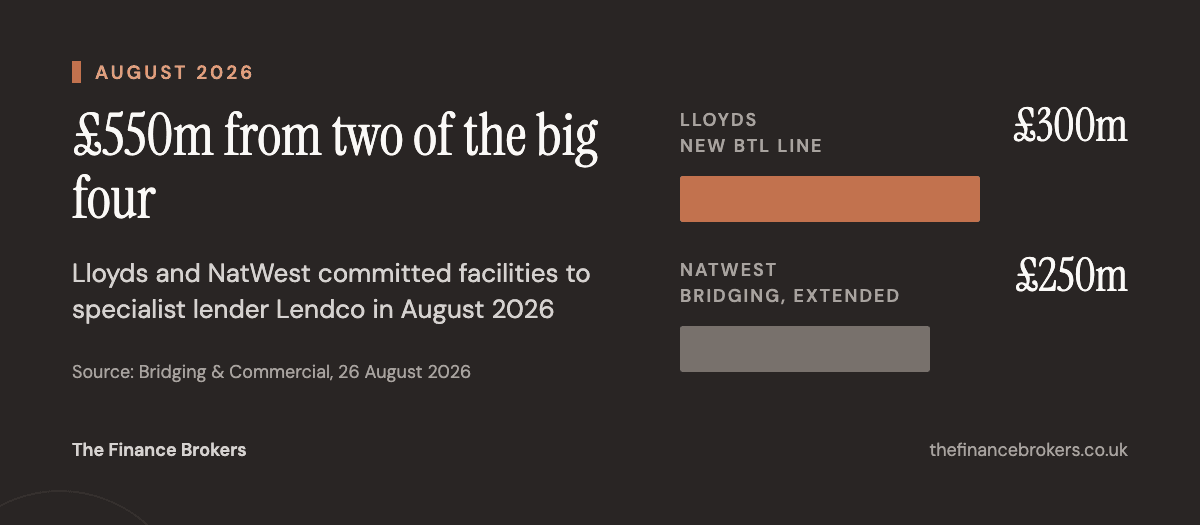
Lloyds has committed a new £300m funding line to a lender that manually underwrites every case it writes. NatWest has extended the term on another £250m. Neither bank will be underwriting the deals that money funds.
That is the whole story of UK specialist lending in one August, and it is the opposite of the story most borrowers have been told.
On 26 August, Bridging & Commercial reported that Lendco completed more than £500m of financing activity during the month, taking its total funding activity for 2026 past £1bn. The two headline transactions: a new £300m funding line with Lloyds, earmarked for growing Lendco's buy-to-let mortgage portfolio, and a term extension to its existing £250m bridging facility with NatWest.
Two of the big four clearing banks, £550m of committed facilities, one specialist lender.
What Lendco actually does with the money
This matters because of who Lendco lends to. The firm launched in July 2018 and built its book around professional property investors, the portfolio landlords and complex cases that automated criteria tend to reject. Its own description of its process is the relevant detail: "Every case is manually underwritten, and assessed on its own merits. There are no tick-boxes here." It spun bridging out into a separate arm, Lendco Bridging, in Q4 2023.
It has grown quickly on that basis. Lendco passed £3bn of total originations in May 2026, and in April it completed Atlas 2026-1, a £519m buy-to-let securitisation, its largest to date and the seventh under the Atlas programme, which has now issued around £2.5bn.
So the £550m is not going into a mainstream mortgage book. It is going into exactly the lending a high-street credit engine is built to decline: multi-property portfolios, unusual titles, short-term bridging against assets that need work before they will support a term loan.
Adrian Scragg, Lendco's director of treasury, framed August as a scaling exercise: "It has been a busy time for the treasury team as we continue to build scale into our funding platform. Not only have we strengthened our existing partnerships, but we've forged new relationships ahead of this exciting new phase for the business." Simon Knight, Lendco's chief executive, called them "committed top-tier funding partners that believe in the Lendco business."
Why a clearing bank funds the manual underwriter
There is a real economic logic here, and it is worth understanding because it changes what a high-street decline actually tells you.
A clearing bank's competitive advantage in mortgages is volume at low cost per case. That means automated decisioning, standardised criteria, and a valuation process built for a three-bed semi. Those systems are extremely good at what they do and structurally incapable of pricing a nine-property portfolio held across two SPVs with a mixed-use unit in it. Building a parallel manual-underwriting operation to capture that business would mean running a second, slower, more expensive bank inside the bank.
Funding someone else's manual underwriting is a far better trade. The bank takes a senior, secured position against a diversified pool of loans, at a conservative advance rate, with the specialist absorbing the first loss and doing all of the work. The bank earns a spread on a large, well-protected exposure without touching a single valuation.
Which is why "the banks have pulled out of specialist property lending" was never quite right. The capital did not leave. It moved one rung up the stack, from lending to borrowers to lending to lenders.
We have now watched this pattern from several angles in a single quarter. In June, JPMorgan and Deutsche Bank wrote cheques to two UK specialist lenders in a fortnight while bank-to-SME lending sat near a 30-year low. In August, Shawbrook raised Hope Capital's committed facility to £50m, the third increase in three years. And FLA members reported £34.4bn of new lending from non-bank lenders in H1 2026.
What is new in the Lendco transactions is the tier of the funder. Shawbrook is a specialist bank funding specialists. JPMorgan and Deutsche Bank are global investment banks. Lloyds and NatWest are the two largest retail banking groups in the country, the same brands whose branch networks decline the complex cases in the first place.
The full stack, in one lender
There is a second layer worth noting. In April, Cerberus Capital Management agreed to acquire Lendco from Cabot Square Capital and minority shareholders.
Stack it up and a single portfolio landlord's loan now sits on top of an American private-capital owner, a securitisation programme funded by institutional bond investors, and senior warehouse lines from two British clearing banks. Four distinct pools of capital, each taking a different slice of risk at a different price, so that one manual underwriter in London can say yes to a case a branch system cannot read.
That is not a sign of a fragile market. It is what a mature one looks like.
What a funding line means for your next deal
Funding announcements read like corporate housekeeping. For a borrower or a broker they carry three practical signals, and they are the reason we pay attention to them.
Capacity. A lender with a freshly committed £300m line is not going to run out of money halfway through your application. Specialist lenders price and pace their lending against available facilities, and the ones running low get slower and pickier long before they say so publicly. New committed capital is the most reliable public evidence that a lender is genuinely open.
Pricing. Senior bank funding is the cheapest money in a specialist lender's stack. A lender that replaces or supplements more expensive capital with a clearing-bank line has more room to compete on rate. It does not guarantee a better quote, but it is the precondition for one.
Term certainty. The NatWest transaction is a term extension, which matters more than a headline number. On bridging finance especially, a lender's ability to commit to your timetable depends on the maturity of its own funding. Longer facilities mean fewer conversations that begin "we'd like to, but our line matures in March."
The corollary is worth saying plainly. When a specialist lender declines your case, the constraint is usually its lending criteria or your exit strategy, not a shortage of money in the market. There is a great deal of money in the market. In August, £550m of it arrived at one lender from two banks that will never see your file.
Where this leaves borrowers
If you have been declined by a high-street lender on a portfolio purchase, a mixed-use unit, or anything needing work before it refinances, the useful conclusion is not that funding has dried up. It is that you were assessed by the wrong machine.
The money that funds the right one is increasingly coming from the same institution that turned you down. Finding the lender whose underwriting actually fits the asset is the entire job, and it is the one worth getting help with.
If you are weighing a portfolio refinance, a complex buy-to-let purchase, or a bridge that needs a lender to commit to a real timetable, our team can tell you which lenders are genuinely open on your case this month, and which are quietly waiting on their next funding line.