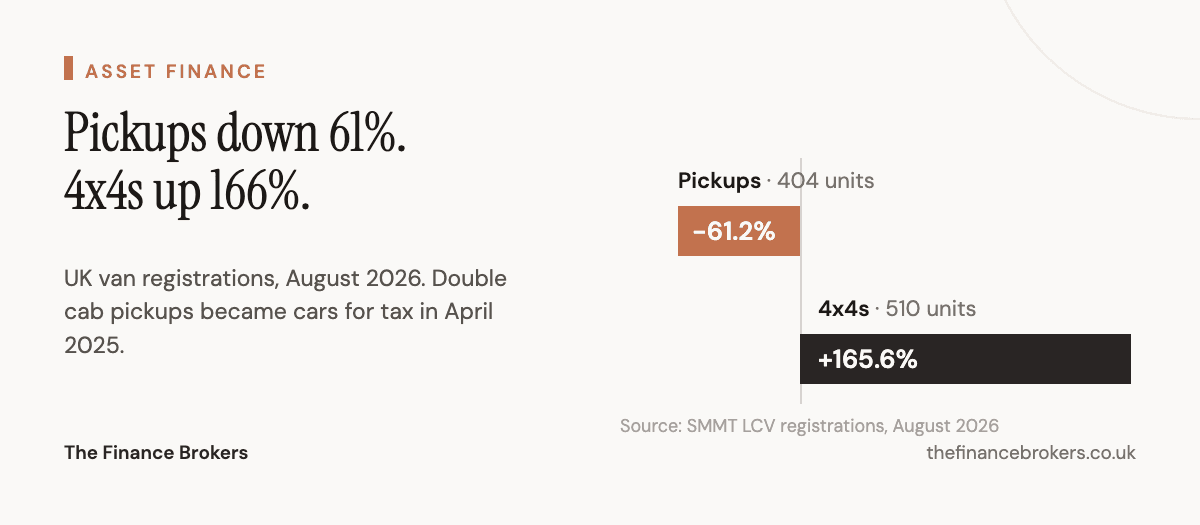
Two numbers in yesterday's van registration data point in opposite directions, and the same tax change explains both.
Pickup registrations fell 61.2% in August. Registrations of 4x4s rose 165.6%, according to the SMMT figures published on 4 September. Nothing about the work these vehicles do changed. What changed is that one of them stopped being a van for tax purposes, and the other never was one.
That is not a market signal about demand. It is a market rearranging itself around a rule.
What actually changed
Since 6 April 2025 for income tax and 1 April 2025 for corporation tax, a double cab pickup with a payload of one tonne or more is treated as a car, not a van, for both benefit in kind and capital allowances. ICAS set out the detail when the rules took effect.
Most of the coverage at the time focused on the benefit in kind side, and it is genuinely severe. A van attracted a flat benefit of £4,020, plus £769 for fuel, in 2025/26. Under the car rules the benefit becomes a percentage of list price set by CO2 emissions, and a large diesel pickup lands at or near the top band. For the driver, the same vehicle on the same drive became several times more expensive to have.
But the benefit in kind change is the employee's problem. The capital allowance change is the business's problem, and it is the one that reshapes the funding decision.
The line that moves the money
Before April 2025, a qualifying pickup was plant and machinery. It could go through the Annual Investment Allowance and attract 100% relief in year one.
Now it follows the car rules. HMRC's own guidance puts a vehicle emitting more than 50g/km of CO2 into the special rate pool at 6% a year on a reducing balance. Vehicles at 50g/km or below get the main rate, currently 14% (it was 18% before April 2026).
Work that through on a £40,000 pickup. Under the old treatment, the full £40,000 could be relieved in the year of purchase. Under the special rate, the first year's allowance is £2,400. The relief has not disappeared, but it has been pushed out over a decade and more, and relief you receive in 2036 is worth materially less than relief you received in 2025.
For a business buying one vehicle, that is an annoyance. For a business replacing six, it is a cash flow event in the year of purchase, and it arrives at exactly the moment the deposit is due.
Why 4x4s went up 166%
Once the pickup lost its van status, the tax reason to choose one over an alternative went with it. The market did the obvious thing and moved.
Be careful with the percentage, though. The 4x4 category registered 510 units in August and pickups registered 404. These are small absolute numbers in a deliberately low-volume month, because August buyers routinely wait for the September plate change. A 165.6% rise off a small base is a direction, not a landslide.
The direction is still worth reading. Total light commercial vehicle registrations were essentially flat in August at 14,445 units, up 0.6%, while large vans rose 5.2% to 10,943 units in a ninth consecutive month of growth. Operators are still replacing the vehicles that carry the goods. They have stopped replacing the vehicle whose tax treatment was reclassified underneath them.
There is also a transitional rule doing quiet work here. A pickup bought, leased or ordered before 6 April 2025 keeps the old benefit in kind treatment until the earlier of disposal, lease expiry, or 5 April 2029. So a meaningful number of operators are not deferring a purchase out of caution. They are sitting on grandfathered vehicles and will face this decision at renewal, not today. The registration data understates how many businesses this eventually touches.
The electric van question is a residual value question
The same release carried a record: battery electric vans took 16.3% of the August market on 2,395 registrations, up 25.9%.
Read the year instead of the month and it looks different. Year to date, electric vans are 11.0% of the market on 22,527 units, against a ZEV mandate target of 24% for 2026, rising to 34% in 2027. Mike Hawes, SMMT chief executive, said that "with EV demand remaining drastically adrift of mandate targets, government's decision to bring forward its review is essential." That review is out for consultation until 23 October 2026.
For an operator, the interesting part is not the compliance arithmetic. It is that nobody currently knows what a three-year-old electric 3.5-tonne van will be worth, because the residual value assumptions are being set against a target that may itself move in October.
Residual value uncertainty is a finance structure question, not a vehicle question. If you buy on hire purchase, you own the asset at the end and you carry the residual risk yourself. If you take a finance lease or an operating lease, a large part of that risk sits with the lender who set the residual. When the residual is genuinely hard to call, that allocation is worth more than a few basis points on the rate.
What we would actually look at
Three things, in this order.
First, the structure before the price. The tax treatment of the vehicle now changes which structure is efficient, and the answer is no longer the same for a pickup, a large panel van and an electric van in the same fleet. Our asset finance work is mostly this: hire purchase against a finance lease against an operating lease, judged on the borrower's tax and accounting position rather than on the headline rate.
Second, the year-one cash cost, not the monthly payment. A 6% writing down allowance where a business had budgeted for 100% relief is a real hole in the same year's tax bill. If that bill is the constraint rather than the vehicle, a VAT and tax loan is often the cleaner fix, and it keeps the asset facility clean.
Third, whether the existing fleet can fund the new one. Assets already owned outright can be refinanced to release the deposit, which matters more than usual when the relief profile has just been stretched over a decade. Where the requirement is broader than a single asset, it is worth understanding how secured and unsecured facilities compare before defaulting to either. It is also worth knowing how large this market is before treating it as a last resort: a third of UK equipment investment is financed rather than bought outright.
None of this is an argument against buying a pickup. Plenty of businesses need one and will keep buying them. It is an argument that a tax reclassification changed the funding maths on a whole vehicle class in 2025, most of the fleets affected have not hit their renewal date yet, and the decision they make then should not be the one they made last time by habit.
If a renewal is coming up and the structure is worth a second opinion, talk to us before the order goes in. It is easier to get right at the quote stage than after the invoice.