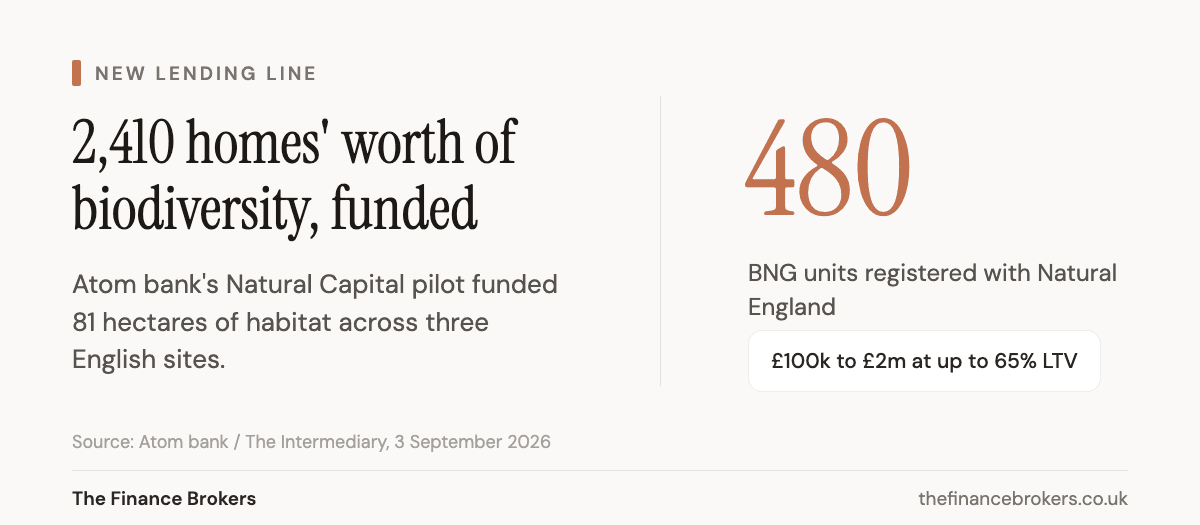
81 Hectares of Habitat Just Unblocked 2,410 Homes
Eighty-one hectares of land in Cambridgeshire, Northamptonshire and Hampshire have just cleared the biodiversity requirement for around 2,410 new homes. Not by being built on. By being planted.
Atom bank confirmed this morning that it is turning that pilot into a permanent lending line. Its new Natural Capital proposition provides secured funding against English land bought or refinanced to create Biodiversity Net Gain units. The pilot funded three habitat banks: 21 hectares at Boxworth in Cambridgeshire, 40 hectares at Aldwincle in North Northamptonshire and 20 hectares at Stockbridge in Hampshire. Between them they produced 480 BNG units registered with Natural England.
That is roughly one unit for every five homes it unlocks. It is also the first time we have seen a UK bank build a standing product around habitat as the thing being financed rather than as a condition attached to something else.
What Atom has actually launched
The terms are deliberately modest, and reading them properly matters more than the press release framing.
Natural Capital loans run from £100,000 to £2m, at up to 65% loan to value, and they are available to limited companies and LLPs. The security is English land intended for BNG unit creation, on either a purchase or a refinance.
The detail that decides who this is really for sits in the valuation basis: the 65% is measured against the original land value, not against the value of the units the site will eventually generate. Atom is lending against the dirt, not against the biodiversity uplift. If you have been waiting for a lender to advance against a projected BNG unit sale price, this is not that product, and it is worth being clear-eyed about the difference before you build a model on it.
Edward Twiddy, director of ESG at Atom bank, said that "supporting the creation of BNG habitat banks is essential for the future of the housing sector." Jason C Wright, director at BNG Partnership, which delivered the three pilot sites, said that "Atom's financial insight and dedication to the environment is what has allowed us to create these three sites."
Why habitat banks have a funding problem in the first place
Biodiversity Net Gain has been mandatory in England for over two years. Under the Environment Act 2021, major developments granted planning permission from 12 February 2024 must deliver a minimum 10% uplift in biodiversity value, with small sites following from 2 April 2024. Where a site cannot deliver the full 10% within its own red line, the shortfall is met off-site, usually by buying units from a registered provider.
That created a market almost overnight, and it created a cash flow shape that most lenders are not set up for.
A habitat bank operator buys land, changes what grows on it, registers the units, and then sells those units to developers over a period of years. The biodiversity gain has to be secured for at least 30 years through a Section 106 agreement or a conservation covenant. So the operator pays for the land up front, carries the establishment and management cost, and receives income slowly and unpredictably as local planning pipelines move.
That is a working capital problem wearing a land purchase costume, and it is exactly the profile that falls between conventional agricultural lending and development finance. The land is not being developed, so a development facility does not fit. The income is not agricultural, so an agricultural mortgage underwriter has nothing familiar to price. Atom's answer is to treat it as a straightforward secured land loan and let the borrower carry the unit-sale risk.
The market this lands in is no longer speculative
The early BNG market was thin enough that pricing was guesswork. It is not any more.
Nearly 200 habitat banks are now registered with Natural England, with over 1,000 allocations completed and close to 5,000 hectares registered for delivery, according to the RICS Land Journal in April 2026. Prices have settled in most habitat types: neutral grassland units at roughly £24,000 to £25,000, hedgerow units at £23,000 to £29,000. Watercourse units remain the scarce end of the market, with priority river units at around £200,000.
The same analysis makes a point developers should take seriously: supply expansion over the next 12 to 24 months may outpace near-term demand. A habitat bank funded today is entering a market where the unit price is more likely to soften than to spike. That is not a reason to avoid the sector, but it is a reason why a lender advancing 65% against original land value rather than against projected unit revenue looks like sensible underwriting rather than timidity.
What this changes if you are the developer
If you are building in England, BNG is already a line in your appraisal, and it is often a line in your programme too. The delay is rarely the cost of the units. It is finding registered units of the right habitat type, in the right local planning authority area, at the point you need them.
More funded habitat banks means more registered supply, which means fewer schemes stalling on a biodiversity condition they cannot discharge. That is the practical read on today's announcement: it is a supply-side intervention in a market where supply, not price, has been the constraint on getting permissions signed off.
It also has a quieter implication for how you structure the appraisal. If off-site units become easier to source and slightly cheaper, the calculation between delivering BNG on-site (which costs you developable area) and buying it off-site (which costs you cash) shifts. On a tight urban site, that can be the difference between a viable unit count and an unviable one, and it feeds straight into your loan to cost and loan to value position.
What this changes if you own the land
For landowners, this is the more interesting half.
Land with poor agricultural yield and no development prospect has historically had one financing story: an agricultural mortgage priced on farm income. A registered habitat bank gives that land a second income story, and Atom has now attached debt to it. An 81-hectare pilot producing 480 units is a real illustration of the scale involved, and the sites were 20 to 40 hectares each, not vast estates.
The honest caveat is the one in the terms. At 65% of original land value, on land whose original value is low precisely because it was low-yield, the absolute advance may be small relative to the establishment cost of the habitat. This product helps you buy or refinance the land. It does not fund the 30 years of management that follow.
Our read
We have spent this year writing about capital arriving behind lenders rather than through new lenders: £550m from Lloyds and NatWest behind Lendco, £50m from Shawbrook behind Hope Capital. This is a different shape and a more unusual one. A bank has looked at a regulatory obligation, found the funding gap it created, and built a product for the people filling that gap rather than for the people subject to the obligation.
Whether £100,000 to £2m at 65% is enough to move the market is a fair question. It is a small facility size against a market with 5,000 hectares registered. But a standing proposition from an authorised bank does something a one-off deal does not: it tells every land agent, ecologist and habitat bank operator in England that this asset class is now bankable, and it gives the next lender a template to price against.
If you are holding land that might work as a habitat bank, or you are a developer whose scheme is sitting behind a biodiversity condition, the financing options are wider this week than they were last week. Those are two very different conversations with two very different sets of lenders, and neither is well served by going to a single bank and asking what they will do. Talk to us about which side of it you are on.