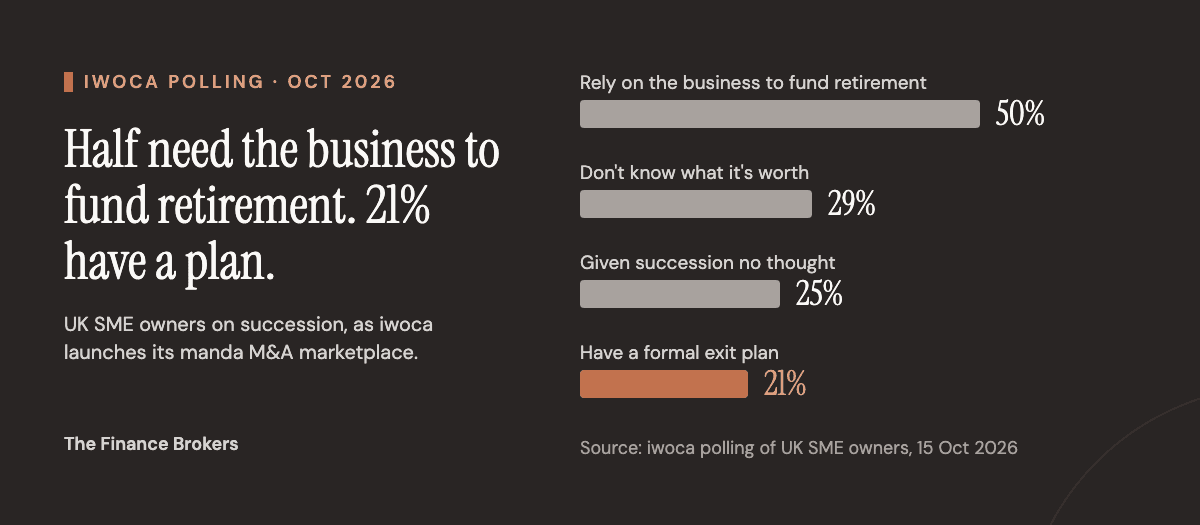
Half of UK small business owners expect their business to fund their retirement. Only 21% have a formal, documented plan for how they will get out of it.
Those two numbers come from new polling by iwoca, and the lender did not publish them as a warning. It published them to launch a product. On 15 October iwoca, best known for fast unsecured loans to small firms, opened manda, a marketplace for buying and selling small businesses. A lender building a business-sale platform is a signal worth reading: the next big source of SME borrowing demand may be ownership changing hands, not just cash flow.
What iwoca actually launched
According to iwoca's announcement on 15 October, manda works as a market maker rather than an adviser to one side. Owners who want to sell are matched with buyers that include search funds, family offices and private equity firms. Buyers are shown opportunities surfaced from iwoca's data on more than 100,000 SMEs, with due diligence drawn from bank feeds, filed accounts, VAT returns and payroll. Fees are charged only when a deal completes.
The platform went public after its first completed deal: the sale of roofing contractor TRC (Midlands) Ltd to TrueNorth Capital Group. No price or terms were disclosed.
Christoph Rieche, iwoca's chief executive and co-founder, framed it around the polling: "Our analysis shows the majority of small business owners have no formal succession plan for the business they've built."
The succession gap, in iwoca's numbers
The polling behind the launch is stark, even allowing for the fact that iwoca has not published its sample size or fieldwork dates:
- 21% of SME owners have a formal, documented succession or exit plan
- 25% have given succession no thought at all
- 73% of owners aged 55 to 64 have only a rough idea of what happens to the business when they step back
- 29% of owners aged 65 to 74 have a formal plan, fewer than a third
- 50% expect to rely on their business to fund their retirement
- 29% do not know what their business would be worth if sold today
The combination is the problem. A business that has to fund a retirement has to be turned into cash at some point, and the most common way that happens for a profitable small firm is a sale. An owner who has no plan and no idea of value is going into the biggest transaction of their working life without a price, a buyer or a timetable.
A sale only happens if the buyer can fund it
Every succession plan has a second half that the polling does not cover: the person on the other side of the table needs the money. A search fund or a private equity buyer may arrive with capital. A manager buying the firm they already run, a competitor buying a rival's customer book, or an individual buying their first business usually will not have the full price in cash.
That is where business acquisition finance comes in, and it rarely looks like a single loan. On the smaller deals we see, the funding is usually assembled from several sources:
- A term loan against the target's cash flow. The lender is underwriting the profits the business already makes, so clean, recent accounts matter more than anything else.
- Asset finance against equipment and vehicles. If the business owns plant, machinery or a fleet, those assets can carry part of the price on their own security, often at a better rate than the trading loan.
- A charge over property. Where the business owns its premises, a commercial mortgage on the building can be the cheapest money in the structure.
- The buyer's own contribution. Lenders want to see the buyer putting real money in.
- Money the seller leaves in. Deferred consideration, where the outgoing owner takes part of the price over time, is common on small deals. It closes the gap between what lenders will advance and what the business is worth, and it tells the lender the seller believes in the numbers.
Most smaller deals are structured as an asset purchase, where the buyer acquires the goodwill, equipment, customers and trading assets rather than the company itself. A share purchase buys the company with its history, liabilities included, and lenders underwrite it differently. Which structure is used affects what can be secured and how the funding is priced.
Two things surprise first-time buyers. Acquisition finance prices above straightforward secured lending, because the lender is backing someone to run a business they do not yet run. And it takes months, not weeks: lenders want to see the target's figures properly, and the legal work on an acquisition is slower than on a normal loan. Our guide to secured versus unsecured business loans explains why the secured route usually wins on larger sums.
Why a lender wants to be in the room
iwoca does not need to be an M&A firm to make money from manda. Every completed sale is a buyer who may need funding, and a business that, under new ownership, may need working capital, an asset facility or a refinance. A lender that sits at the point of sale meets that borrower before anyone else does.
That is the part of this launch the rest of the market should take note of. If half of owners are counting on a sale and four in five have no plan, the volume of small-business transfers over the next decade is a lending opportunity as much as an advisory one. Expect more lenders to look for a way into it.
What this means if you own, or want to buy, a business
If you are an owner thinking about an exit, the two numbers to fix first are the ones the polling found missing: a plan and a value. Lenders fund buyers on the strength of the target's accounts, so a business with up-to-date management figures, clean filings and a clear picture of its assets is easier to sell, and sells for more, because the buyer can borrow against it. If your likely buyer is your own management team, talk to them early; a management buyout funded partly by a lender and partly by deferred consideration is often the most realistic route for a profitable small firm.
If you are a buyer, start the funding conversation before you agree a price. Knowing what lenders will advance against the target's cash flow, assets and property tells you how much of the price you need to find yourself, and how much the seller will have to leave in. Picking the wrong lender wastes weeks you will not have once heads of terms are signed; our guide on how to pick the right lender covers how to shortlist.
Acquisition funding is case by case, with no standard rate card, which is exactly why it is worth comparing structures across lenders rather than taking the first offer. If you are buying or selling a business and want to know how the deal could be funded, get in touch and we will look at the options across our lender panel.