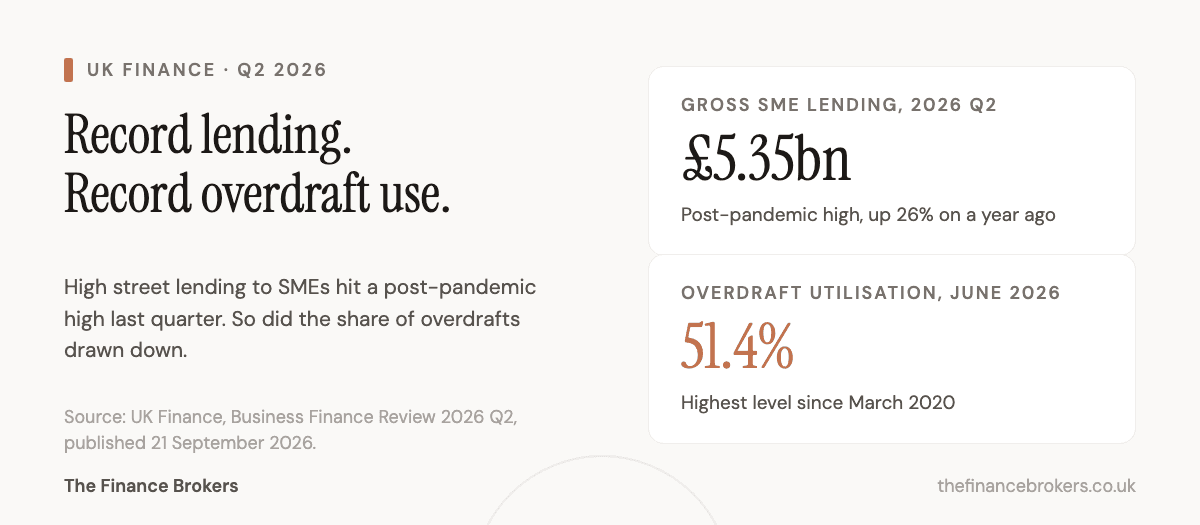
SME lending just hit its highest quarterly level since the pandemic. In the same three months, businesses drew down more of their overdrafts than at any point since March 2020.
Those two numbers landed in the same report, on the same page, and most of the coverage has run with the first one. The second is the one that tells you what is actually happening in SME cash flow right now.
UK Finance published its Business Finance Review for Q2 2026 on 21 September. Gross lending to SMEs by the main high street lenders reached £5.35 billion, more than 26 per cent up on the same quarter of 2025 and the fastest growth since the recovery began at the start of 2024. It is the tenth consecutive quarter of year-on-year increases.
Read on its own, that is a good news story. Read alongside the rest of the report, it is a more interesting one.
The number under the number
Overdraft utilisation reached 51.4 per cent in June, the highest level since March 2020. UK Finance records the increase across every sector it tracks, in both small and medium-sized firms, with the rise faster among medium-sized businesses.
Utilisation is the share of an agreed overdraft facility a business is actually using. It moves slowly, which is what makes a move worth reading. UK Finance noted the first material movement in two years only last quarter; this quarter it moved again.
And it did not move alone. The report shows most sectors also reduced current account balances compared with a year ago, with hospitality, construction, and transport and storage singled out as the sectors most likely to be drawing on existing resources to manage. Higher overdraft use and lower cash buffers in the same quarter is a working capital signal, not a growth signal.
That distinction matters if you are a business owner reading the headline and wondering whether the lending market has finally loosened up. Some of the £5.35 billion is expansion. Some of it is firms covering a gap.
Applications fell off a cliff in April
The most striking single figure in the review is not about lending at all. It is about demand.
UK Finance identifies a clear inflection point at the end of Q1 for both loan and overdraft applications, with a sharper drop in loan applications. Among medium-sized businesses, the value of loan applications fell by 40 per cent between March and April alone.
The cause, per the report, was confidence: escalating Middle East tensions, an energy price shock, and the prospect of interest rates rising again rather than falling. Oil above $100 a barrel does not appear on a lending application, but it appears in the decision to make one.
Approvals stayed positive year-on-year across both small and medium firms, so this is not lenders closing the door. It is borrowers pausing at the threshold. There was a small uptick in loan application volumes in June as ceasefire talks progressed, which is the same signal running in reverse.
For a broker, that is a familiar shape. Demand does not disappear in these moments, it defers. The deals that were shelved in April are the deals that come back, and they tend to come back all at once.
Who actually got the money
The sector picture in Q2 was, in UK Finance's own word, variable.
Real estate and professional services did most of the heavy lifting, with health and agriculture also contributing. Real estate in particular was a major driver of the quarterly increase, which is consistent with what we have been seeing in commercial mortgage and property lending through the year.
Against that, manufacturing and hospitality both went backwards. Gross lending in the first half of 2026 ran 6 per cent lower than a year ago in manufacturing and 1.5 per cent lower in hospitality. Lending to transport and storage, and to wholesale and retail, slowed while staying positive.
There is a warning attached. Manufacturing, construction, and accommodation and food also saw the largest declines in new finance approvals compared with the start of the year, which UK Finance suggests could signal another weak quarter of lending to those sectors in Q3.
The other split worth noting is by size. The very strong growth in lending to small companies reported in Q1 unwound in Q2, with the reversal particularly marked in manufacturing and in transport and storage. Lending to medium-sized firms, in aggregate, kept building momentum. Smaller firms felt the confidence shock harder, which is what usually happens.
The record is real. The context is that it is still a small number.
Here is the line that should sit next to every "post-pandemic high" headline: in real terms, lending by the main banks in the first half of 2026 was still about a third below the 2019 average.
Ten quarters of growth have not got the high street back to where it was before Covid. That is not a criticism of the banks in the data, it is a description of the hole the market has been climbing out of, and it is why the growth rate and the absolute level tell such different stories.
It also explains why so much of the actual funding now comes from elsewhere. We covered this in detail when non-bank lenders provided £34.4bn of new lending in H1 2026, and the Q2 review is the other half of that picture: the high street is growing from a reduced base, while the specialist and challenger market keeps expanding alongside it.
David Raw, managing director of commercial finance at UK Finance, framed the quarter this way: "The continued growth in SME financing since the pandemic is evidence of the sector's resilience and testament to the collaboration between banks and businesses." He also noted that amid continued geopolitical tension, small businesses' confidence inevitably took a bigger hit.
Both halves of that are in the data.
What we would take from this if we were running a business
Three practical reads.
An overdraft at 51 per cent utilisation is a warning light, not a facility. If your overdraft is where your working capital gap lives, it is expensive, it is repayable on demand, and it caps out exactly when you need headroom most. A structured facility sized to the actual gap is almost always cheaper. That might be an unsecured business loan, or, if the gap is in your debtor book rather than your trading, invoice finance releases cash you have already earned rather than adding new debt on top.
If you paused an application in the spring, the reason you paused has changed. Rate expectations, oil, and the geopolitical picture all moved through the summer. A decision made in April on April's information is not a decision, it is a snapshot. It is worth re-testing.
Sector matters more than it did a year ago. Real estate and professional services borrowers are walking into a market that wants their business. Manufacturing and hospitality borrowers are not, and the approvals data says that is likely to persist into Q3. The Bank of England's Q3 survey has since gone further, showing banks cut small-business credit for a second quarter while defaults held flat. That does not mean the funding is not there, it means the high street is not where it is. Knowing the difference between secured and unsecured routes, and which lenders are genuinely open in your sector this quarter, is worth more than a rate comparison.
The headline number is a good one. The report underneath it says a lot of UK businesses are funding today out of yesterday's cash buffer, and that is a solvable problem if you catch it early.
If your overdraft is doing a job it was never designed for, talk to us about what the alternatives actually cost. We work across more than 300 lenders, and the answer is very often not another bank.