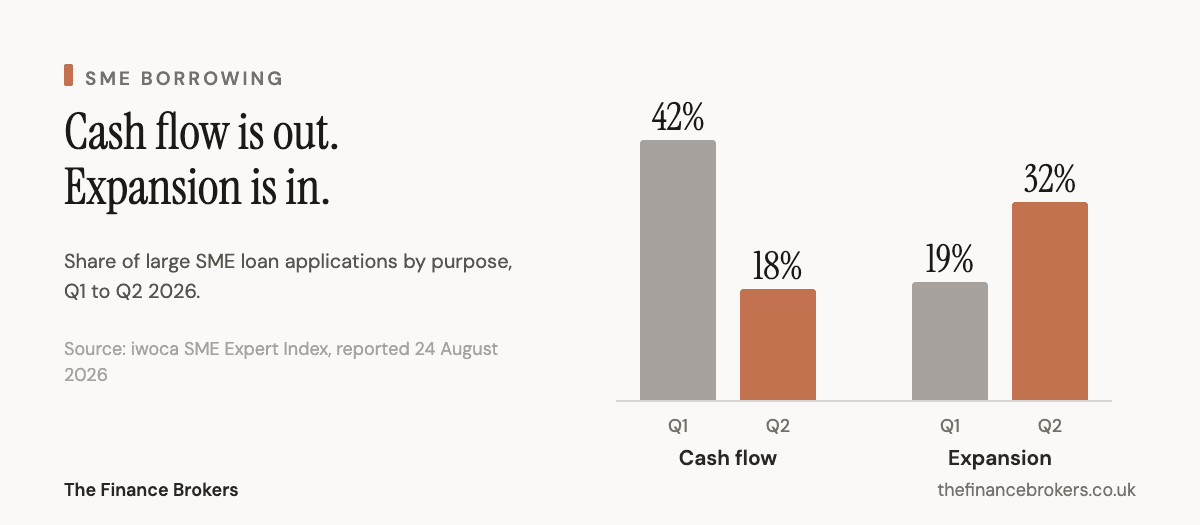
The share of large SME loan applications being used to cover cash flow fell from 42% to 18% in a single quarter. Over the same period, applications to fund expansion rose from 19% to 32%. That is not a change in how much British businesses are borrowing. It is a change in why.
The figures come from iwoca's SME Expert Index, a rolling survey of UK finance brokers, reported by Bridging & Commercial on 24 August 2026. Alongside them sits the headline the trade press led with: three-quarters of brokers expect SME demand for finance to rise over the next six months, the sharpest quarterly jump in that expectation since Q4 2022.
Volume forecasts are easy to shrug at. Brokers have expected demand to rise for most of the last three years, and they have usually been right without it telling anyone anything useful. The purpose split is the number worth stopping on, because it is the one that changes what a good funding conversation looks like.
Survival borrowing and growth borrowing are different products
A business borrowing to bridge a cash flow gap and a business borrowing to open a second site are not doing the same thing, even if the loan amount is identical.
Cash flow borrowing is defensive. It is usually urgent, usually short, and usually priced accordingly. The question a lender is really asking is whether the gap is timing or trend. Facilities that fit are flexible and revolving: an overdraft alternative, a short unsecured line, or invoice finance where the cash is genuinely tied up in unpaid receivables rather than lost.
Growth borrowing is the opposite shape. It is planned, it is longer, and the lender is underwriting a forecast rather than a shortfall. That opens up structures a distressed applicant cannot reach: term debt over three to five years, asset finance against the equipment or vehicles being bought, or a larger unsecured business loan priced off trading history rather than off urgency.
So a market where 32% of large applications are expansion-led rather than 19% is a market where more businesses qualify for better money. That is the real content of the number.
What else the Index says
The rest of the survey is consistent with a confidence story rather than a credit story:
- Broker-reported client recession concern fell to 46%, down from 54% in Q1 2026
- The share of brokers saying clients are not worried about recession rose to 11%, from 8%
- Nearly two-thirds of brokers now expect year-end inflation at 3% or below
Mark Di-Toro, iwoca's director of strategic communications, put it plainly in the coverage: "Small business optimism is showing early signs of recovery. Recession fears are easing and three-quarters of brokers expect SME demand for finance to rise."
A month ago we wrote about the same Index from a different angle, when iwoca raised £250m to serve the £50,000 to £100,000 loan band that had jumped from 27% to 42% of applications in a year. Read together, the two readings say something more specific than either does alone: the mid-sized ticket is growing, and the money is increasingly going into the business rather than plugging a hole in it.
The number that does not fit the mood
We would not be doing our job if we left it there, because a second dataset published the same week points the other way.
BTG's Red Flag Alert for Q2 2026, published on 21 August, found 53,756 UK businesses in critical financial distress, up 9.0% year on year, with a further 674,030 in significant distress. Leisure and cultural businesses were up 27.1%, hotels and accommodation up 26.6%, and real estate and property services up 9.0%.
Julie Palmer, managing partner at BTG, described businesses as "walking a tightrope as we move through the second half of 2026". Ric Traynor, its executive chairman, noted that insolvency rates lag distress, so the effects could land in 2027.
Both things are true at once, and that is the actual state of the market rather than a contradiction. Confidence is recovering unevenly. A manufacturer with a full order book and a hospitality operator carrying two years of cost inflation are reading completely different economies, and a national average sits somewhere between them that describes neither.
What it means in practice is that "the market is more confident" is not a fact you can borrow against. Your own numbers are.
What a borrower should take from this
Three practical points from our side of the table.
1. Ask for the facility that matches the purpose, not the amount. The most common expensive mistake we see is a business that needs £150,000 for a growth project asking for "a business loan" and being quoted short-dated working capital pricing, because that is the default shape of an unsolicited enquiry. Lead with what the money is for and over what horizon. It changes which lenders are even in the conversation.
2. If you are genuinely in the growth camp, the paperwork changes. Cash flow lending is underwritten on recent trading. Growth lending is underwritten on a plan. That means management accounts that are current, a forecast you can defend line by line, and a clear statement of what the borrowed money buys and when it starts paying for itself. Our guide on how to get an unsecured business loan covers what lenders actually look at.
3. Do not assume unsecured is the right answer just because it is quickest. If the borrowing is funding a physical asset, asset-backed structures are usually cheaper and preserve your unsecured headroom for the next thing. Our note on secured versus unsecured business loans sets out the trade-off, and the unsecured business loan glossary entry covers the basics if the term is new to you.
There is also a timing point worth naming. If three-quarters of brokers are right and demand does rise sharply over the next six months, the businesses that arrive with clean, current numbers will be the ones that get looked at properly. Lender appetite is real, but underwriting capacity is finite, and a rushed application in a busy market gets the answer a rushed application deserves.
Where we sit on it
We would treat this Index as a genuine signal rather than a mood swing. A purpose split moving more than twenty points in a quarter is a large move in a slow-moving series, and it is corroborated by the loan-size data we wrote about last month.
We would also hold the Red Flag numbers next to it. Roughly 53,000 businesses in critical distress is not a rounding error, and the sectors carrying it are the ones where a growth-framed application will be tested hardest.
One practical footnote on where you ask. Since this Index was published, the same lender has been embedding that application inside software businesses already use, and a card machine can now approve a term loan of up to £1m in minutes. Convenient, and worth understanding before it becomes the default.
The official quarterly data has since caught up with the same tension. UK Finance's Q2 2026 Business Finance Review records record gross lending alongside overdraft utilisation at a six-year high, which is the growth-versus-survival split showing up in the national numbers rather than one lender's book: SME Lending Hit a Post-Pandemic High. So Did Overdrafts.
If your borrowing is about growth rather than survival, this is a reasonable market in which to ask. If you are not sure which of the two you are in, that is worth a conversation before you approach a lender rather than after, because the answer determines which door you should be knocking on. We are happy to have it either way.