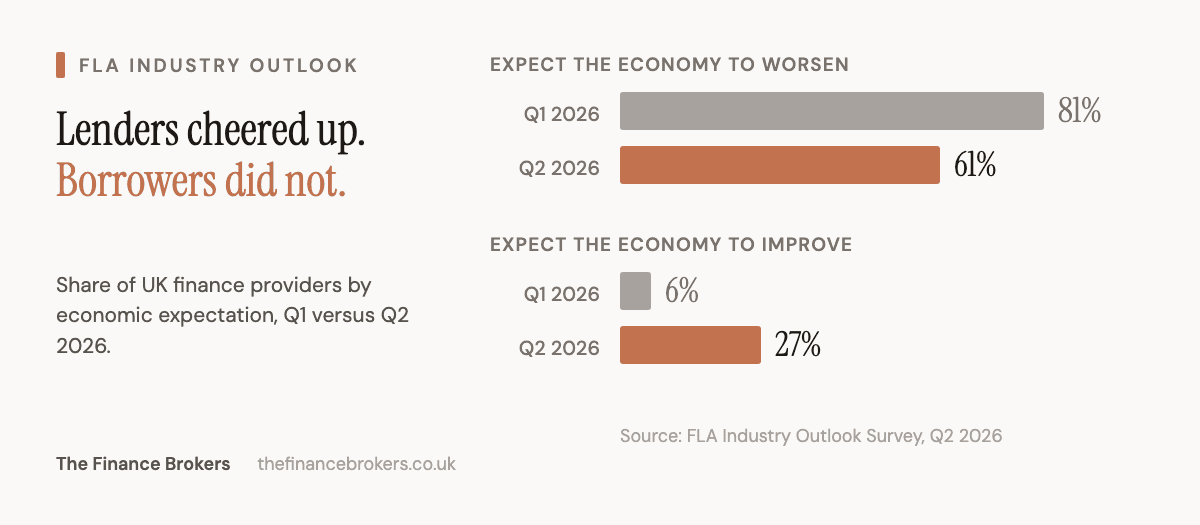
The people who lend money to British businesses have quietly cheered up. In the first quarter of 2026, 81% of UK finance providers expected the economy to get worse. Three months later that had fallen to 61%, and the share expecting it to improve went from 6% to 27%. Nearly two thirds now expect to write more business over the next year.
Their customers have not had the same quarter. Separate research published in the same fortnight put a number on it: £54bn of revenue that UK SMEs did not earn, because they did not have the confidence to go and get funded.
Two surveys, two moods, one market. That gap is the most useful thing in UK business finance right now, because it is not a credit problem. It is an information problem, and information problems are fixable.
What actually changed on the lender side
The FLA's Q2 2026 Industry Outlook Survey, reported on 5 and 6 August, is a survey of the firms that supply finance rather than the businesses that use it. Its members provided £163bn of new finance to UK households and businesses in 2025, so this is not a fringe sample.
Almost every line moved the right way:
- Expecting the economy to deteriorate: 81% to 61%
- Expecting it to improve: 6% to 27%
- Expecting their own new business to grow over 12 months: 63%
- Expecting business insolvencies to rise: 87% to 79%
- Expecting their own funding costs to rise: 78% to 63%
- Expecting funding availability to stay stable: around two thirds
Geraldine Kilkelly, the FLA's director of research and chief economist, put it plainly: "confidence has improved since the start of the year." She also noted members are spending the current cycle investing in technology, automation and risk processes rather than battening down.
Read that last point again, because it is the one with teeth. When a lender expects its own cost of funding to stop rising and its own volumes to grow, it does two things. It widens criteria at the edges, and it competes harder on the deals it already wanted. That is a borrower's market forming, and it forms quietly, months before anyone writes a headline about it.
It also fits what we have been seeing in the data all year. Bank lending to SMEs sat at a 30-year low as a share of the market while specialists went the other way, and lenders like iwoca have been raising capital specifically to serve the £50,000 to £100,000 band the high street stopped underwriting properly. The money did not leave. It changed hands.
What did not change on the borrower side
Now the other survey. Broker-lender Portman Finance Group polled 2,000 UK SMEs for a report it calls The Cost of Misconfidence, and the results were picked up across the trade press in the last week.
The headline figure: 30% of businesses said they had missed a growth opportunity because of a lack of external finance, and those firms put the average cost at over £73,000 each. Extrapolated across the UK SME population, that is roughly £54bn of forgone revenue, or about 2% of annual GDP.
The reasons underneath it are the interesting part:
- 40% of firms that considered external finance either took less than they set out to raise, or dropped the application entirely
- 52% do not have complete or high trust in high street banks for business finance advice
- 53% find the business finance market confusing
- 66% say they would be more likely to borrow if they understood the options better
- 20% did not apply at all because they expected to be rejected
None of those are rate problems. Only one of them is even a lender problem. Four in five of the barriers on that list are a comprehension gap, and the last one, fear of rejection, is a comprehension gap wearing a disguise.
The one in five that never applied
That 20% deserves its own paragraph, because it is invisible in every official lending statistic in the country.
Approval rates only count applications. A business that talks itself out of applying never appears in a rejection figure, never appears in a bank's decline data, and never appears in the Bank of England's lending numbers. It simply does not buy the second van, does not take the contract that needed a stock build, does not hire.
We see the same shape from the other direction. Shawbrook's research found 22% of mid-sized firms had lost a deal outright because funding took too long. Same underlying mechanic: the finance was available, the process was the obstacle, and the business ate the cost silently.
Why the market feels confusing (because it genuinely is)
There is no conspiracy here. UK business finance is confusing because it is fragmented, and it is fragmented because that fragmentation is what replaced the bank branch.
A firm that needs £80,000 might be best served by an unsecured business loan, by invoice finance against its sales ledger, by asset finance if the money is going into equipment, or by a combination that costs materially less than any one of them alone. Those four routes have different pricing conventions, different security requirements, different speeds and almost no shared vocabulary. A borrower comparing them is not comparing like with like, and they know it, which is exactly why 53% call the market confusing and 40% take less than they need.
Two practical points cut through most of it. First, secured and unsecured are not a straight rate trade: what you are really trading is speed, personal exposure and how much of your balance sheet stays free for the next facility. Second, most of the "will I be rejected" anxiety is answerable before anything touches your credit file, because the criteria that actually decide an unsecured application are knowable in advance.
The window is the point
Put the two surveys side by side and the read is straightforward.
Lenders expect their funding costs to stabilise and their volumes to grow. Two thirds expect funding availability to hold steady. That is the environment in which appetite widens and pricing sharpens. Meanwhile a third of SMEs are sitting out growth opportunities, and by their own account it is confusion and expected rejection doing it, not cost.
Windows like that do not stay open indefinitely. Sentiment surveys turn, and 61% of finance providers still expect the economy to weaken, so nobody should mistake this for a boom. But the practical implication for a business owner is simple enough: the reason to test the market this quarter is that the supply side is leaning forward and most of your competitors have not noticed.
The FLA's half-year lending figures, published the day after this survey, put a number on how misplaced the caution is: of the £84.3bn its members advanced in the first six months of 2026, £34.4bn came from lenders that are not banks. The capacity is real and already deployed.
Since this survey, broker-reported sentiment has begun to close the gap from the borrower side: cash flow fell from 42% to 18% of large SME loan applications while expansion rose to 32% in a single quarter, which is what a confidence recovery looks like in the application data rather than in a sentiment score.
If you are one of the 66% who would borrow with a clearer picture of the options, that picture takes about twenty minutes to build. We price the same requirement across 300+ lenders rather than one balance sheet, and we will tell you when the honest answer is that you do not need the facility at all. Tell us what you are trying to fund and we will show you what the market says.