Business Borrowing From Banks Just Fell 76% in a Month. Don't Panic.
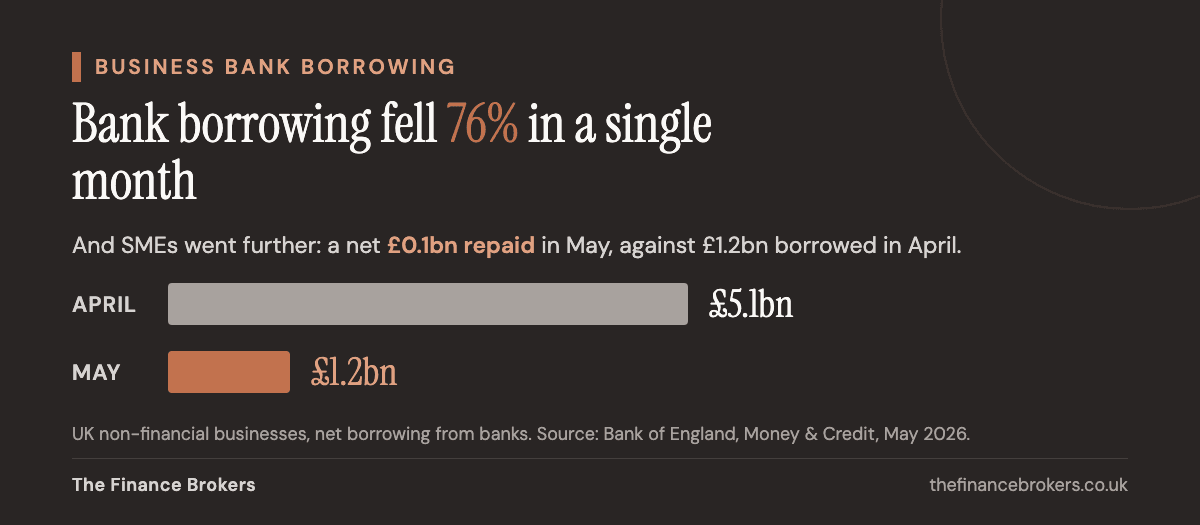
In April, UK businesses borrowed a net £5.1bn from the banks. In May, that number fell to £1.2bn. Small and medium-sized firms went one step further: they did not borrow at all. They repaid.
That is the headline from the Bank of England's Money and Credit release for May 2026, published on 29 June. Read on its own, a 76% month-on-month drop in business bank borrowing, with SMEs swinging to a net repayment, looks like the opening line of a credit-crunch story. It is not. The money did not dry up. It moved.
What the BoE numbers actually say
UK non-financial businesses borrowed a net £1.2bn from banks in May, down sharply from £5.1bn in April. Within that, SMEs made a net repayment of £0.1bn, after borrowing a net £1.2bn the month before. Large businesses kept borrowing, taking £1.3bn. The annual growth rate of SME borrowing eased to 3.9%, from 4.2% in April.
A month ago, we wrote that SME borrowing had accelerated even with the base rate frozen at 3.75%. May flipped that. So before anyone reaches for a recession narrative, it is worth being honest about what a single month of these figures can and cannot tell you.
Monthly net borrowing is a volatile series. It nets new lending against repayments, so a quiet month for new facilities combined with a normal run of scheduled repayments can tip the whole number negative without a single business being turned away. A £0.1bn net repayment across the entire UK SME population is, in cash terms, a rounding error. What it is not is evidence that funding has been switched off.
The housing market tells the same "caution, not collapse" story
The mortgage data points the same way. Net mortgage approvals for house purchase fell to 56,200 in May, down almost 15% from 66,034 in April and below the 63,300 six-month average. The effective rate on new mortgages ticked up to 4.22%.
Households are clearly being more deliberate about big commitments, and so are businesses. But deliberate is not the same as distressed. Lloyds' June Business Barometer showed overall confidence easing, yet firms' optimism about their own trading prospects held close to its 12-month average, and hiring intentions actually rose for the first time in three months. Companies that are planning to hire are not companies that have stopped investing. They are companies choosing their funding more carefully.
Where the money went
Here is the part the bank-lending headline misses. The Bank of England series measures borrowing from banks and building societies. It was never designed to capture the market that now does most of the work.
According to the British Business Bank's Small Business Finance Markets Report 2026, specialist and non-bank lenders together now provide 68% of gross SME lending, up from 39% in 2012. Challenger banks alone account for 60% of the market. Gross SME lending hit £68bn in 2025, up 9% and the second-highest annual total in over a decade, with net lending of £4.6bn, the first positive net figure since 2020. Crucially for anyone reading this, broker-facilitated lending rose 25% to £33bn.
So when the high-street bank line goes flat for a month, it does not follow that SMEs have stopped funding their growth. A growing share of that funding simply never appears in the headline bank-borrowing number, because it comes from invoice financiers, asset lenders, challenger banks and non-bank specialists.
As we covered when bank lending to SMEs hit a 30-year low, this is a structural shift, not a blip. Louis Taylor, chief executive of the British Business Bank, has been clear that while there is "some willingness for the big street banks to reduce market share loss", there are still "holes in the system" for smaller loans and early-stage firms. Those holes are exactly what specialist lenders have spent a decade filling.
The lenders filling them are not shy about why it matters. Christoph Rieche, CEO and co-founder of iwoca, recently argued that "small businesses with real potential are being held back because many can't access the finance they need." His firm's own data makes the point: businesses that took iwoca funding were 70% more likely to still be trading after three years than the wider UK business population. Janine Hirt, chief executive of Innovate Finance, put the shift more bluntly still: specialist lenders "are no longer a fringe option."
What this means if you run a business
If you are an SME owner who looked at the May figures and felt a chill, take a breath. The picture is not "nobody is lending." It is "the banks are doing less of it, and the rest of the market is doing more."
That changes the question you should be asking. It is no longer "will my bank say yes?" It is "which type of lender is right for what I actually need?" A short-term cash-flow gap and a five-year equipment purchase are different problems with different answers:
- Working capital and cash-flow gaps are often better served by an unsecured business loan or a flexible credit line than by waiting on a bank overdraft decision. If you are weighing the trade-offs, our guide to secured versus unsecured business loans walks through when each makes sense.
- Outstanding customer invoices tying up your cash can be turned into funding through invoice finance, without taking on new debt at all.
- Vehicles, plant and equipment are usually best financed through asset finance, which spreads the cost against the asset itself rather than your general borrowing capacity.
The reason this matters is that a single bank rejection, or a quiet month in the BoE data, tells you almost nothing about whether your business can be funded. It tells you about one channel, in one month. With specialist and non-bank lenders now behind more than two-thirds of SME lending, the relevant market is far wider than the one most owners think to approach.
That is the case for working with a whole-of-market broker. We are not tied to a single balance sheet, so when one channel tightens we look across the other 300-plus lenders we work with. The May numbers are a useful reminder that the money for good UK businesses has not gone anywhere. It has just moved to lenders you may not have heard of, and finding the right one is most of the job.
Wondering whether an unsecured loan, invoice finance, or asset finance fits your next move? Talk to The Finance Brokers. We place deals across 300+ lenders and find the funding the high street misses.