SME Borrowing Accelerated in April, While the Base Rate Stayed Frozen
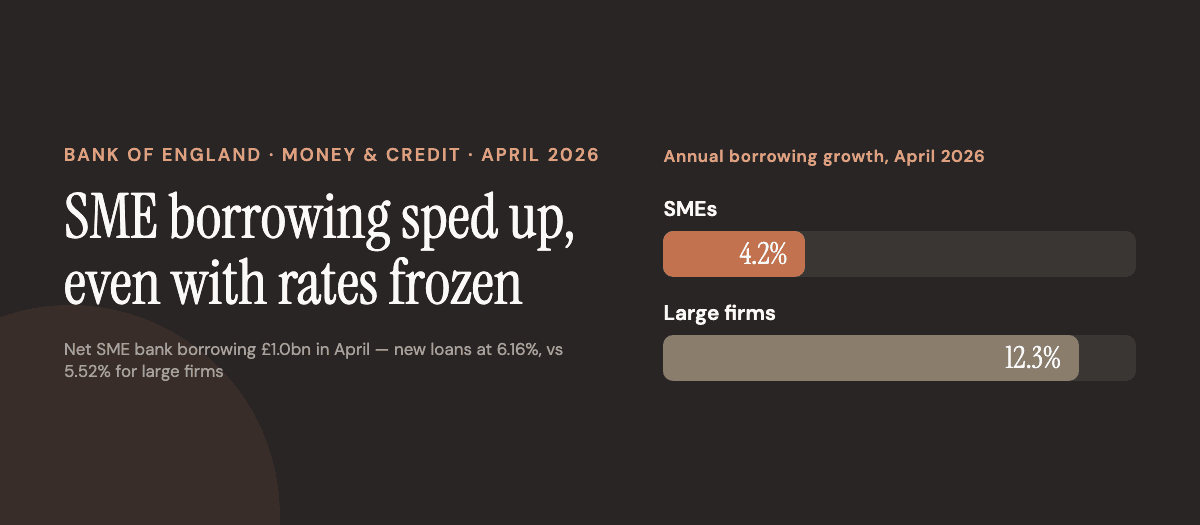
This morning's Bank of England data carries a number that cuts against the mood music. UK small and medium-sized businesses borrowed a net £1.0bn from banks in April, up from £0.8bn in March, and the annual growth rate of SME borrowing accelerated to 4.2%, from 3.7%.
That is not what most lenders expected to see. The base rate has been frozen at 3.75% since December. The price of new bank credit for SMEs actually rose in April: the effective interest rate on new SME loans ticked up 5 basis points to 6.16%. And just three weeks ago, the brokers who place this lending were telling iwoca they expected demand to cool, not climb.
It climbed anyway. Here's what the April Money and Credit release actually shows, and why the headline rate is the wrong number for any SME to be watching.
A two-speed credit market, in four numbers
Strip the release down to business lending and a clear split appears between large corporates and everyone else:
| Metric (April 2026) | SMEs | Large businesses |
|---|---|---|
| Net bank borrowing | £1.0bn | £4.2bn |
| Annual growth rate | 4.2% | 12.3% |
| Direction vs March | Accelerating | Accelerating |
| Effective rate, new loans | 6.16% | 5.52% (all PNFCs) |
Large businesses are borrowing at nearly three times the annual pace of SMEs, and they're doing it more cheaply. The effective rate on new loans to all private non-financial corporations held at 5.52%, while the SME-specific rate rose to 6.16%, a gap of roughly 64 basis points that smaller firms pay simply for being smaller.
None of that is a surprise on its own. What's notable is the direction: with the base rate flat, you'd expect new-loan pricing to sit still. Instead SME pricing edged up while big-corporate pricing held, and SME borrowing volumes grew regardless. Demand, not the cost of money, is doing the work here.
The sentiment said one thing. The data said another.
The interesting tension is with what the market was forecasting. In iwoca's quarterly survey of UK finance brokers, conducted across April and May, 22% of brokers expected demand for finance to fall, the highest reading since the tracker began in 2022. The share forecasting demand to rise dropped to 57%, down from 74% in Q4 2025. The caution was real: 54% of brokers cited running costs as SMEs' top concern, and 70% flagged rising energy prices.
"These numbers reflect what we are hearing from brokers: small businesses are worried, and the concerns are stacking up," said Colin Goldstein, iwoca's UK Chief Commercial Officer, on the survey's release.
And yet the realised April figures show borrowing accelerating. The two can both be true. Worried businesses still borrow, often because they're worried. When running costs climb and customers pay late, working capital becomes the thing that keeps the lights on, not an optional bet on expansion. The BoE's own agents have noted that where SMEs are borrowing, it's tilted toward refinancing and working capital rather than expansion. That is defensive borrowing, and it shows up in the data as growth all the same.
Why the headline rate is the wrong number
Here is the practical takeaway for any business owner reading the rate-decision headlines. The base rate at 3.75% tells you almost nothing about what you'll actually pay. The realised number, 6.16% on new SME bank loans in April, sits 2.4 percentage points above base, and that's just the average. The spread you personally get is set by where you borrow, how you borrow, and how your application is presented.
That spread is wide. The same business can be quoted materially different rates depending on whether it walks into a high-street bank, approaches a challenger directly, or runs a whole-of-market search across unsecured, secured and asset-backed options. High-street banks are still the most expensive route to a "no": rejection rates remain elevated and each decline costs weeks. Challenger banks and non-bank lenders now hold the majority of the SME market, and they price on different logic, often rewarding the trading data a bank's automated credit committee never looks at.
Three behaviours close the gap between the headline rate and the rate you actually pay:
- Don't anchor to the base rate. A 25bps cut or hold from the Bank of England is noise next to the 64bps SME premium and the far larger spread between the cheapest and most expensive lender for your profile.
- Match the product to the need. A term loan isn't always right. Secured or asset-backed lending can be cheaper where you have the collateral, and invoice finance turns 60–90 day terms into same-day cash without touching property security. The product, not the lender, drives the rate.
- Apply to the whole market at once, not one bank at a time. A modern SME loan application puts your profile in front of 20–30+ suitable lenders simultaneously, on a soft search, so you compare real offers on total cost rather than burning weeks collecting individual rejections.
What April is really telling us
The story under the data is continuity, not reversal. SMEs are borrowing more, and growing that borrowing faster, even as sentiment sours and new-loan pricing creeps up. The capital is clearly available: net SME lending has now been positive and accelerating into a high-rate hold. What's uneven is the price, and price is the one variable a borrower can actually influence.
For context, this is landing on top of the structural shift we wrote about in April: challenger banks and non-bank lenders now hold the majority of SME lending, and the firms growing fastest (Allica, iwoca, Funding Circle, OakNorth) are the ones most SME owners still haven't built into their finance search. April's numbers don't change that picture. They sharpen it. Demand is holding up; the only question is whether you're accessing it at 6.16% or well above.
Getting started
If you're weighing up business borrowing in the second half of 2026, the first move isn't to pick a lender: it's to see what the whole market will offer for your situation. We work with Allica, OakNorth, Funding Circle, iwoca and 300+ other UK business lenders as a whole-of-market broker, with no upfront fees and a soft-search-first process that doesn't mark your credit file while we shop.
Get in touch for a free consultation and we'll come back within 24 hours with indicative terms from the lenders most likely to approve your profile at the keenest price.
Further reading: Bank Lending to SMEs Just Hit a 30-Year Low · How to Get an Unsecured Business Loan in the UK · Secured vs Unsecured Business Loans · What is an Unsecured Business Loan? · Allica Grew SME Lending 23% While High Street Banks Reject 56% · The April SME Cost Squeeze · Every Big Four Bank Has Exited Invoice Factoring · SMEs Repaid the Banks in May