A Distillery Borrowed £11m Against Unsold Whisky
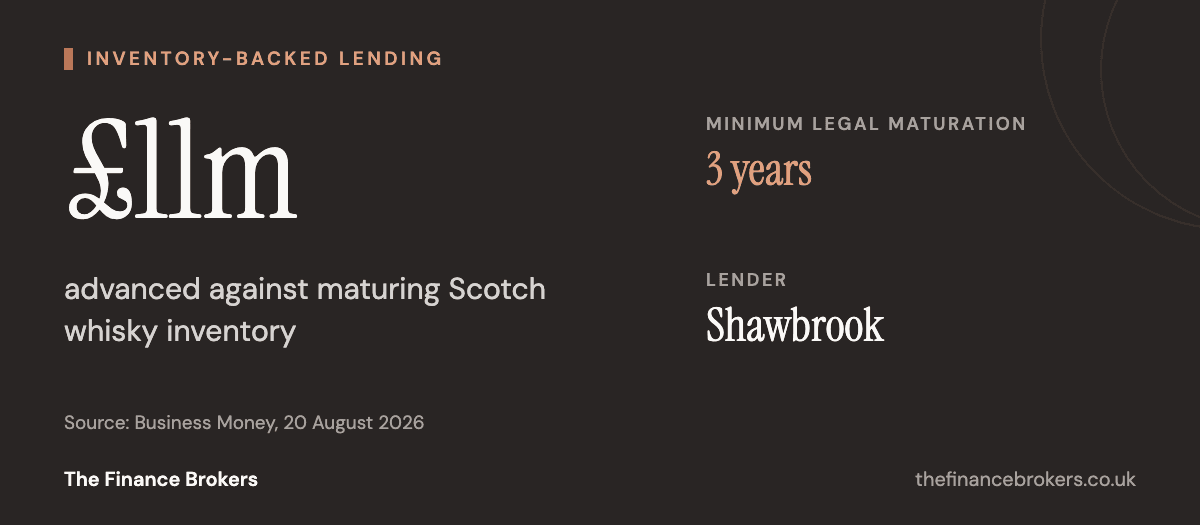
A Glasgow distillery has just raised £11m against whisky it is not legally allowed to sell yet. On 20 August, Shawbrook provided Glasgow Distillery Company with an £11m inventory-backed asset based lending facility, secured against its eligible maturing Scotch inventory. That is the whole story in one line, and it is worth sitting with, because most owners of stock-heavy businesses have been told for years that their stock is not fundable.
It is fundable. It is just rarely offered.
What was actually lent, and against what
The facility refinances Glasgow Distillery's existing funding and releases additional working capital on top. The security is not property, not the debtor book, and not plant. It is casks of whisky sitting in a warehouse, years away from a sale.
Mike Hayward, co-founder of Glasgow Distillery Company, put the problem plainly: "As an independent distiller, significant value is created long before every bottle reaches the shelf. Shawbrook understood our business model and the characteristics of whisky maturation, structuring a facility that unlocks working capital and enables us to invest in production, expand our inventory and continue delivering exceptional spirits to customers around the world."
Jeremy Bolton, senior director of asset based lending at Shawbrook, described the underwriting work behind it: "By taking the time to understand both the business and the value of its maturing whisky inventory, we were able to structure a funding solution that provides flexibility today while supporting its long-term growth strategy."
Noble & Company introduced the deal and Addleshaw Goddard provided legal support.
The three-year problem
Whisky is an unusually clean illustration of a problem thousands of UK businesses share. Under the Scotch Whisky Regulations, spirit cannot be called Scotch until it has matured in oak casks in Scotland for at least three years. So a distiller spends cash on barley, energy, casks, labour and warehousing, then waits years before a single bottle can legally be sold. The value is real, it is growing, and it is completely illiquid.
The scale of what sits in those warehouses is not trivial. The Scotch Whisky Association reported exports of £5.4bn in 2024, the equivalent of around 1.4bn 70cl bottles. Every one of those bottles spent years as an unsellable asset on somebody's balance sheet first.
Strip out the romance and the same shape turns up across the economy:
- A furniture maker holding six months of finished goods for a seasonal order book
- A wholesaler who has to buy a full container to get the unit price that makes the margin work
- A food producer carrying ageing stock (cheese, charcuterie, wine) by the nature of the product
- An importer whose cash is sitting on a ship for five weeks
- A parts distributor whose whole proposition is next-day availability from stock
In every case the business looks cash-poor on a bank statement and asset-rich in the warehouse. The conventional answer is an unsecured loan against the trading record, which is smaller, shorter and dearer than the stock actually justifies.
That mismatch between a good business and a bankable shape is the same one behind eight new products for the cases banks keep declining, a specialist commercial suite built backwards from the deals mainstream credit policy turns away.
Why most lenders wave stock away
Stock is harder to lend against than invoices, and the reasons are honest ones. An invoice is a debt owed by a third party with a due date. Stock is an asset whose value depends on whether anyone still wants it, what it would fetch in a hurry, and whether it survives being moved. Lenders think about obsolescence, perishability, title, location, insurance and what a forced sale would realise.
Which is exactly why the interesting variable in the Shawbrook deal is not the money. It is the phrase "eligible" inventory. Somebody had to form a view on how maturing Scotch behaves: that it appreciates rather than depreciates, that it is fungible and independently valuable, that there is a functioning market in casks, and that the warehousing arrangements can be verified. That is underwriting work, not box-ticking, and it is the reason inventory lines are concentrated among specialist asset based lenders rather than sitting on a high-street product sheet.
Asset based lending is the family this belongs to. It usually starts with the debtor book, the same core asset as invoice finance, and then extends the facility across other business assets: plant and machinery, property, and, when a lender is willing to do the work, stock. UK Finance, which represents the sector, says its invoice finance and asset based lending members provide well over £20bn at any one time to tens of thousands of UK client businesses, supporting businesses whose combined annual turnover topped £315bn in 2024.
Read those two numbers together and the gap is the story. Tens of thousands of client businesses, against a UK business population in the millions. This is not a marginal product with a small addressable market. It is a well-established product most eligible businesses have never been walked through.
Who is actually writing these facilities
It will not surprise anyone who has followed this market for the last few years that the £11m came from a specialist rather than a clearing bank. We have written about the high-street retreat from working capital repeatedly: banks walking out of invoice factoring, bank lending to SMEs at a 30-year low, and £34bn of new lending in the first half of this year coming from non-bank lenders.
Inventory finance is the sharp end of that pattern. It is the product that most rewards a lender for understanding a specific industry, and it is therefore the product a generalist credit committee is least equipped to price. The same logic is visible in the consolidation now running through specialist SME lending, including the £650m platform being assembled out of Time Finance and Ultimate Finance: scale in these products comes from concentrated expertise, not branch networks.
What to do if your cash is sitting in a warehouse
If a material share of your working capital is tied up in stock, a few practical points from our side of the table:
- Get the stock data in order first. Ageing, turnover by SKU, gross margin, location and a defensible valuation basis. An inventory line lives or dies on whether a lender can trust your stock reporting, and monthly reporting is usually a condition of the facility.
- Expect a blended facility rather than a pure stock loan. In practice the debtor book usually carries most of the advance and stock extends the headroom. That is normal, and it is still more capital than a receivables-only line.
- Understand what "eligible" will exclude. Slow-moving lines, consignment stock, work in progress and anything with a short shelf life will typically be carved out or heavily discounted.
- Do not benchmark it against an unsecured loan. These are different instruments. Compare total available headroom and how the facility flexes with your trading cycle, not just the headline rate. Our guide on secured versus unsecured business loans sets out the trade-off, and how to get an unsecured business loan covers the alternative if your stock genuinely will not support a line.
- Ask specifically for stock to be assessed. This is the one that costs businesses the most. If you approach a lender for "a business loan", you will be quoted a business loan. Inventory capacity has to be asked for, and not every lender has an appetite for it.
The useful lesson from an £11m facility secured on whisky is not about whisky. It is that the boundary of what counts as security is set by which lender is looking at it, and how well they understand what you actually own. A distiller with barrels, a wholesaler with a container and a manufacturer with a finished-goods warehouse are all in the same position: holding real value that their bank statement does not show.
If your cash is sitting in stock rather than in the bank, it is worth finding out what a lender who understands your inventory would actually advance against it. That is a conversation about secured business lending and, where goods are still in transit, about trade finance. We are happy to have it, whether or not it ends in a facility.