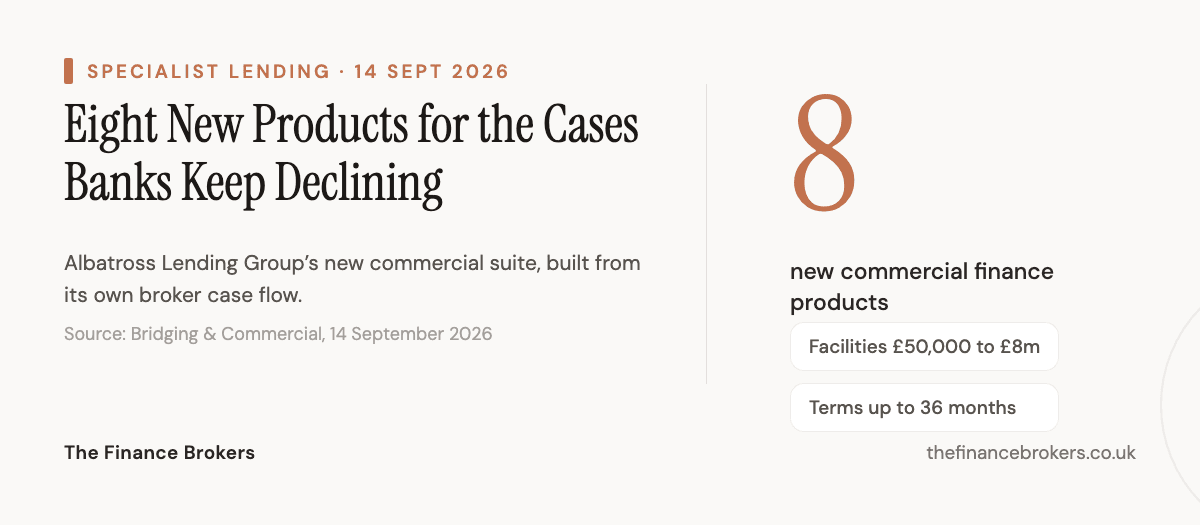
A specialist lender launched eight commercial finance products this morning. Read the list as a product range and it is unremarkable. Read it as a list of the reasons a high street bank says no, and it is one of the clearest maps of the UK commercial lending gap published this year.
Albatross Lending Group launched its commercial suite on 14 September, less than a year after entering the commercial market. Eight products, facilities from £50,000 to £8m, terms up to 36 months on selected lines. The launch was independently reported the same day by The Intermediary.
What makes it worth an article rather than a paragraph is where the products came from. The lender says it built them from the cases actually coming through its own team, plus broker feedback, rather than from a strategy deck. That makes the range something close to a live census of the deals the mainstream market is turning away.
The eight, and what each one is really answering
Here is the suite, with the decline reason each product exists to solve.
Albatross Consolidate is commercial debt consolidation for fundamentally sound owner-occupier trading businesses, bringing multiple secured or unsecured facilities into a single first-charge structure. The decline reason: a business that has accumulated four or five separate facilities over a few years does not present as a clean single-loan proposition, and consolidating them is exactly the sort of restructure a mainstream credit policy tends to refuse.
Albatross Stabilise is for viable owner-occupier businesses that need time to build the trading history a mainstream refinance requires, with terms up to 36 months. The decline reason is stated openly in the product name: you are not bankable yet, and the market's usual answer to that is to come back in two years.
Albatross Expand funds growth for established owner-occupiers, whether through equity release from existing premises or towards acquiring an additional trading site.
Albatross Scale runs from £2m to £8m for established, profitable owner-occupied businesses needing larger specialist funding. Note where that band sits. It is above the size most challenger banks treat as routine and below the size that gets a dedicated corporate relationship team.
Albatross Bespoke is individually structured finance for sound owner-occupied deals that fall outside the standard range: unusual circumstances, mixed purposes, complex structures. Every specialist lender needs this line, and its existence is an admission that no criteria grid catches every good deal.
Albatross Yield is asset-led bridging against income-producing commercial investment property, and Albatross Mixed-Use is a dedicated route for mixed-use and semi-commercial assets. Semi-commercial is a perennial orphan: too commercial for a residential lender, too residential for a commercial one.
Albatross Third Party is cashflow lending to qualifying limited companies where suitable unencumbered residential property can be provided as third-party security. This is the one most banks will not write at all, because the security sits outside the borrowing entity.
The pattern: it is not the borrower, it is the box
Line those eight up and a single theme runs through them. Not one of these products exists because the underlying businesses are bad credit. They exist because the businesses are the wrong shape for an automated criteria grid.
Lewis Casserley, co-founder and principal of Albatross Lending Group, put the commercial logic plainly: "The market's response gave us the confidence to go further. When we launched into commercial lending last year, the intention was never to stand still." He was explicit that this is not a criteria tweak. "This isn't simply a criteria refresh; we've built eight clearly defined specialist products, each responding to a distinct commercial funding requirement we're seeing through our broker network."
His co-founder Jordan Fearnley-Brown framed the same point from the underwriting side: the expansion is "about giving Albatross the range to say yes to a much wider set of commercial cases, without diluting how we underwrite them."
That distinction, between widening the range and loosening the credit, is the part borrowers most often get wrong. A specialist product is not a lower bar. It is a different question being asked about the same business.
The same week, the same shape, from two other directions
This would be easier to dismiss as one lender's marketing if it were happening in isolation. It is not.
Four days earlier, Luke Watson, director of intermediary sales and lending at Recognise Bank, made the argument directly in Mortgage Solutions: "Deals that don't fit neatly into rigid automated criteria boundaries are often declined before anyone has taken the chance to understand the opportunity and motivations behind them." That is a lender describing the market's default failure mode, and it matches the Albatross product list almost line for line.
On the same day, Together funded a dairy farmer consolidating six separate loans into a single £1.4m bridge, specifically to make repayment manageable. That is Albatross Consolidate as a completed deal, at a different lender, in the same week. When two unconnected lenders productise the same problem inside seven days, the problem is structural rather than anecdotal.
The macro backdrop supports the read. The Bank of England's Credit Conditions Survey for 2026 Q2, published on 2 July, reported that credit availability slightly decreased for small and medium businesses in the quarter, with overall availability expected to be unchanged in Q3. Supply from the mainstream is flat to tightening while specialist capacity is being built out. That gap is where a broker earns their fee.
What to do if you have been declined
If your business has been turned down for commercial funding in the last eighteen months, the useful question is not "am I creditworthy?" It is "which box did I fail, and does anyone lend outside that box?" In practice, the common failure points are narrow and identifiable:
- Multiple existing facilities. Consolidation into a single first charge is a product now, not a favour.
- Not enough clean trading history. A 36-month term that gets you to bankable is a legitimate route, not a stopgap.
- The security is in the wrong place. Unencumbered residential property held outside the trading company can support a corporate facility with the right lender.
- The asset is semi-commercial. Mixed-use needs a lender who prices it as mixed-use rather than penalising it as both.
- The deal is simply unusual. Complex structures are bespoke-desk work, and bespoke desks exist.
None of that is a reason to accept the first no. It is a reason to know what you are being declined for, which is the single most useful piece of information a borrower can carry into the specialist market. Our guide to secured versus unsecured business loans sets out how security placement changes what is available, and our note on how AI is changing commercial lending covers exactly the automated-criteria problem Watson describes: faster decisions are genuinely better, right up until the model has never seen your shape of deal.
The honest caveat
Eight products announced is not eight products written. A launch is intent, and the market will tell us in two quarters whether the criteria behind the names are as flexible as the names suggest. Facilities from £50,000 to £8m is a wide range to underwrite consistently, and the discipline Fearnley-Brown talks about is easier to state than to hold while a book is growing.
But the signal stands regardless of how any single lender executes. When a lender builds its product range backwards from its own declined and awkward cases, that range is a published account of what the mainstream is not doing. This one says: owner-occupiers with messy balance sheets, short histories, unusual security and mixed-use assets. Which is, more or less, a great many perfectly good British businesses.
Pricing across that panel has since started to move in both directions at once: Allica waived a 2% arrangement fee and raised fixed rates 0.45% on the same day, which is a reminder that a new entrant's headline criteria and its total cost of funds are two separate questions.
If you have a commercial deal that a bank has already declined, or one you suspect it will, it is worth understanding the whole panel before you accept that answer. Our commercial mortgages and secured business loans desks cover exactly this territory, and the first conversation costs nothing.