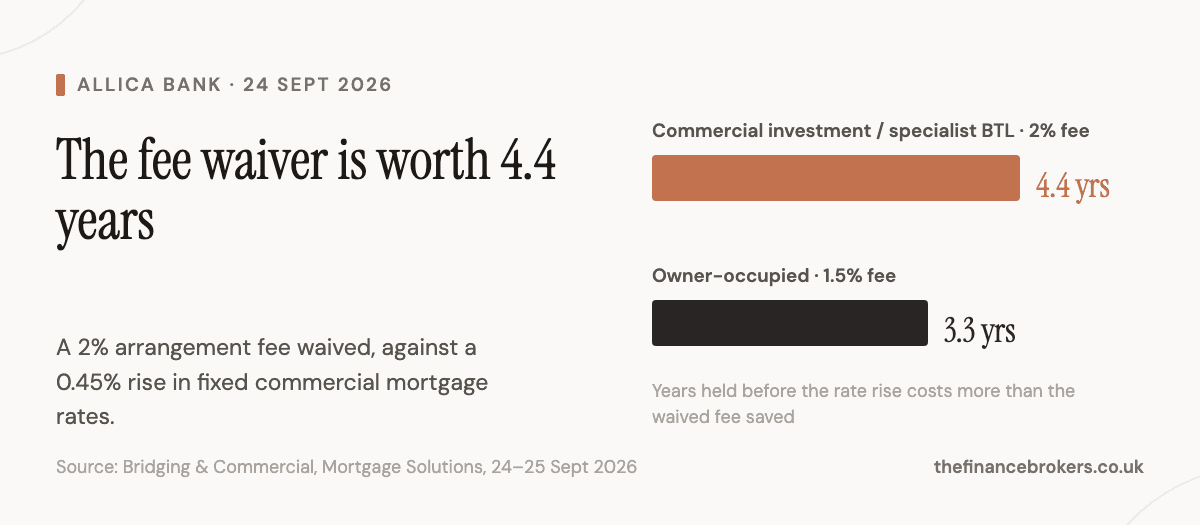
On 24 September, Allica Bank announced it was extending its commercial mortgage arrangement fee waiver, worth up to 2% of the loan, until the end of the year. The same announcement raised fixed rates across the entire commercial mortgage range by 0.45%.
Both halves are true, both were effective immediately, and the trade press led on the generous one. For a borrower drawing £750,000, the waiver is worth £15,000 once. The rate rise costs £3,375 every year. That is a crossover at four and a half years, and it is the number nobody printed.
What Allica actually announced
The arrangement fee waiver was due to expire on 30 September. It now runs to 31 December 2026, and applications have to be submitted by that date to qualify. As reported by Bridging & Commercial and Financial Reporter, it covers three tiers:
- Owner-occupied mortgages from £750,000: 1.5% arrangement fee waived
- Commercial investment mortgages from £750,000: 2% waived
- Specialist buy-to-let from £1.5m: 2% waived
Alongside it, Mortgage Solutions reported that fixed rates across the commercial mortgage range and the specialist buy-to-let range rose by 0.45%, effective 24 September.
Nick Baker, Allica's Chief Commercial Officer, was direct about the cause of the rise: "Movements in swap rates mean we need to make a change to our fixed rate commercial mortgage and specialist buy-to-let pricing." On the waiver, he framed it as a broker-facing response to the same pressure, "helping brokers to keep getting deals over the line."
Read those two sentences together and the announcement is coherent rather than contradictory. Funding costs went up, so the rate went up. The lender then gave back some of what it took, in the one form that costs it least over the life of a loan.
The crossover is 4.4 years, and it is not close
An arrangement fee is paid once. A rate is paid every year the loan is outstanding. Comparing them requires dividing one by the other, and the answer is uncomfortably specific.
| Product tier | Fee waived | Rate rise | Crossover |
|---|---|---|---|
| Commercial investment (£750k+) | 2% | 0.45% | 4.4 years |
| Specialist buy-to-let (£1.5m+) | 2% | 0.45% | 4.4 years |
| Owner-occupied (£750k+) | 1.5% | 0.45% | 3.3 years |
Below the crossover, the waiver wins. Above it, the rate rise has quietly taken back more than the fee ever saved.
On a five-year fix at commercial investment tier, the borrower saves 2% up front and pays 2.25% extra over the term. On a £750,000 loan that is £15,000 saved against £16,875 paid. On a £1.5m specialist buy-to-let it is £30,000 against £33,750. The borrower who fixes for five years on the strength of a waived fee has made a small loss and will not notice, because the fee saving landed on day one and the rate is buried in a monthly payment.
Two honest caveats, because this is a rule of thumb and not an amortisation schedule. First, an arrangement fee is usually added to the loan rather than paid in cash, so waiving it also avoids the interest that would have accrued on it, which pushes the crossover out by a few months. Second, a borrower who genuinely intends to repay or refinance inside three years is comfortably on the right side of the line and should take the waiver without hesitation. Our guide to property finance fees sets out how the rest of the cost stack behaves on a shorter hold.
The point is not that Allica has done anything sharp. It has not: this is ordinary, competent pricing, announced openly on the same day, with the reason stated. The point is that a fee waiver is a term-sensitive incentive, and it is being presented alongside products whose value proposition is a long fix.
Commercial went up in the same week buy-to-let came down
The Allica move is easier to read against what the rest of the market did in the same 48 hours.
Keystone Property Finance cut rates by up to 0.15% on 23 September across two-year and five-year fixes. Landbay expanded its tracker range and cut rates the same day. Skipton Building Society announced cuts of up to 0.15% on 24 September.
So residential and buy-to-let pricing eased while commercial pricing rose 0.45%. These are not the same funding curve and there is no contradiction, but the divergence matters to anyone holding a mixed portfolio: a landlord refinancing a residential block this month is in a softening market, and the same landlord refinancing a semi-commercial unit is not.
Keystone's own range makes the underlying trade explicit in a way worth borrowing. It offers the same five-year fix at 2.5%, 5% and 7% arrangement fees, with a different rate behind each. The lender is not hiding the fee-versus-rate choice, it is selling it as a choice, and it prices each version so the borrower can pick the shape that matches the hold period. That is the correct way to present this decision, and it is the comparison every commercial borrower should be running whether or not their lender lays it out that neatly.
What a broker should do with this
Three practical consequences, in the order they will come up.
Ask for the hold period before the product. The crossover maths means the right answer for a three-year hold is the opposite of the right answer for a seven-year hold, on the same lender and the same day. A deal structured around a fee waiver without a stated exit horizon has been structured backwards. This is the same discipline our guide to picking the right lender applies to criteria: match the product to the plan, not the plan to the offer.
Treat 31 December as a real deadline, not a marketing one. Allica has already moved this date once, from 30 September, and it may move again. It may also not. A £750,000 commercial investment case that completes in January and misses a 2% waiver has lost £15,000 to a diary, which is a large amount of money to leave to optimism.
Price the whole market, not the headline. A whole-of-market comparison is the only way to know whether a 0.45% increase leaves Allica competitive or not, and on a lot of cases it will. Allica has built its commercial mortgage proposition on serving established businesses that high street banks have stopped underwriting properly, and a rate rise driven by swaps does not undo that. What it does is narrow the gap, which is exactly when a comparison stops being academic.
The wider signal
Swap rates have been moving against fixed-rate pricing for weeks, and Allica is not the first lender to pass that on. What makes this announcement worth reading closely is the shape of the response: hold the rate as long as you can, then raise it and soften the blow with a one-off incentive that costs less than it looks.
Expect more of this. A fee waiver is the cheapest concession a lender can make in a rising-cost environment, because its cost is fixed and known while a held rate is an open-ended liability. When funding costs rise, incentives migrate from the rate to the fee, and the borrowers who benefit are the ones with short holds. Everyone else is paying for the giveaway over the term of their loan.
If you are refinancing a commercial or semi-commercial asset in the next quarter, the question to put to every lender is not "what is the rate" and not "what is the fee". It is "what does this cost me over the years I actually intend to hold it". Talk to us and we will run that comparison across the market before the December deadline does the deciding for you.