There are two numbers in Octane Capital's latest developer sentiment survey, published on 29 July 2026, and they point in opposite directions. That is what makes them worth reading together.
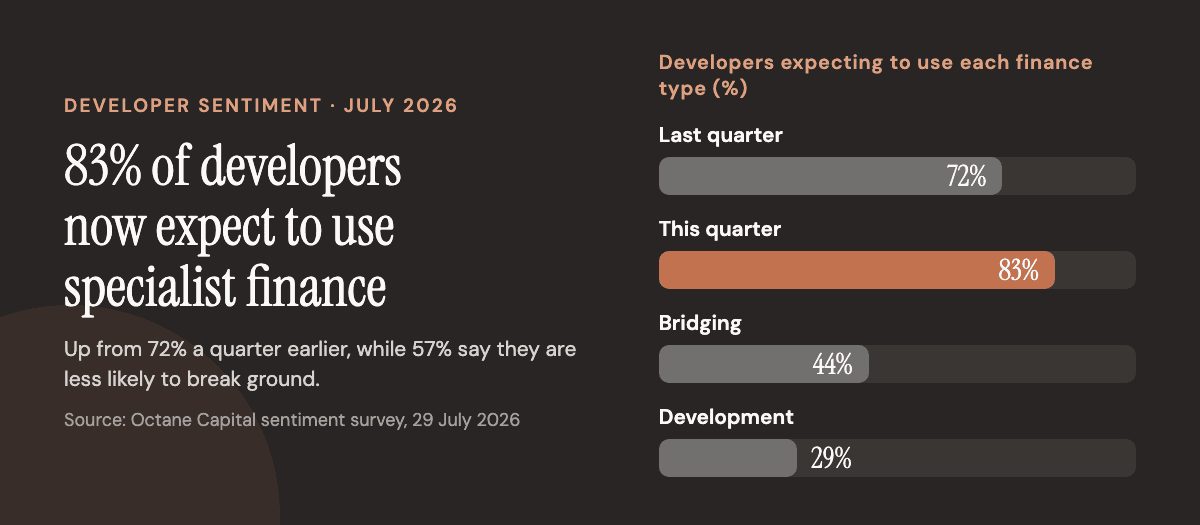
83% of developers now expect to use specialist lending, up from 72% the previous quarter. 44% expect to use bridging finance, up from 40%. 29% anticipate using development finance, up from 24%.
At the same time, 57% say they are less likely to break ground on a new project, against 37% in the first quarter. Only 23% think UK property conditions will improve in 2026, down from 35%. 77% expect conditions to stay challenging.
So: fewer developers starting, and a materially larger share of the ones who do start going to specialist lenders rather than the high street.
Why both numbers are true at once
The instinct is to read the second set as contradicting the first. It does not. It explains it.
When conditions are easy, a lot of schemes are fundable by a lot of routes. A mainstream bank with a slow process and rigid criteria is still a workable answer if your timeline has slack in it and your scheme is conventional.
When conditions tighten, the schemes that go ahead are the ones where the developer is confident enough to push through the difficulty. Those are rarely the simple ones. They are the sites with a planning wrinkle, a tight purchase deadline, a part-built structure from a previous owner, or a funding requirement that does not fit a standard box. Those cases go to specialist lenders because they are the lenders equipped to say yes to them.
Octane's CEO, Jonathan Samuels, put it directly: "Developers still want to transact, but they're increasingly looking for lenders that can provide speed, flexibility and certainty."
Speed and certainty, notably, not price.
The barriers are not financial
The two obstacles developers named most are high build and labour costs (35%) and planning delays and uncertainty (29%).
Neither is a funding problem, which is a useful thing to know. It means the developers pulling back are largely not doing so because money is unavailable. They are doing so because the numbers on the build side and the timeline on the planning side have stopped working.
That matters for anyone still transacting, because it tells you what the constraint actually is. If you are competing for a site, you are competing against fewer bidders. If your scheme's costs are locked and your planning is settled, you are in a much smaller group than you were eighteen months ago.
We wrote recently about England's 91,400-home shortfall against its target, and the same pattern shows there: the constraint is rarely one thing, and funding is often the part that can be unstuck fastest.
What the specialist shift means in practice
If you are among the 83%, three things follow.
The panel is the product. Specialist lending is not a single market with a single price. It is dozens of lenders with materially different appetites that change month to month. In July alone, Shawbrook lifted its maximum commercial bridging LTV to 75%, and Hampshire Trust Bank and YBS Commercial both cut commercial pricing. Knowing which lender has moved this month is most of the job.
Speed has a price and it is usually worth paying. Shawbrook's own research this month found 22% of mid-sized firms lost a deal because funding was too slow. On a development site, a missed deadline is not a delay, it is the deal.
Plan the exit at the start, not at month nine. More specialist finance in the market means more schemes reaching completion with a bridge or a development facility that needs to come off. Our guide to development exit finance covers the options, and how development finance works covers the structure end to end.
The broker's view
A survey like this is a reasonable proxy for what we see in enquiries. The developers still moving are more experienced, more selective about sites, and much more likely to arrive with a specific lender problem rather than a general funding question.
If you are weighing a scheme and the funding route is the open question, tell us the details and we will tell you which lenders are realistically in play, and which are not.
Source: Octane Capital quarterly developer sentiment survey, reported by Introducer Today, 29 July 2026.