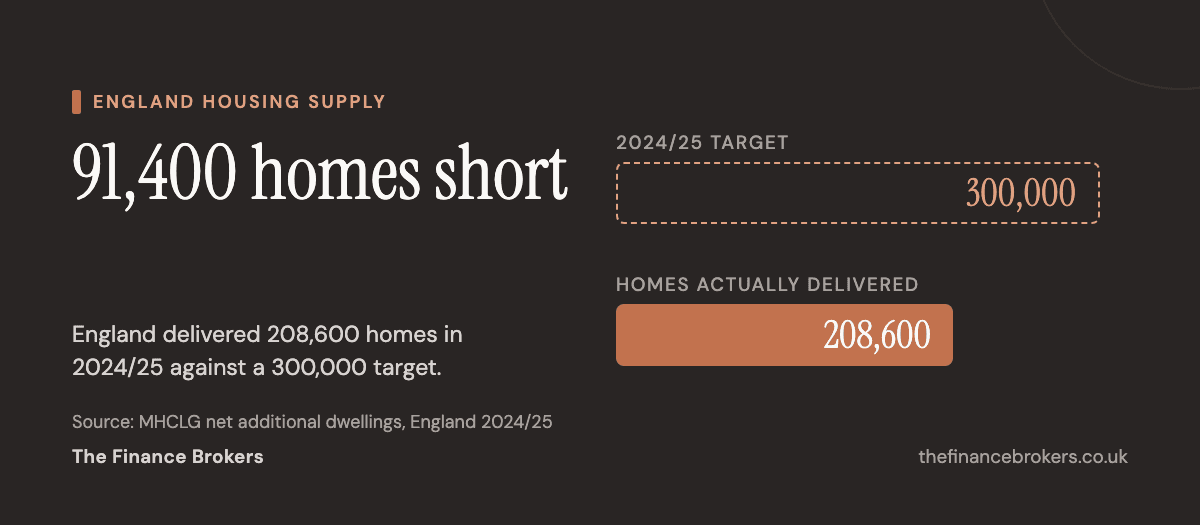
England fell 91,400 homes short of its housing target last year, and the five-year shortfall now stands at 383,490 homes. On the very same morning that number was published, a Hertfordshire site that had sat frozen after its previous owner went into administration got a £20m funding line and started building 52 houses.
Those two stories landed within an hour of each other. Read together, they say something the housing debate keeps missing: a large share of the homes we are short of are not blocked at the planning committee. They are blocked at the funding stage, on sites that already have consent and no money behind them.
The shortfall, in the actual numbers
Analysis published on 27 July by Property Buyers Today, drawing on official housing supply data, puts England's 2024/25 delivery at 208,600 net additional dwellings against the 300,000 annual target (The Intermediary). That is 69.5% of the target, and a shortfall of 91,400 homes in a single year.
Stretch it over five years and the gap compounds. Between 2020/21 and 2024/25 England delivered roughly 1.12 million homes against a 1.5 million target, or 74.4%. The cumulative miss is 383,490 homes.
The regional spread is where it gets uncomfortable. Castle Point delivered 3% of its target. Kensington and Chelsea managed 8%. Tewkesbury, meanwhile, beat its target by 819 homes. Same national policy, same national economy, wildly different outcomes.
Saif Derzi, founder of Property Buyers Today, framed the consequence plainly: around 75% of targeted homes have been delivered since 2020, and that "is likely to compound the effects of shortages throughout the remainder of the decade."
The underlying figure is not new. The official net additional dwellings statistics recorded 208,600 net additions for 2024/25, a 6% fall on the year before. What today's analysis adds is the arithmetic nobody enjoys doing: at this run rate, the gap is not closing.
Planning gets the blame, and deserves some of it
Research published on 24 July by Savills and Hallam Land makes a genuinely useful point about why delivery has slipped. Their report found that the strongest period of housing delivery in the last decade, 2016 to 2020, coincided with a settled planning framework, with over 300,000 consents a year and completions peaking at 245,600 in the year to March 2020.
Emily Williams, Director of Residential Research at Savills, put it this way: "The strongest period of housing delivery coincided with prolonged policy stability, giving confidence for long-term decisions."
Since 2020, nutrient neutrality rules, revised housing need calculations and Local Plan delays have each taken a bite. Paul Burton, Executive Director at Hallam Land, added the operational version: when everyone understands the framework they are working within, schemes come forward more easily.
Small sites have been hit hardest. The Home Builders Federation found that approvals on sites of three to nine units fell to around 17,000 in 2024, against a long-run average nearer 35,000, with small sites' share of all permissions dropping from roughly 20% in 2008 to between 6% and 8% today.
So yes, planning is a real constraint. But planning explains why sites do not get consent. It does not explain why consented sites sit still.
What unstalling a site actually looks like
Also on 27 July, Close Brothers Property Finance agreed a £20m revolving credit facility with the developer gs8 to fund Medburn Yard in Radlett: 52 homes across a four-acre site, 38 private and 14 affordable, with a gross development value of £47m and a Grade II listed barn conversion in the mix (The Intermediary).
The detail that matters: the site had stalled after its former owner went into administration, and gs8 acquired it out of receivership. It was not waiting for a planning officer. It was waiting for someone to fund it.
Phil Hooper, Chief Executive of Close Brothers Property Finance, said the bank was "proud to be supporting ambitious businesses like gs8 and funding schemes that are raising the bar for what new housing in this country can deliver." Josh Gordon, co-founder of gs8, said Close Brothers "understood that vision from the outset, and their expertise has been invaluable in bringing the scheme forward at pace."
Fifty-two homes is 0.06% of last year's shortfall. On its own it is a rounding error. As a template it is the whole argument: a distressed, consented, physically ready site produced nothing for as long as it was unfunded, and produced 52 homes the moment it was.
Why the structure of the money matters
The facility here is a revolving credit facility rather than a single project loan, and the distinction is worth understanding if you develop property.
A standard development finance facility is drawn in stages against construction progress and repaid in full on exit, usually from sales or a refinance. It is built around one scheme with one end point. A revolving facility behaves more like a working line: capital is drawn, repaid as units sell or phases complete, and drawn again. For a developer running phased delivery or a pipeline of sites, that recycling of capital removes the dead time between finishing one scheme and arranging funding for the next.
Both are assessed on the same fundamentals. Lenders look at loan to cost and loan to gross development value, the credibility of the GDV, the build contract, and above all the developer's track record. That last one is why distressed sites stay distressed: the site may be sound while the previous owner's position was not, and it takes a lender willing to underwrite the new sponsor rather than the site's history.
If you want the mechanics in full, our guide to how development finance works walks through drawdowns, interest treatment and exit, and ground-up development finance covers new-build schemes specifically. On the planning side of the same problem, we looked at how a bank is now lending against biodiversity units, which is one of the conditions consented sites most often stall behind. And for where the capital for small builders is now coming from, see Goldman Just Put £500m Behind Britain's Small Builders.
If you are the one holding a stalled site
The national numbers are a backdrop. The practical question is narrower: what do you do when a scheme has consent and no funding behind it?
- Separate the site's problem from the seller's problem. A site that stalled because its owner ran out of money, or fell into administration, is not the same as a site that stalled because it does not stack up. Specialist lenders price those two very differently, and plenty of good sites carry the stigma of a bad previous owner.
- Get the exit defined before the funding conversation. Development lenders underwrite the way out as hard as the way in. Whether that exit is unit sales, a term refinance or development exit finance to buy sales time on a completed scheme, having it costed makes the difference between an indicative yes and a real one.
- Do not assume your bank's answer is the market's answer. The high street's appetite for SME development lending has thinned considerably, which is exactly why specialists, challenger banks and debt funds now do so much of this lending. We covered the same split in bridging and development lending volumes earlier this year.
- Check whether the facility shape fits your pipeline. If you are running more than one scheme, a revolving or portfolio-level facility can be worth more to you than a slightly cheaper single-project loan, because it removes the arrangement gap between projects.
Ministers can restore housing targets and steady the planning rules, and on the Savills evidence that would genuinely help. But policy does not lay bricks. Funded developers do, and a meaningful slice of the 91,400-home gap is sitting on sites that are already consented and simply have nobody paying for them.
If you are holding a site that has stalled, or you are buying one out of a difficult situation, the question worth answering is not whether finance exists. It is which lender will look at your scheme, your experience and your exit and say yes. Tell us about the site and we will tell you where that yes sits.