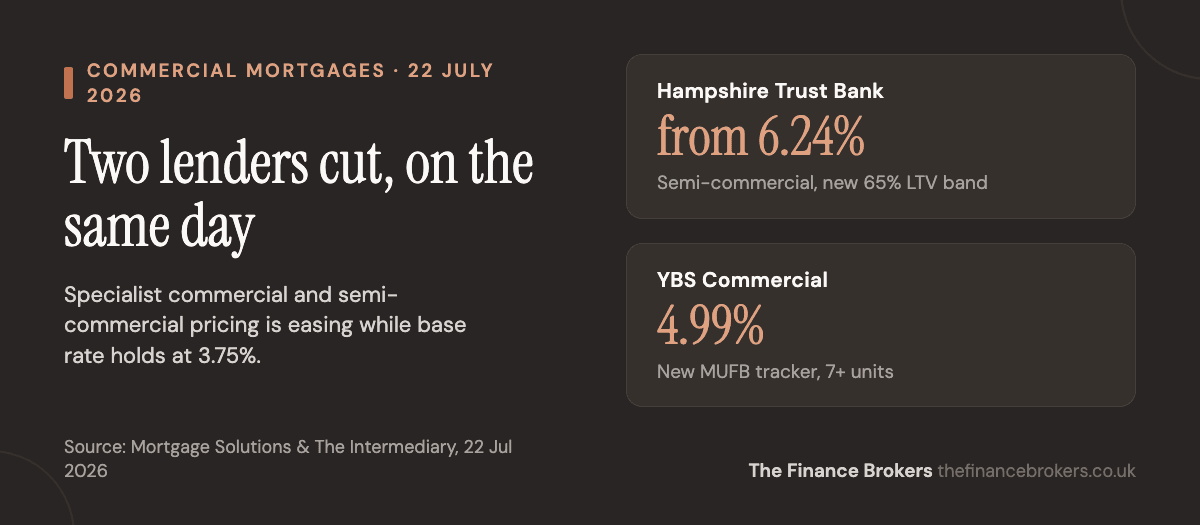
On the same day this week, two specialist lenders quietly made commercial property cheaper to borrow against. Hampshire Trust Bank cut its semi-commercial rates and added a 65% loan-to-value band. YBS Commercial launched a sub-5% tracker for portfolio landlords. Neither move made headlines, and neither is dramatic on its own. Together they point one way, and it matters if you own commercial or mixed-use property, or you are thinking about buying some.
Here is what changed on 22 July, and why the direction of travel is more useful than the individual numbers.
What actually moved
Two announcements landed the same morning, from two different corners of the specialist market.
- Hampshire Trust Bank (HTB) enhanced its semi-commercial proposition with a new pricing band for loans between £250,000 and £1m from 6.64%, alongside a new 65% loan-to-value range priced from 6.24% (Mortgage Solutions). The changes took effect immediately. Alex Upton, HTB's Managing Director for Specialist Mortgages and Bridging Finance, said "semi-commercial continues to be an important part of the conversations we're having with brokers, and those conversations continue to evolve."
- YBS Commercial Mortgages launched a three-year tracker for landlords with multi-unit freehold blocks of seven or more units, priced at 4.99%, which is 1.24% over the 3.75% Bank Base Rate, up to 75% LTV with a 2% arrangement fee (The Intermediary). Angela Norman, Managing Director of YBS Commercial Mortgages, framed it as a response to a market where borrowers increasingly want the flexibility of a tracker rather than locking into a fixed rate while conditions are uncertain.
A sub-5% tracker on a portfolio of flats, and a semi-commercial deal from 6.24% at a genuine 65% LTV, are not the rates that were on offer this time last year. And these two are not outliers. YBS Commercial has trimmed pricing across parts of its range in recent weeks, and the wider specialist market has been sharpening commercial and semi-commercial rates as the base rate has settled.
Why commercial pricing is easing now
The backdrop is the useful part, because it tells you whether this is a blip or a trend.
The Bank of England has held Bank Rate at 3.75%, after the cut from 4% late in 2025, and markets currently expect it to hold for the rest of the year. So this is not lenders passing on a fresh base-rate cut. The base rate is flat.
What is moving is competition. When the headline rate stops falling, commercial pricing moves on two things instead: swap rates, and how hard lenders are willing to fight for business. Transaction volumes in specialist property have been steady rather than booming, so the lenders still active are competing harder for the deals that do come through. Cutting rates, loosening loan-to-value bands and launching new products is how they win that business. That competition is quietly worth more to a borrower than most people realise: on a commercial case, moving down a tier of lender or LTV band can be worth 50 to 100 basis points on the rate.
That is the pattern we have been tracking across the specialist market. A few weeks ago we covered the same drift in buy-to-let, where Paragon, Shawbrook and others all cut rates. The commercial and semi-commercial side is now following, and it is arriving through better LTVs and new products as much as through the headline rate.
Semi-commercial and MUFB, briefly
These two announcements sit in corners of the market that trip people up, so it is worth being clear about what they are.
Semi-commercial (or mixed-use) property is a single building that is part commercial and part residential. The classic example is a shop or office on the ground floor with flats above. It falls between a standard commercial mortgage and a residential buy-to-let, which is exactly why a specialist lender like HTB prices it as its own product rather than lumping it in with either.
An MUFB, a multi-unit freehold block, is a single freehold title containing several self-contained flats, held on one loan rather than one mortgage per flat. It is the workhorse structure for professional landlords building scale, and YBS Commercial's new tracker is aimed squarely at that borrower.
Both are assessed on the property's income and the borrower's experience as much as on personal affordability, and both live or die on the loan-to-value the lender will accept. HTB adding a 65% LTV band matters as much as the rate cut, because a higher LTV can be the difference between a deal working and not working when deposit cash is tight.
What it means if you own or are buying commercial property
For anyone holding, buying or refinancing commercial and mixed-use property, the takeaway is simple: the numbers are better than they were, and better than the mood music suggests.
A few practical points:
- If a deal did not work six or twelve months ago, run it again. A rate that has come down and an LTV band that has widened can change the arithmetic on a case that was previously marginal. The building has not changed; the terms available against it have.
- A tracker is a live choice again. With the base rate expected to hold, a tracker like YBS Commercial's removes the premium you pay to fix while giving up little in certainty. Whether it beats a fixed rate depends entirely on your plans and your view on rates, which is exactly the kind of trade-off worth talking through before you commit.
- Watch the total cost, not just the rate. A headline 4.99% with a 2% arrangement fee is a different deal from a slightly higher rate with a lower fee, especially on a shorter term. On commercial cases the fee structure often moves the real cost more than the rate does.
- If you are exiting a bridge, your landing gets cheaper. Most bridging loans are repaid by refinancing onto a longer-term product. When commercial and semi-commercial term rates fall, the refinance you exit onto is more affordable, which eases the serviceability test that decides whether the exit gets approved at all.
Update, September 2026. That direction of travel has since reversed for part of the market. Allica waived a 2% arrangement fee and raised fixed rates 0.45% the same day on 24 September, citing swap rate movements, while buy-to-let lenders were still cutting. The fee-versus-rate point below is now the whole argument rather than a footnote.
None of this is a signal to rush. It is a signal to look. The specialist commercial market rarely moves all at once, and the difference between two lenders on the same deal can be substantial, which is precisely the gap a broker exists to close.
If you are weighing up a commercial or semi-commercial purchase, a refinance, or a portfolio move, it costs nothing to find out where the sharpest terms sit right now. Tell us about the deal and we will tell you where the yes is.