Most lender announcements are about rate. This one is about how much you can actually borrow, which is usually the number that decides whether a deal happens at all.
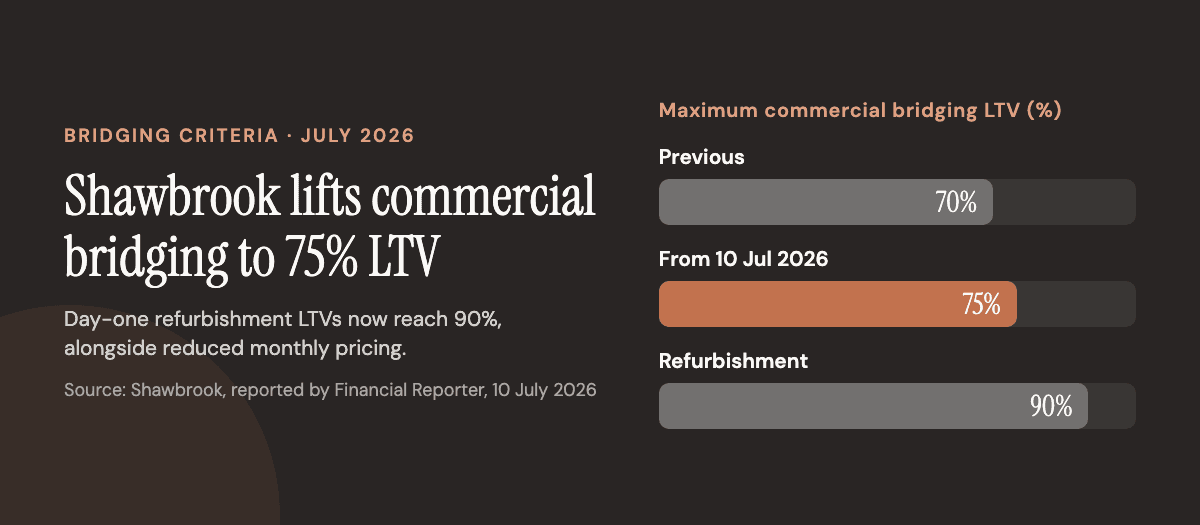
On 10 July 2026, Shawbrook raised the maximum loan-to-value on eligible commercial bridging loans to 75%. It came as part of a wider package: day-one LTVs on refurbishment cases up to 90%, reduced monthly pricing, a lower minimum loan size and a streamlined underwriting process.
"Increasing our maximum commercial bridging LTV up to 75% gives brokers greater flexibility to support commercial property investors and developers when higher leverage is needed," said Daryl Norkett, Director of Real Estate Proposition at Shawbrook.
Why leverage beats rate on a short-term loan
On a twelve-month bridge, a quarter-point of monthly rate is real money but rarely decisive. Leverage is different. It is the difference between a deal you can fund and a deal you cannot.
Take a £2m commercial purchase. At 70% LTV you need £600,000 of your own money in the deal. At 75% you need £500,000. That £100,000 is not a saving on the cost of borrowing, it is £100,000 you still have available for the next site, the build cost overrun, or simply the cushion that lets you sleep.
The refurbishment change is arguably the bigger one. A 90% day-one LTV on a refurb case means the purchase itself absorbs far less of your capital, leaving more of it where it earns its keep, in the works.
If the distinction between these ratios is not something you think about daily, our guide to LTV, LTC and GDV sets out how lenders actually stack them.
What it signals about the wider market
One lender moving is a product update. The direction of travel is the story.
Through the first half of 2026 the pattern has been consistent: specialist lenders competing on criteria and leverage rather than purely on headline pricing. We have seen the same in commercial mortgage pricing, where Hampshire Trust Bank added a 65% LTV band at the same time as cutting rates, and Yorkshire Building Society Commercial launched a sub-5% tracker.
Lenders loosen criteria when they want volume and are comfortable with the risk. For a borrower, that is the window worth using.
What this means if you are borrowing now
Three practical points.
Re-test deals you shelved. If a commercial purchase or a refurb did not stack at 70%, it may stack now. Deals that were 5% short of workable are exactly the ones this change rescues.
Higher available leverage is not an instruction to take it. Borrow to 75% because the exit supports it, not because the lender allows it. The bridging market spent the first quarter of 2026 doing the opposite, with average LTVs falling from 56% to 52% as borrowers deliberately took less. That caution was sensible and it still is.
Get the exit straight first. A bridge at 75% needs a genuinely evidenced way out, whether that is a sale or a term refinance. Our guide on refinancing an existing bridging loan covers what lenders want to see, and bridging finance criteria covers what gets a case declined.
The broker's view
Criteria changes are quiet and they move fast. A lender that would not look at your case in May may be the right answer in July, and the only way to know is to be watching the whole panel rather than one relationship.
If you have a commercial purchase or a refurbishment that was close but not quite fundable, it is worth another look. Tell us what the deal is and we will tell you honestly whether the market has moved far enough to make it work.
Sources: Shawbrook announcement reported by Financial Reporter, 10 July 2026, and Mortgage Solutions, 9 July 2026.