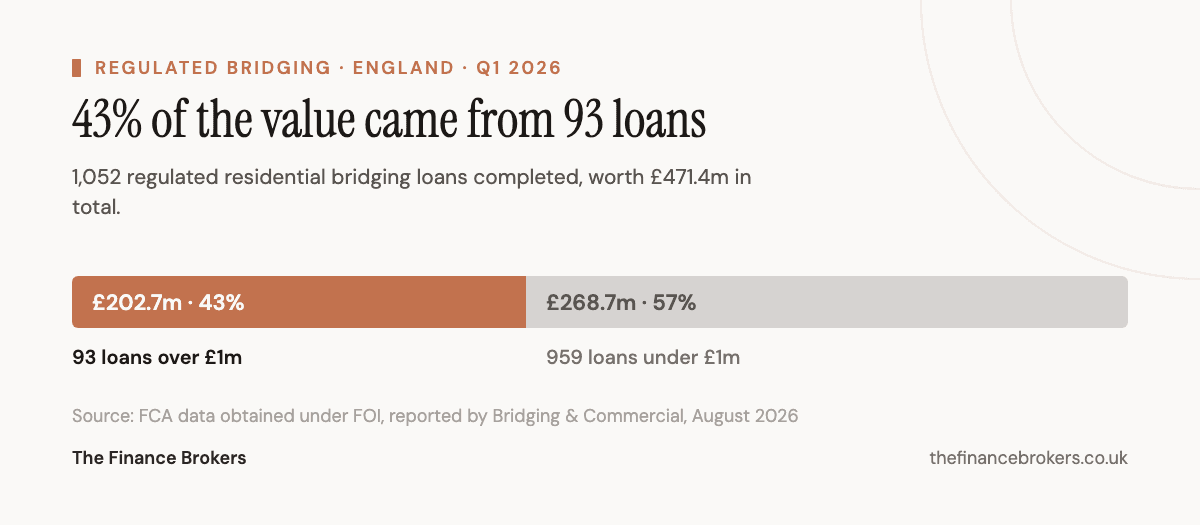
43% of Regulated Bridging Value Came From 93 Loans
In the first three months of 2026, lenders completed 1,052 regulated residential bridging loans in England, worth £471.4m between them. Ninety-three of those loans were over £1m. Those 93 accounted for £202.7m, which is 43% of the money, from under 9% of the deals.
That distribution is the single most useful thing published about the bridging market this month, and almost nobody is talking about it. The figures come from the FCA, released under a Freedom of Information request and reported by Bridging & Commercial on 10 August. They are regulator data rather than trade-body estimates, which makes them unusually hard to argue with.
What the numbers actually say
The headline is concentration. Within that £1m-plus band, the mean loan was around £2.18m and the median around £1.43m. The gap between those two numbers matters: it means a handful of very large facilities are pulling the average up, and that the typical seven-figure bridge is closer to £1.4m than to £2m.
The growth picture is just as lopsided. Between 2021 and 2025:
- Total regulated loans: 2,134 rose to 4,249, a 99% increase
- Total value advanced: £862.9m rose to £1.72bn
- Loans over £1m: 170 rose to 321, an 89% increase
- Value of £1m-plus loans: £293.9m rose to £607.9m, up 107%
Read those last two lines together. The number of large loans grew slower than the value they carried. Big bridging deals have not just become more common, they have become bigger. That is a market where lender appetite at the top end has expanded faster than the deal count, which is the opposite of what a cautious market looks like.
The word doing the heavy lifting is "regulated"
Here is the part the headline figure hides, and it changes how you should read every number above.
The FCA only sees regulated bridging. A bridging loan is regulated when the security property is, or will be, occupied by the borrower or an immediate family member. Everything else, which means investment property, buy-to-let, most commercial security, the majority of development exits, is unregulated and sits outside this dataset entirely. We explain where that line falls in our guide to what bridging finance is and how it works, and in the bridging loan glossary entry.
For scale: the Bridging and Development Lenders Association put total UK bridging completions at £1.8bn for Q1 2026, a figure we covered when completions fell 28% on the quarter. The FCA's regulated England figure for the same quarter is £471.4m. The two are not measuring the same thing, since one is UK-wide across all bridging and the other is England-only and regulated-only, so treat the comparison as directional rather than exact. But the direction is clear enough: regulated lending is the minority of this market, probably around a quarter of it.
That has a practical consequence. When a borrower reads that bridging is booming, or cooling, or consolidating, the data behind that claim is usually the trade-body number, which is dominated by investment and development lending. If you are buying your own home at auction, or bridging a chain break on a house you will live in, you are in a much smaller pool with a different set of lenders and a different set of rules.
What concentration means if your deal is not a big one
The temptation is to read "43% of value from 93 loans" as bad news for everyone else. It is not, but it does tell you something about where lender attention sits.
Large deals get the sharpest pricing and the most flexibility. A £1.5m regulated bridge on a well-located property with a clean exit is a case multiple lenders will compete for, because it moves their book meaningfully in one transaction. Below roughly £300k, the fixed costs of a bridging case (valuation, legals, underwriting time) are the same but the interest earned is far smaller, so the pricing and the enthusiasm both tighten.
The exit is what closes the gap. For smaller cases, the thing that gets a competitive answer is not the size of the loan, it is the quality of the way out. A signed sale memorandum or a mortgage offer in principle turns a marginal case into a straightforward one. Our bridging loan exit strategy guide sets out what lenders actually want to see, and the criteria guide covers where the current panel sits on LTV, term and security type.
Whole-of-market matters more at the small end, not less. When a deal is big, lenders come to you. When it is not, the spread between the best and worst available terms is wider, and finding the lender whose appetite happens to match your case is most of the work.
The honest caveats
Three, and they matter.
The dataset is England-only, so Scotland, Wales and Northern Ireland are absent. It covers completions rather than applications, so it says nothing about how many people asked and were declined, which is the number we would most like to see. And "regulated residential" excludes second-charge lending against a main residence in some reporting definitions, so the true consumer-facing figure may be slightly larger than £471.4m.
None of that undermines the concentration finding. A 43% share from under 9% of cases is far too large a gap to be explained by definitional edges.
What we take from it
The regulated bridging market has roughly doubled in four years and its value has skewed steadily upward. That is a market with more capital, more lender competition and more appetite for size than it had in 2021, which is consistent with everything we have seen on the funding side, including banks continuing to put committed facilities behind specialist bridging lenders.
It is also a market where the published statistics describe a slice most borrowers are not in. If your bridge is against a property you will live in, you are looking at a smaller, more regulated, more consumer-protected market than the headline numbers suggest. If it is against an investment asset, none of these figures are about you at all.
Knowing which of those you are is the first question worth answering, and it is usually the first one we ask.
The other half of the picture is criteria rather than size. Since these figures were published, several lenders have widened who they will lend to, including on impaired credit: we covered that in bridging lenders reopening the door to adverse credit.
If you have a bridging case, at any size, we can put it across our panel of specialist lenders and come back with real terms. Get in touch and we will tell you honestly where your deal sits in the market.