Bridging Lenders Are Reopening the Door to Adverse Credit
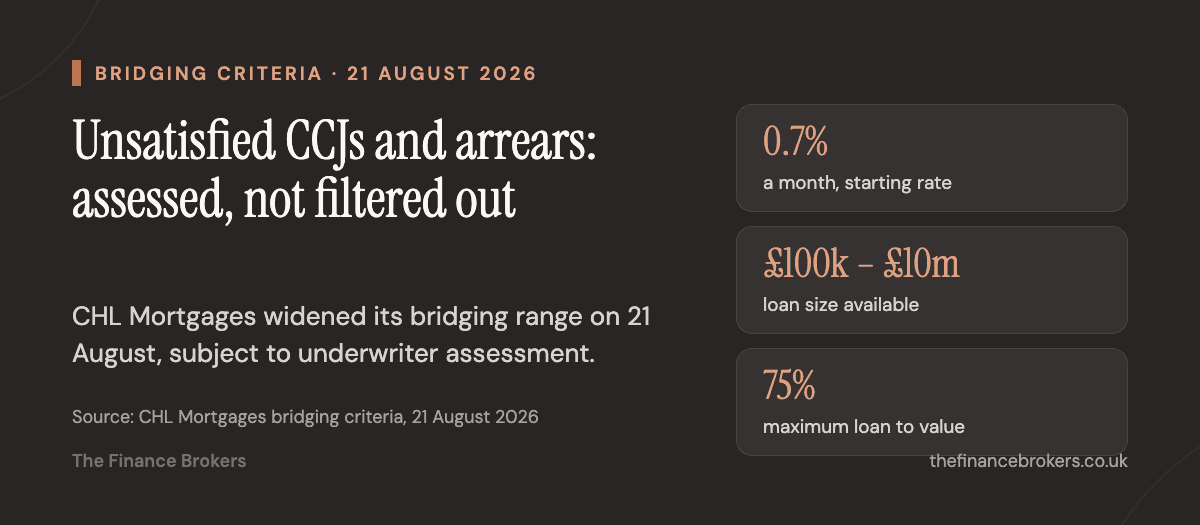
On Friday, a specialist lender published something most borrowers assume does not exist. CHL Mortgages widened its bridging range to consider applications carrying unsatisfied county court judgments, outstanding debts, and secured and unsecured arrears. Not settled CCJs from years ago. Unsatisfied ones, still on the file, subject to an underwriter taking a view.
The pricing attached to that is the part worth reading twice: rates from 0.7% a month, loans of £100,000 to £10m, up to 75% loan to value, with no exit fees and no early repayment charges. That is not a distress product with a punitive rate bolted on. It is close to the mainstream of the bridging market, offered to a borrower profile the mainstream is supposed to decline.
And CHL only launched a bridging proposition at the start of the month. Within about three weeks of entering the market, it widened the credit box rather than tightening it.
What actually changed
Three things moved at once, and only one of them is about credit.
The credit criteria now allow unsatisfied CCJs, debts and arrears to be assessed rather than filtered out. Roger Morris, group distribution director at Chetwood Bank for CHL Mortgages, put the logic plainly: "Every case we receive is assessed by experienced underwriters who take a practical view of the overall application and understand that complex cases rarely fit neatly into a box."
The valuation route changed too. Automated valuation models are now available on eligible properties, which can remove the need for a physical inspection. On a bridge, where the borrower is usually paying for speed, losing a week of surveyor diary is worth more than most rate comparisons.
And the product range spans chain break finance, auction purchases, light refurbishment for non-structural work, and heavier refurbishment involving structural works. Distribution runs through directly authorised brokers via selected mortgage clubs and CHL's bridging packager panel.
This is not one lender being generous
It would be easy to read the announcement as a single lender's appetite. The week around it says otherwise.
Two days earlier, Castle Trust Bank cut the minimum loan on its light refurbishment bridging range to £150,000, with new products at 0.78% a month for loans between £150,000 and £200,000, across both its standard and drawdown versions. Lowering a minimum loan size is the same move as widening a credit box, aimed at a different exclusion: it lets in the smaller refurbishment project that previously fell below the floor.
Earlier in the week, a new entrant arrived. GoGoProp, a digital bridging lender headquartered in Hong Kong, launched into the UK offering £100,000 to £750,000 against residential buy-to-let property in England at a flat 1% a month, up to 75% LTV, with initial approvals inside 24 hours and completions in as little as ten days.
Behind all three sits a market with capacity to deploy. The Bridging and Development Lenders Association's most recent published figures, reported in March, put lender loan books at £13.4bn and applications at £11.7bn for the final quarter of 2025. Completions came in just under £2.5bn. When that much capital is competing for a finite number of good deals, the way lenders compete is by widening who counts as a good deal. Criteria are where a funding surplus shows up first, and it shows up long before headline rates move.
What "adverse credit considered" actually means
Here is the part borrowers get wrong, in both directions.
It does not mean credit is ignored. It means credit stops being the first gate and becomes one input among several. What the underwriter is really pricing is the exit. A bridge is repaid by a sale or a refinance, and if that exit is credible, documented and dated, an unsatisfied CCJ becomes a question to answer rather than a reason to decline. If the exit is vague, a clean credit file will not rescue it. We set out how lenders weigh this in our guide to what bridging lenders actually check, and the exit strategy guide covers what "credible" looks like in practice.
It also does not mean the credit issue is free. Where it shows up is usually in one of three places: a lower LTV than the headline, a rate a notch above the best-case tier, or a condition requiring the arrears to be settled from the loan advance. A borrower who expects the sticker rate and gets a structured offer often reads that as a rejection. It is not. It is the deal.
The severity, recency and cause matter more than the score. A missed payment during a tenant void two years ago and an active default from last quarter are not the same application, even if a credit report renders them in the same red.
Why the "computer said no" reflex costs money
The practical problem is not that lenders will not lend. It is that borrowers with a mark on their file stop asking.
We see this most often in refinancing an existing bridge. A borrower whose term is running out assumes the arrears that appeared during the project have closed the market, so they do not test it, and they roll onto default interest or accept whatever their incumbent offers. Meanwhile a lender two doors down has just published criteria that would have taken the case.
The same reflex shows up at the front end. Someone with a CCJ from a disputed supplier invoice self-declines on a property finance deal that a specialist desk would have underwritten on the strength of the asset and a dated exit.
Neither of those is a pricing problem. It is an information problem, and it is the reason criteria announcements like Friday's are worth more attention than rate cuts.
What to do with an impaired file
If your credit history is not clean, the work is in the presentation, not the concealment.
Lead with the explanation. An underwriter taking a "practical view" needs the facts in front of them: what happened, when, why, and what has changed since. A one page narrative attached to the application does more than any amount of hoping the search comes back quiet.
Be precise about the exit. A sale needs an agent, a valuation basis and a realistic timeline. A refinance needs a lender, a product and evidence you fit its criteria on the day the bridge matures, not in theory. Our introduction to bridging finance covers how the two exits differ in the underwrite.
And do not run a scattergun search. Multiple applications leave multiple footprints, and on an already-impaired file that is a self-inflicted wound. This is precisely the point of using a broker with a whole-of-market view: the criteria are moving weekly, and knowing which desk has appetite this week is the difference between one application and six.
The wider read
The bridging market is not loosening because lenders have become relaxed about risk. It is loosening because there is more capital chasing deals than there are deals, and the borrowers at the edges of the credit box are the growth left on the table.
That will not last forever. Credit boxes widen in competitive markets and narrow in stressed ones, and the window is open now. The same competition is showing up in pricing: a bridging lender just cut to 0.75% with no bank involved, funded entirely by a family that decided to commit more capital. If you have been told your credit history rules out short-term finance, that advice may simply be out of date.
If you want to know whether your case fits somebody's current criteria rather than last year's, talk to us. We will tell you where it sits before you put a footprint on your file.