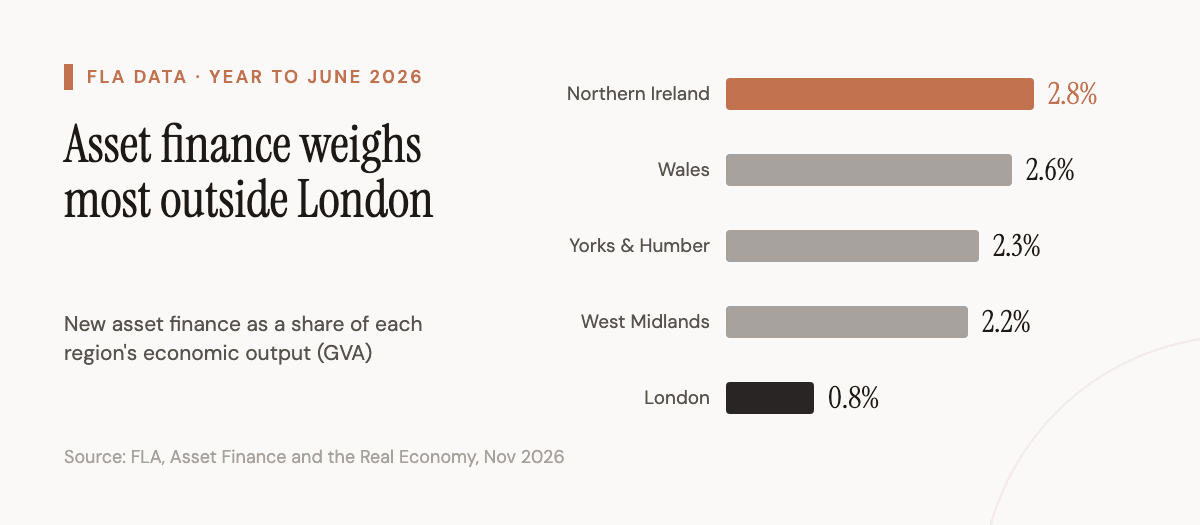
London produces close to a quarter of everything the UK economy makes. It takes barely an eighth of the finance that UK businesses use to buy their machines, vans and trucks.
That is the finding at the centre of new research from the Finance & Leasing Association, published on 16 November. Relative to the size of each economy, new asset finance was worth 2.8% of output in Northern Ireland and 2.6% in Wales, against 0.8% in London. In Northern Ireland that is three and a half times the London figure.
For a business owner outside the capital, this is not a statistic about lenders. It is a description of how firms like yours already pay for the equipment that does the work, and it says something useful about where to look when you next need to.
The regional numbers
The FLA's briefing, Asset Finance and the Real Economy, breaks down the asset finance its members wrote in the 12 months to June 2026 by UK nation and region, and sets each figure against that region's estimated 2025 gross value added (GVA, the standard measure of economic output).
The pattern is not subtle. The regions where asset finance carries the most weight relative to their economies are:
- Northern Ireland: £1.7 billion of new business, equal to 2.8% of regional GVA
- Wales: £2.3 billion, 2.6%
- Yorkshire and the Humber: £4.1 billion, 2.3%
- West Midlands: £4.2 billion, 2.2%
London sits at the other end. It wrote the second-largest volume in cash terms, £5.2 billion, but against an economy of its size that is just 0.8%, the lowest share of any region in the table. The South East wrote the most of all, £6.1 billion, at 1.6%.
The FLA puts the headline plainly: London accounted for 23.4% of UK output but only 12.9% of asset finance new business. In Wales and Northern Ireland, asset finance was "more than three times as large, relative to GVA" as in London, and "close to three times as large" in Yorkshire and the Humber and the West Midlands.
Across the UK, FLA members provided £41.6 billion of asset finance to businesses over the year, of which £25.4 billion went to SMEs.
Why the map looks like this
The explanation is in what gets financed. The FLA's own reading is that London "generates a large share of its output from relatively asset-light service sectors", while asset finance is concentrated in vehicles, machinery, equipment and other physical assets.
A law firm or a software business in the City needs laptops and a lease on an office. An aerospace toolmaker, a dairy farm or a regional haulier needs a CNC machine, a milking parlour or a tractor unit, and each of those costs more than most firms want to pay out of cash in one go. The places where the economy is made of physical things are the places where the finance that buys physical things carries the most weight.
We saw the same geography from the other side last month. When the SMMT published its third-quarter truck figures, Northern Ireland registered 45.8% more HGVs than a year earlier, while Scotland registered fewer. The places buying heavy kit are not the places with the biggest economies.
"There's a lot of attention on where the next factories will be built," said Shanika Amarasekara MBE, the FLA's Chief Executive, on publication. "If the Government wants to see these regions grow, it needs to consider the financing decisions businesses face."
What it looks like on a single deal
The briefing carries four examples drawn from the FLA's Impact Report earlier this year. Two of them are worth reading closely, because they show how differently a deal can be shaped.
Datum Tool Design, Northern Ireland. Paragon provided £1.6 million towards a £3.1 million five-axis CNC machine for the aerospace tooling specialist. The machine's 22-metre bed lets the business take more complex work in-house and bid for higher-value aerospace contracts. The finance covered a little over half the cost.
A family dairy farm, West Wales. A third-generation farm used £360,000 of asset finance towards a £400,000 robotic rotary milking parlour that can milk up to 50 cows at once and cuts labour needs by around half. The finance covered 90% of the cost, which kept the farm's own cash in the business.
Those are very different structures for the same product. One borrower put in close to half; the other put in a tenth. Neither is the "right" answer in general. The right contribution depends on the asset, how long it will earn, how much cash the business wants to hold back for stock, staff and the unexpected, and how a particular lender views that type of kit.
The other two examples make the same point at smaller scale: Haydock Finance arranged £1.3 million for three bottling machines after a drinks producer won new supermarket contracts, and Shire Leasing funded £125,000 of coffee equipment on a three-year lease so a young café could open a second site without draining its working capital.
Read the footprint numbers with care
The briefing also estimates that the £41.6 billion was associated with around £28.2 billion of GVA and roughly 350,000 jobs, and gives a regional split: about 36,400 jobs in the West Midlands, 35,700 in Yorkshire and the Humber, 20,000 in Wales and 14,700 in Northern Ireland.
Those figures deserve the caveats the FLA itself attaches. They are a gross footprint, built by mapping lending onto ONS sector multipliers, not an estimate of activity that would vanish without the finance. Some of the lending replaces existing kit rather than adding new capacity. And the regional GVA values are uprated from 2023 data, because official regional output figures run two years behind. The ranking of regions is robust; the job counts are indicative.
None of that weakens the core finding, which rests on lending volumes and output rather than on modelling.
What this means if you are borrowing outside London
Asset finance is the mainstream route in your region, not a niche one. If your business runs on equipment or vehicles and you are outside the capital, the firms around you are disproportionately funding their kit this way. Treating it as a last resort after a bank declines is backwards.
Shape the deal around your cash, not just the asset. The Datum and dairy examples show contributions ranging from about 10% to nearly 50%. Matching the term to the working life of the asset, and deciding deliberately how much cash to keep back, matters as much as the rate. Our guide to secured versus unsecured business loans explains where asset-backed lending sits against the alternatives.
Specialist lenders read regional and sector risk differently. A lender that knows agricultural robotics or aerospace machining will price a deal that a generalist declines. That is the case for looking across the whole market rather than one relationship, which we set out in how to pick the right lender. It is also why specialist appetite moves quarter to quarter: a lender's capacity is often set by its own funding lines, a theme we picked up when the FLA made its Budget case for more private capital.
Plan the next replacement cycle early. If you are expecting to renew a fleet or a production line in 2027, the time to line up funding is before the quote expires, not after. Our asset finance service covers hire purchase, finance leases and refinancing of existing equipment.
The FLA is a trade body making a case to government, and it chose the numbers that help that case. But the regional table is a description of lending that has already happened. Across much of the UK outside London, the machines, vans and trucks that keep businesses running are paid for over time. The useful question for any owner is whether they are getting the best structure for theirs.