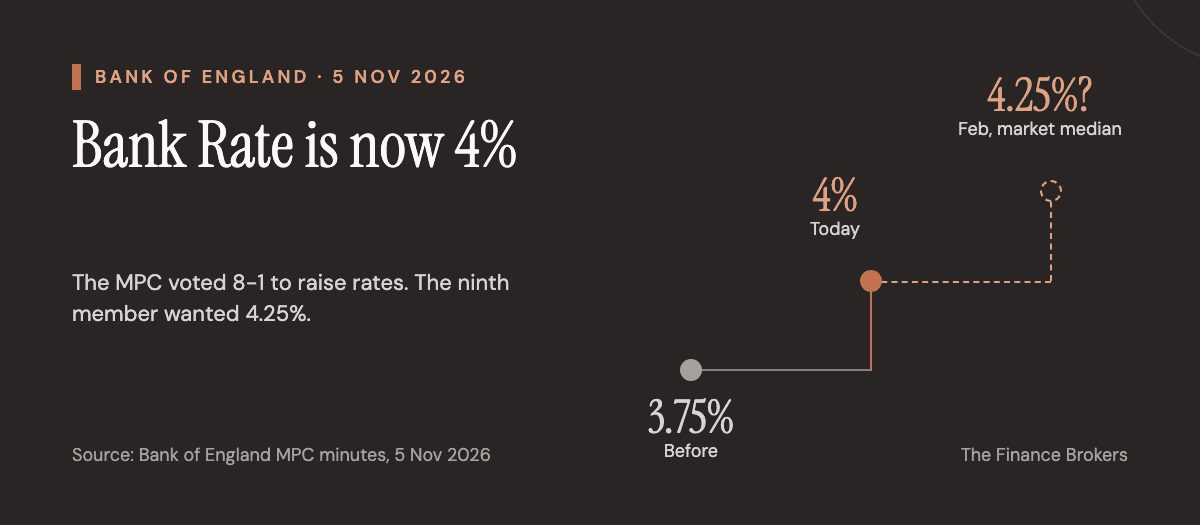
The Bank of England raised Bank Rate to 4% at noon today. It is the first rise since August 2023, when Bank Rate went to 5.25%.
The headline vote was 8-1, and the one dissenter wanted more: Catherine Mann voted for 4.25%. But the part property and business borrowers should read is what the members wrote next. Four of the eight who voted for 4% said a further rise is likely, or that they can see the case for one. Add Mann, and five of the nine rate-setters are pointing up from here.
That changes the question. It is no longer "will rates go up?" It is "what happens to my deal if they go up again in December or February?"
What the Bank decided, and why
According to the November 2026 Monetary Policy Summary and minutes, the Monetary Policy Committee voted 8-1 to raise Bank Rate by 0.25 percentage points to 4%. The reason is energy. The conflict in the Middle East is in its ninth month, CPI inflation rose to 3.5% in September, and the Bank now expects it to reach around 5% by the middle of next year.
The Bank was clear that it has not yet seen the knock-on effects it fears most, where higher energy costs feed into wages and other prices. But it judged that "the degree of inflationary pressure in the pipeline is now sufficient to warrant an increase in Bank Rate", and noted that activity has been stronger than expected.
The next decision is due on 17 December 2026.
The real signal: five of nine pointing up
Each member sets out the reasoning behind their vote in the minutes. Read together, they split into three camps.
Wanted more today. Catherine Mann voted for 0.5 percentage points, to 4.25%, calling it "good policy" from a risk management and credibility perspective.
Voted 0.25 and flagged more to come. Four members:
- Governor Andrew Bailey: "Without news which softens the risks to inflationary pressures, I can see the argument for a further increase in rates."
- Huw Pill, the Bank's chief economist: "a single 25-basis point hike is unlikely to be sufficient", with more tightening likely "including in the near term".
- Megan Greene: "Additional hikes will likely be required going forward."
- Clare Lombardelli: "there is likely to be a case for a further increase in rates in the near term."
Voted 0.25 and stressed it is conditional. The other four. Alan Taylor went furthest, calling it a "one-for-now insurance hike" and writing that "the next move could be up, down, or sideways." Sarah Breeden, Swati Dhingra and Dave Ramsden all tied any further move to whether high energy prices start to feed through to pay and prices.
The market already leans the same way as the hawks. The minutes record that the median expectation in the Bank's own Market Participants Survey is for Bank Rate to reach 4.25% in February.
So the honest reading is: 4% today, with a real chance of 4.25% within three months, and a committee that is genuinely divided on what happens after that.
What moves straight away, and what has already moved
Not every loan feels a Bank Rate change on the same day. That timing is what borrowers should be checking this week.
Variable facilities reprice now. Anything priced as a margin over Bank Rate moves with it, typically from the next interest period. That covers many commercial mortgages on tracker terms, a lot of development finance, and revolving business facilities such as overdrafts and many invoice finance lines. A 0.25 point rise on a £2m variable facility is £5,000 a year in extra interest, before any further move.
Most bridging loans do not. Bridging is usually priced as a monthly rate agreed at completion, so an existing loan is normally unaffected for its term. The pressure lands at the exit instead, which is where we would focus (see below).
Fixed rates moved weeks ago. Fixed pricing follows swap rates, and swap rates move on expectations, not decisions. The minutes say benchmark two-year mortgage rates had already risen by nearly 50 basis points since the start of September. On the residential side, Moneyfactscompare put the average two-year fix at 5.97% on 4 November, a three-year high, as reported by Financial Reporter. We covered how fixed rates ran ahead of the Bank in The Bank Held. Fixed Rates Hit 5.93% Anyway, and today's decision is that story catching up.
One line in the minutes is worth noting for business borrowers: the Committee said growth in lending to businesses "had remained strong", even as new mortgage approvals for households had been falling. Credit for firms is still flowing. It is just getting dearer.
Three things we would do this week
1. If you are on a bridge, re-run your exit at today's rates, then at 4.25%. The term loan you plan to refinance onto will be priced off rates that have already risen, and that affects how much it will lend as well as what it costs. Rental cover tests on investment property are stress-tested against the interest rate, so a higher rate can mean a smaller loan. If the numbers get tight at 4.25%, start the conversation now, not in the last month of the term. Our guides on bridging loan exit strategy and refinancing an existing bridging loan walk through the options.
2. If you have a variable development or commercial facility, check the interest reserve. On development loans the interest is often rolled up or retained from day one (our explainer on rolled-up vs retained interest covers the difference). A higher rate eats into that reserve faster. Ask your lender how the reserve was sized and what headroom is left. The ranges in our development finance rates guide already assume rates move with the base rate.
3. If you are choosing between fixed and variable, price both scenarios honestly. A tracker can still look cheaper than a fix on day one. Whether it stays cheaper depends on the path from here, and five of the nine people who set that path have just told you which way they lean. Fixing buys certainty. Staying variable bets on Alan Taylor's "up, down, or sideways" turning out to be down.
The bottom line
A quarter point is not a crisis. Most deals that worked at 3.75% still work at 4%. The risk is the deals that only just worked, especially bridges whose exit refinance was sized when rates were lower, and variable facilities without much headroom in the interest reserve.
If you want a second pair of eyes on an exit or a refinance before the December decision, talk to us. We compare terms across the market, so we can tell you quickly whether your current plan still holds at 4% and at 4.25%.