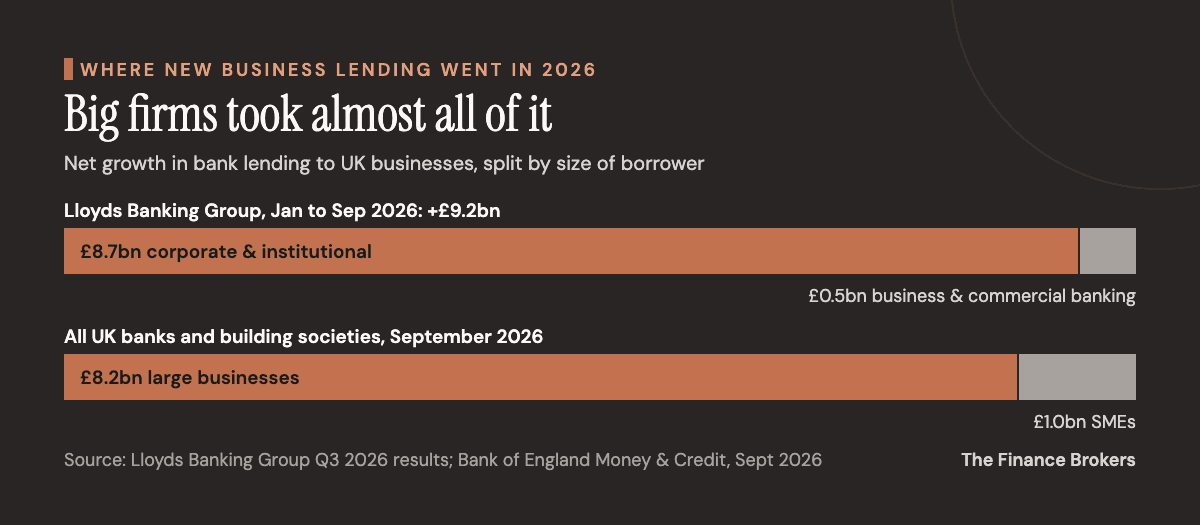
Lloyds Banking Group added £9.2bn to its commercial lending book in the first nine months of 2026. £8.7bn of it went to its corporate and institutional clients. The part of the bank that serves smaller businesses grew by £0.5bn.
At 9:30 the same morning, the Bank of England published September's lending figures for every UK bank and building society. The split was almost the same.
Neither number says small businesses cannot borrow. Both say that when UK banks grow their business lending, the growth is going overwhelmingly to bigger firms.
What Lloyds reported this morning
Lloyds' Q3 2026 interim management statement, published at 7am today, breaks its commercial lending into two books:
- Corporate and Institutional Banking: £61.0bn at the end of 2025, £69.7bn at 30 September. Up 14%.
- Business and Commercial Banking: £29.3bn at the end of 2025, £29.8bn at 30 September. Up 2%.
In the third quarter alone, the corporate book grew by £3.1bn and the business book by £0.2bn.
Two points of fairness. First, Lloyds moved some clients from the corporate book to the business book during the quarter and restated the earlier figures on the same basis, so the comparison is like for like. Second, the bank says its business lending growth is "net of continued government-backed lending repayments". Bounce Back and other pandemic-era scheme loans are still being paid down, and they sit mostly with smaller firms. That drags the business book's net figure down even when new lending is being written.
So the smaller-business book is growing, slowly. It is just a small slice of a much bigger expansion.
Charlie Nunn, Lloyds' Group Chief Executive, said the bank continues "to focus on supporting UK households and businesses" as it moves into its next strategy, Accelerate 2030. On these numbers, the businesses getting most of the new support are the big ones.
The Bank of England saw the same thing across the market
At 9:30 the Bank of England published Money and Credit for September 2026. UK businesses borrowed a net £9.3bn from banks and building societies in September, up from £4.7bn in August. Within that:
- Large businesses borrowed a net £8.2bn, up from £3.7bn in August.
- SMEs borrowed a net £1.0bn, unchanged from August.
The annual growth rate of lending to large businesses rose to 11.7%, from 9.2%. For SMEs it rose to 5.3%, from 4.7%.
That second number deserves credit. SME borrowing growth of 5.3% a year is real growth, and it is rising. But large-firm lending is growing more than twice as fast, and in September it took nearly nine pounds in every ten of net new bank lending to business.
The price gap tells the same story. The average interest rate on new bank loans to all UK businesses fell 10 basis points to 5.47%. For SMEs it fell to 6.55%, from 6.63%. Smaller firms are paying about a full percentage point more for new credit, and that gap did not close this month.
Lloyds is not alone
Last week Barclays' Q3 results showed the same shape. Its UK corporate bank, which serves businesses with turnover above £6.5m, grew loans by 14% in a year to £33.0bn. Its Business Banking book, for smaller firms, fell from £18.2bn to £17.6bn, again partly because government-scheme loans are being repaid (Barclays Q3 2026 results).
And three weeks ago, the Bank of England's own survey of lenders showed banks cutting credit availability to small businesses for a second quarter running, while availability to large corporates held steady.
That survey described lenders' appetite. Today's figures show where the money actually went. They agree.
If you are a smaller business with a facility up for renewal or a project to fund, this is the point to look beyond your own bank's answer rather than after it. Tell us what you need and we will tell you where the appetite is.
Why the big end is winning
None of this needs a conspiracy. Large corporate loans are bigger tickets, so one deal moves the balance sheet more than dozens of small ones. They tend to come with deposits, payments and other fee income attached. And the cost of assessing a £500k loan is not ten times lower than the cost of assessing a £5m one, so on a per-pound basis big loans are cheaper for a bank to write.
Add the scheme-loan repayments still running off smaller-business books, and it is not surprising that a clearing bank's growth shows up in its corporate division first.
It does mean a growing share of small-business credit is being written outside the big banks. Earlier this year non-bank and specialist lenders provided £34bn of new lending in a single half-year, and some of the largest banks have left parts of small-business finance altogether.
What we would do with this as a business owner
Do not assume your bank's appetite is the market's. A bank growing its corporate book at 14% and its business book at 2% is telling you where its attention is. Plenty of challenger and specialist lenders are actively trying to grow their small-business lending. Knowing how to pick the right lender for your size and sector is worth more when the default route is the slow lane.
Compare the price, not just the yes. The average new SME loan costs about a point more than the business-wide average. On a £250k facility that is roughly £2,700 a year. A comparison across several lenders is how you find out whether your quote is at the average or above it.
Match the product to the need. A short working capital gap may suit an unsecured business loan. If the problem is cash tied up in invoices, invoice finance lends against money you are already owed. If you have property or equipment, a secured business loan can open up larger amounts at better rates. Our guide to secured versus unsecured borrowing sets out the trade-offs.
Start before you need it. Large-firm demand is absorbing bank capacity right now. An application made early, with up-to-date accounts and a clear use of funds, has time to try a second route if the first one stalls.
The bottom line
Lloyds grew its commercial lending by £9.2bn this year and £8.7bn of it went to corporate and institutional clients. Across the whole UK market in September, large firms took £8.2bn of new bank borrowing and SMEs £1.0bn, and SMEs paid about a point more than the business-wide average rate.
Small-business lending is growing. It is just not where the banks are putting most of their new money. For a smaller firm, that makes the rest of the market more important, not less.
If you want to know who is genuinely lending to businesses your size this quarter, talk to us. We work across more than 300 lenders, and that is exactly the question we answer every day.
Further reading: Banks Cut Small-Business Credit Again. Defaults Didn't Rise. · £34bn of New Lending Didn't Come From a Bank · Every Big Four Bank Has Now Exited Invoice Factoring