Five days ago the head of a well-known UK bridging lender told a room full of brokers that some major institutions have "either withdrawn or significantly reduced their appetite" to fund specialist lenders. This morning a specialist bank did the opposite: Aldermore put a fresh £5m block bridging facility behind Integer Lending, a young property lender.
Both things are true at once, and the gap between them is the most useful thing a property investor can understand about bridging right now. The money behind small lenders has not disappeared. It has become choosier about who gets it, and on what terms. That choice flows straight through to the borrower.
What Aldermore actually did
According to The Intermediary on 19 October, Aldermore has provided a £5m block bridging facility to Integer Lending Limited, the funding vehicle for Integer Investments' property lending business. Integer lends on refurbishments, blocks of flats, auction purchases, stabilisations and HMO conversions. The facility expands its capacity to fund purchases and eligible renovation work.
Simon Lefevre, head of wholesale and structured finance at Aldermore, said Integer "has developed a strong proposition, focused on supporting property investors and developers", and that Aldermore structured a funding solution "tailored to their needs". Integer's founder, Cristiano Bellavitis, called the facility "an important milestone" that will let the lender support more investors and broker partners and widen its product range over time.
£5m is not a large number by wholesale standards. That is exactly why it matters. A block facility is a bank lending to a lender, so the bank is underwriting the borrower's underwriter. Lines of this size are how small bridging lenders grow, and they are the lines the sector says are hardest to get right now.
Why funders got nervous
The reason is Market Financial Solutions. MFS entered administration in February, and we covered what the collapse meant for developers at the time. Eight months on, the post-mortems are landing.
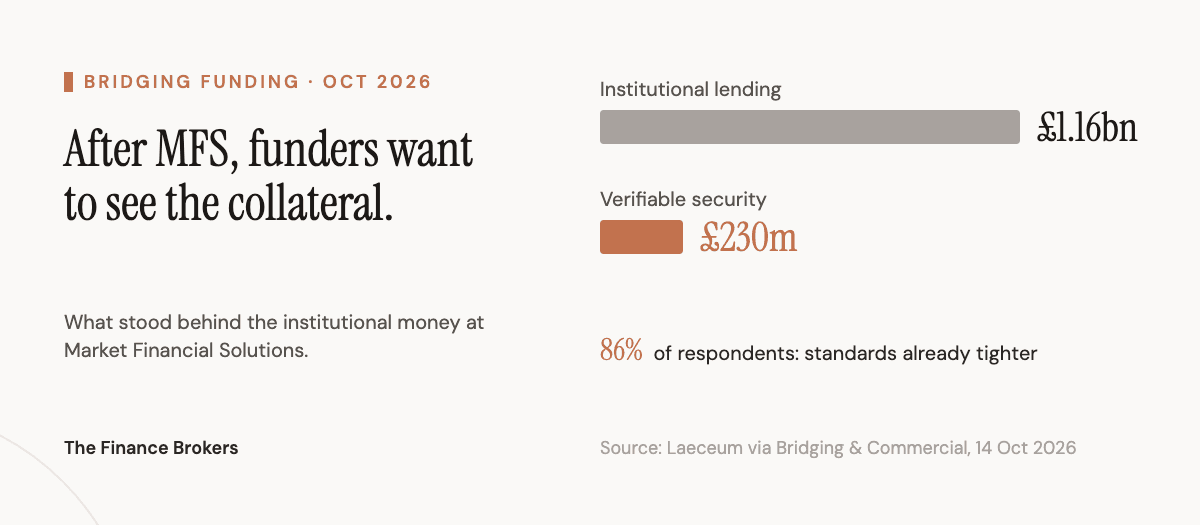
A report from advisory firm Laeceum, covered by Bridging & Commercial on 14 October, found that the same property assets had been pledged to several warehouse funders, leaving about £230m of verifiable security against £1.16bn of institutional lending. In its survey, 86% of respondents said the collapse was avoidable, and 86% said materially tighter collateral standards are already in place.
That second number is the one that reaches borrowers. When a funder tightens its collateral standards, it tightens them on the lender, and the lender passes them on.
Speaking at the Brightstar Specialist Lending Expo, reported by Mortgage Solutions on 14 October, Joshua Elash of MT Finance rejected the idea that MFS exposed a systemic problem. But he was clear about the reaction: "there's a tightening of credit appetite", and smaller lenders "are going to now really struggle to expand their capital stacks". David Whittaker, chief executive of Keystone Property Finance, said lenders have had to strengthen systems, checks and oversight of assets and data, and that "there's a cost for all this".
A market already running cooler
This is happening in a bridging market that was already slowing. The Bridging and Development Lenders Association's Q2 figures, published in September, showed applications down 26.3% on the quarter to £7.3bn, completions down 15.2% to £1.6bn, and total lender loan books down 10.6% to £10.3bn. Average LTV rose slightly, to 57.66%.
Put those together and the picture is a market with fewer deals, smaller books, and funders scrutinising every lender's collateral more closely. In that environment, a bank choosing to put a new line behind a young lender is a vote of confidence in that lender's book, not a sign the tide has turned.
What tighter funding means for your deal
Most borrowers never think about where their bridging lender's money comes from. After MFS, it is worth thinking about, because it affects three things you do care about.
Completion certainty. A lender running close to the limit of its facility can approve your loan and still struggle to fund it on the day. Lenders with fresh or diversified funding have headroom; lenders whose funder has just cut appetite may not. This matters most on auction purchases and other deals with a hard completion date.
LTV and valuation scrutiny. Elash warned that lenders relying on a single funder could see that funder change its requirements, including asking for lower loan-to-value ratios. If your plan assumes the top of a lender's stated range, build in room for a lower offer or a more conservative valuation.
Price. Tighter collateral standards and extra checks cost money, and as Whittaker put it, consumers ultimately pay. Smaller lenders that cannot add funding may compete less hard on rate. Lenders with deep, stable funding can keep pricing sharp, which is the pattern we saw when a bridging lender backed by a family rather than a funding line cut its rate.
None of this means avoiding small lenders. Specialist lenders often move faster and take on deals a mainstream lender will not touch, from refurbishments and HMO conversions to heavy works. It means asking the right questions before you commit.
The questions worth asking now
- Who funds this lender, and how many funding relationships does it have? One funder is a single point of failure.
- Has its facility recently grown, been renewed, or shrunk? A new line, like Integer's, is a good sign. Silence is not necessarily bad, but it is worth a question.
- Can it complete by my date, at the LTV in the terms? Ask for confirmation in writing before you exchange.
- What happens if the deal runs long? Your exit strategy needs to survive a lender that tightens mid-term, especially if you may need to refinance an existing bridge.
These are not questions most borrowers can answer alone. Lender funding positions change quarter to quarter and are rarely published.
Our view
The MFS fallout is doing what a shock usually does to a lending market: the money is still there, but it now follows evidence. Aldermore's line to Integer shows funders will still back small lenders with clean books and a clear proposition. The lenders that cannot show that will find growth harder, and their borrowers will feel it first in completion times and LTVs.
As a whole-of-market broker, we track which bridging lenders are well funded, which are tightening quietly, and which are leaning in. If you have a purchase, refurbishment or bridging refinance coming up and want it placed with a lender that can actually complete, talk to us before you apply.