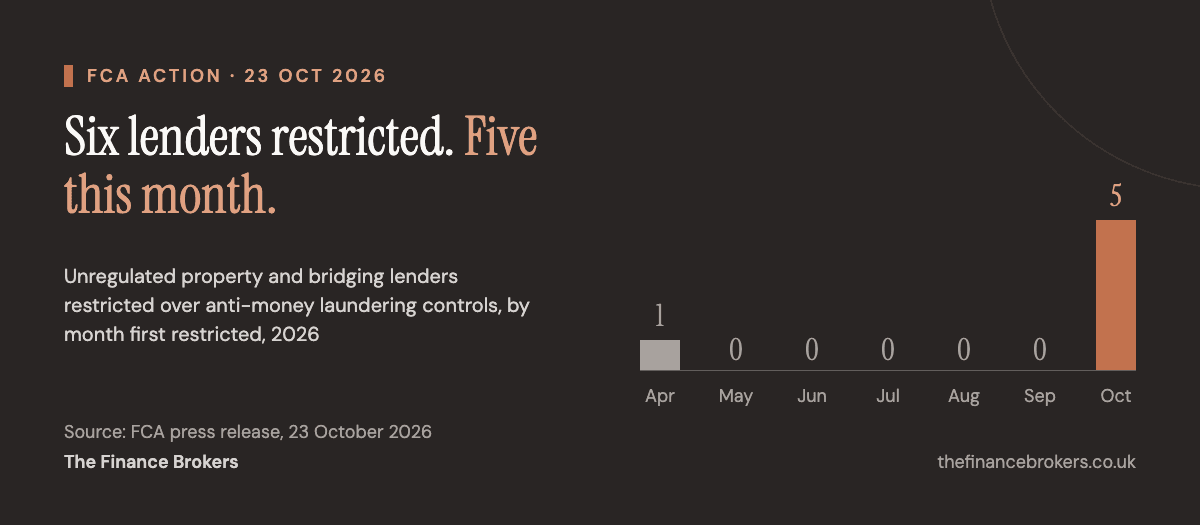
Six property and bridging lenders can no longer take on new borrowers. This morning the Financial Conduct Authority said it has restricted all six over weaknesses in their anti-money laundering controls, and the restrictions also stop them extending credit to the customers they already have.
None of the six is a household name. That is the point. They are the kind of small, unregulated lender that funds a large share of UK bridging and development deals, and most borrowers never check how their lender is supervised until something like this happens. If you have a bridge running, a refurbishment mid-way through, or an exit date coming up, today is a good day to check.
What the FCA announced
According to the FCA's press release of 23 October 2026, the regulator raised concerns about the anti-money laundering policies, controls and procedures of six firms while assessing their applications. The restrictions were imposed at each firm's request, and they were applied in stages over six months:
- Kingscrown Finance Ltd: restricted on 21 April 2026, with further restrictions on 25 September that limit how it can receive payments from existing customers and require an orderly wind-down of its loan book.
- MOMSB Ltd and Momentus Capital Ltd: restricted on 7 October 2026.
- Grosvenor Funding Ltd and Grosvenor Funding (North West) Ltd: restricted on 9 October 2026.
- Abbital Ltd: restricted on 15 October 2026.
For the five firms restricted this month, the terms are similar: no new customers and no new lending arrangements, subject to limited exceptions; limits on when they can accept payments from existing customers; and an independent review of their anti-money laundering framework. Mortgage Solutions describes the group as property, real estate, bridging and development lenders.
Steve Smart, the FCA's executive director lead for fighting financial crime, was direct: "Where they cannot satisfy us, we will intervene."
It is worth being precise about what this is and is not. These are restrictions over anti-money laundering controls, imposed at the firms' own request. The FCA has not said any borrower has lost money, and a restriction is not a finding of wrongdoing against any customer.
Registered is not the same as regulated
All six are what the FCA calls Annex 1 firms: unregulated lenders, money brokers, leasing companies and safe custody providers that must register with the FCA for anti-money laundering supervision, but are not authorised by it or subject to its wider rules.
That distinction matters more than most borrowers realise. In a statement in March, the FCA said around 1,200 Annex 1 firms are registered, that its powers over them are limited to anti-money laundering, and that their customers cannot take a complaint to the Financial Ombudsman Service. It also said it had seen consumers encouraged to set up limited companies to obtain lending such as unregulated bridging finance, without realising what protection they were giving up.
Most commercial bridging and development finance is unregulated by design. Lending to a company against investment property sits outside the FCA's mortgage rules, and that is part of why the market can move fast and take on deals a bank would not. Unregulated does not mean unsafe. It does mean the protections are the ones in your loan agreement, and the quality of your lender matters more.
This is the start, not the end
Today's six are unlikely to be the last. In August the FCA said it was sending an information request to around 900 Annex 1 firms, following earlier work with 300 in late 2025, which together covers every registered firm. It warned that applications to register would take longer, and that firms leaning on a parent company's "off-the-shelf" controls would not pass.
It also lands in a market that was already tightening. Since Market Financial Solutions entered administration in February, which we covered in what the MFS collapse means for developers, institutional funders have become far choosier about which small lenders they back. On Monday we looked at how bridging funders pulled back while Aldermore leaned in. A regulator now working through the whole unregulated lending register adds a second filter on top of the funders' one.
The likely result is a smaller, cleaner group of small lenders. That is good for the market over time. In the meantime, some borrowers will find their lender cannot do what they assumed it could.
What a restriction means if you already borrow
The FCA's wording is that the restrictions limit the firms' ability to take on new customers "or do new business with existing customers, including extending existing credit". For a property borrower, that has three practical consequences.
Extensions are not a given. Many bridging exits slip, and the usual fix is a short extension with the same lender. A lender that cannot extend existing credit takes that option off the table. If your exit depends on more time, you need a refinance of the existing bridge lined up with someone else, well before the term ends.
Further advances may stop. Refurbishment and development facilities are often released in stages. If your project depends on money still to be drawn, confirm in writing whether those tranches will be paid, rather than assuming a signed facility will fund to the end.
Redemption needs planning. The restrictions also limit when these firms can accept payments from existing customers. If you are repaying one of them, involve your solicitor early so the redemption is handled properly and nothing holds up a sale or refinance.
If your lender is not one of the six, none of this applies to you today. But the same questions are worth asking of any lender you are about to sign with.
Four checks before you sign with any lender
- Is it authorised, or only registered? Check the FCA register yourself. Registration for anti-money laundering purposes is not authorisation, and the FCA has told regulated firms to get direct confirmation of status rather than take it on trust.
- Who funds it? A lender's funding lines decide whether it can complete on your date and extend if you need it. After MFS, one funder is a single point of failure.
- What happens if the deal runs long? Your exit strategy should survive a lender that cannot extend. If you are already past your date, a rescue refinance is far easier to arrange early than late.
- Who is checking on your behalf? Most borrowers cannot see a lender's funding position or regulatory history. A broker who places deals across the market every week can.
Our view
Today's action is narrow: six small firms, anti-money laundering controls, restrictions the firms asked for. But it confirms the direction of travel for the unregulated end of property lending. Funders started asking harder questions after MFS, and now the regulator is asking them of every registered firm.
For borrowers, the lesson is not to avoid specialist lenders. They do deals the high street will not, and many are well run and well funded. It is to choose them with the same care you would apply to the property. As a whole-of-market broker we check who stands behind a lender before we place a deal with it. If you have a bridging refinance or development facility coming up, or you are unsure about the lender you already have, talk to us.