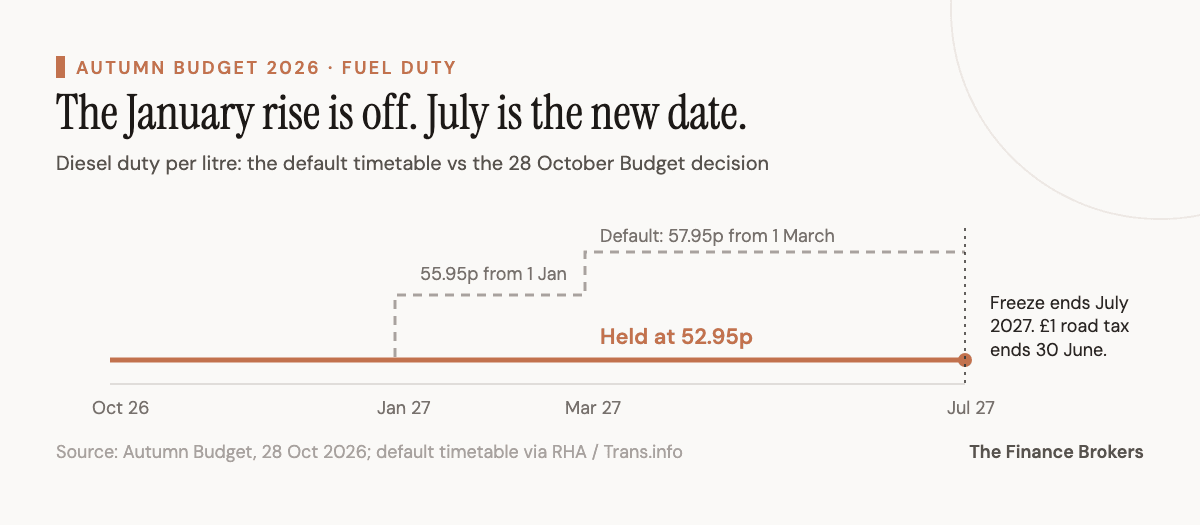
The fuel duty rise hauliers were bracing for in January is not happening. In the Budget on 28 October, the Chancellor, John Healey, extended the 5p cut in fuel duty to July 2027. "With the war in the Middle East still driving high fuel prices, I'm extending these cuts through the winter and spring to July, supporting households, hauliers, and farmers," he said, as reported by Business Motoring.
That is good news for every operator's cost line this winter. It is also a date. The £1 HGV road tax window closes on 30 June 2027. From the summer of next year, both of the reliefs that have held down the running cost of a truck in 2026 are due to end within weeks of each other, unless a later fiscal event extends them again.
What the Budget changed
Two weeks ago we set out the default timetable going into the Budget. Duty on diesel stood at 52.95p a litre, held down by the 5p cut introduced in 2022. Without a decision it would have risen by 3p on 1 January 2027 and a further 2p on 1 March, back to 57.95p.
That rise has now moved. The rate stays where it is through the winter and spring. The extension covers diesel and petrol alike, and the government presented it as support for the businesses that run on them. The Budget documents and the coverage we have read do not yet set out what happens to the rate after July, so an operator should not plan on the freeze continuing past that point.
This is the third time the cut has been pushed back this year. It was due to end in September 2026, was extended to 31 December as part of the transport support package in May, and now runs into July 2027.
What it is worth per truck
The Road Haulage Association's estimate, which we used last time, is that each 5p of duty costs around £2,325 a year per lorry. On that basis, avoiding 3p from January and the full 5p from March to July is worth roughly £1,000 per truck over the six months, by our arithmetic. For a 20-vehicle fleet that is about £20,000 of cash that stays in the business through the winter.
It is a saving against a plan, not a fall in cost. Diesel was already nearly 40% dearer than in February when it passed its 2022 record at the end of September. Nothing in the Budget changes the pump price. Howard Cox of FairFuelUK put it bluntly: "a freeze is not a cut."
Smaller operators are the ones who feel that most. Daniel Miller, managing director of CoolKit, said fleet operators need "long-term certainty about what they'll be paying." A deferral to July gives them eight months of certainty and then a question mark.
Two reliefs, one summer
The more useful way to read the Budget for a fleet is alongside the measure that came before it. From 1 July 2026 most eligible HGVs renewing their road tax pay £1 of vehicle excise duty, worth around £600 a vehicle and up to £912 on the heaviest lorries. That window runs to 30 June 2027.
So in summer 2027, on current policy:
- Road tax reverts to the full rate for renewals from 1 July 2027
- Fuel duty loses its extension in July 2027, with no published path beyond it
Neither is guaranteed to bite. The government has extended the fuel cut three times this year and could do so again in the spring. But a fleet budget built on the assumption that both reliefs roll over is a budget built on hope. The prudent plan is to treat the next eight months as a window to strengthen the balance sheet, not as a lower cost base to spend into.
What to do with eight months
Bank the saving, don't spend it. The cash a business does not pay in duty this winter is the cheapest working capital it will get. Keep it on the balance sheet against the summer, rather than letting it disappear into the general running cost.
Bring forward replacement decisions you were going to make anyway. The third quarter was the first in two years in which HGV registrations grew, up 7.2%, led by heavy artics and tippers. If a vehicle is due for replacement in 2027, financing it now means its monthly cost is fixed before the reliefs expire, and the operating cost saving from a newer, more efficient engine starts sooner. Hire purchase and lease payments are normally fixed for the term, so the biggest line in the fleet budget stops moving even if fuel does.
Use the fleet you already own. Trucks bought in 2021 and 2022 and largely paid down are unencumbered assets. Asset refinance against them releases cash without selling them, and it can be arranged while trading is steady rather than in the quarter the costs rise. Our guide to secured versus unsecured business borrowing explains where it fits against other options.
Put the working capital line in before you need it. Haulage runs on 45 to 60 day terms against weekly fuel and wage bills. Invoice finance closes that gap and grows with the sales ledger, so it scales automatically if fuel prices or duty push the weekly outgoings up. Lenders price a facility on the trading record in front of them. A record with eight steady months in it is a better one to apply on than a record with a fresh cost shock in it.
The wider Budget, briefly
Two other measures matter to how fleets borrow, and both are worth watching rather than acting on yet. The Chancellor announced an extra £5 billion of capital for the British Business Bank, part of a £20.4 billion package with the National Wealth Fund, reported by Private Equity Wire as taking the bank's financial capacity from £25.6 billion to £30.6 billion over around five years. Much of the British Business Bank's support for smaller firms reaches them through lenders, including asset finance providers, so more capacity there should eventually mean more guarantee-backed lending in the market.
Banks, meanwhile, will pay an extra 3 percentage points of bank surcharge for 15 months from January, according to the Guardian's summary of the Budget. The surcharge falls on bank profits above an allowance, and much HGV finance is written by specialist funders rather than the high street, but it is one more reason the high street is unlikely to become a cheaper place for a haulier to borrow in 2027.
The bottom line
The Budget took the January duty rise off the table and replaced it with a July question. For a haulier that is real money, roughly £1,000 a truck over the winter on the RHA's figures, and it arrives at a moment when the replacement cycle has just restarted. Used well, it pays for the working capital line, the refinance or the deposit on the next vehicle. Spent, it disappears into a cost base that is still due to rise next summer.
If you want to know what your fleet could release, or what the next vehicle would cost to finance before the reliefs run out, our asset finance team can price it across the funders actively writing HGV business. Talk to us.
Further reading: Truck Orders Rose 7.2%. Two Weeks Before the Budget., on the Q3 2026 HGV registrations and the fuel duty timetable this Budget has now changed.