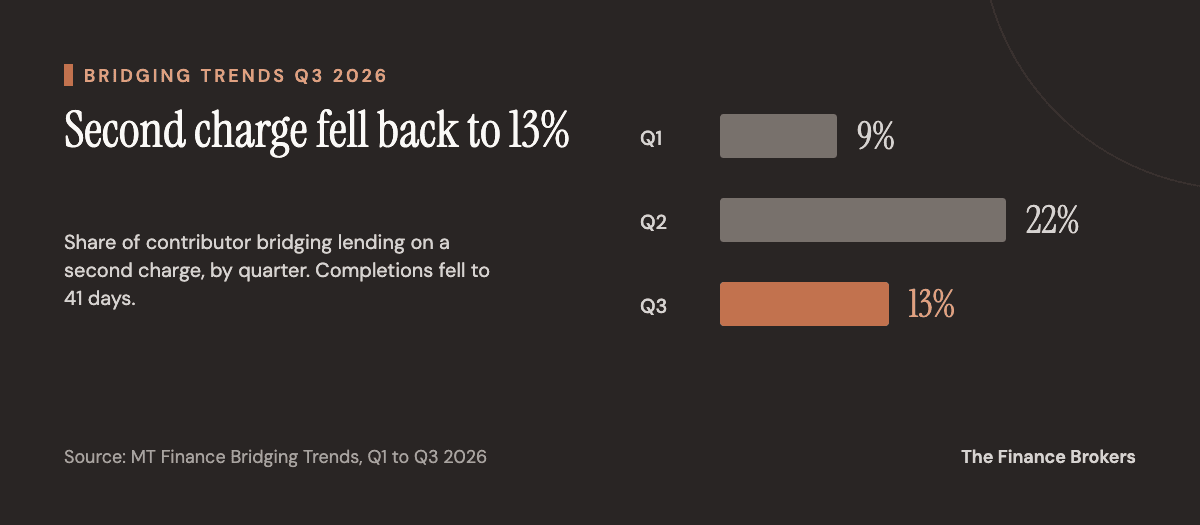
In August we wrote that second charge bridging had gone from 9% to 22% of contributor lending in a single quarter. Three months later it has given most of that back.
The Bridging Trends figures for Q3 2026, published by MT Finance this morning, put second charge bridges at 13% of lending, down from 22% in Q2. First charge bridges rose from 78% to 87%. At the same time the average deal completed in 41 days, down from 46, and the average monthly rate eased to 0.77%.
So the quarter's story is not "the second charge trade is over". It is that borrowers went back to buying things, and the market got quicker and slightly cheaper while they did it.
The headline numbers
Contributors lent £181.8m in Q3, up about 5% from £173.1m in Q2, which itself was down from £199.2m in Q1. So volume has turned up, but it is still 13.2% below the £209.4m lent in Q3 2025. A market recovering from a soft spring, not one back at last year's pace.
The rest of the release, quarter on quarter:
- Second charge bridges fell from 22% to 13% of lending; first charge rose from 78% to 87%.
- Investment purchases rose from 18% to 23% of transactions, the most common use of a bridge in Q3.
- Heavy refurbishment fell from 10% to 6%, which the release links to building costs staying high.
- Average LTV rose from 55% to 59%.
- Average monthly rate fell from 0.81% to 0.77%.
- Average completion time fell from 46 days to 41.
- Average term held at 12 months.
- Unregulated lending was 55% of the total, up from 52% in Q2 and down from 59% in Q1.
Raphael Benggio, bridging director at MT Finance, focused on the two numbers borrowers feel most: "It is really encouraging to see the drop in both completion times and interest rates."
Why second charge fell back
Our read of the Q2 jump was that it came from borrowers protecting cheap existing debt: if your term loan was fixed before this year's repricing, a second charge bridge lets you raise money against the equity without paying to refinance the whole balance.
That logic has not gone away. What changed in Q3 is the mix of what people were borrowing for. Investment purchases rose to 23% of transactions, and a bridge to buy an asset is almost always a first charge on that asset. When more of the market is buying rather than releasing equity from something it already owns, the first charge share rises on its own.
The regulated share points the same way. In Q2, regulated bridging (mostly homeowners and chain breaks) jumped to 48%. In Q3 unregulated lending climbed back to 55%, so regulated slipped to 45%. More investor and business borrowing, less of the "my sale has stalled" borrowing that drove the spring.
Put plainly: Q2 was a market raising money against what it had. Q3 was a market raising money to buy.
Faster, cheaper, and slightly higher leverage
The 41-day average is the number we would pay most attention to. It has now fallen from 53 days in Q1 to 46 in Q2 and 41 in Q3. That is nearly two weeks off the average deal in six months.
Fergus Allen, head of bridging at Clifton Private Finance, was cautious about what drives it, attributing faster completions "most likely" to lenders competing harder for business rather than to sustainable market growth. We think that is the right reading, and it is good news for borrowers either way. A lender competing on speed is a lender that wants your deal.
The same competition shows in pricing and leverage. The average rate fell four basis points a month, and average LTV rose four points, to 59%. Lenders are lending a little further and charging a little less. That is not a stretched market at 59%, but it is a more willing one than it was in the spring.
The part the data cannot show yet
Q3 ran from July to September. On 5 November the Bank of England raised Bank Rate to 4%, its first rise since 2023, and several members of the committee signalled that more may follow.
None of that is in these numbers. The 0.77% average was priced before the rise, and lenders that fund themselves on wholesale lines are likely to pass at least some of the rise through. If you are pricing a bridge today off a Q3 average, treat it as a floor rather than a quote.
The Knowledge Bank search data in the same release hints at where demand is heading next. The biggest rise in broker search terms in Q3 was for development bridging, followed by "defaults over £500" and properties bought at auction. That is a market looking for funding for projects and for borrowers with imperfect credit, both areas where criteria matter more than headline rate.
What this means if you are planning a bridge
Price it now, and expect it to move. A 41-day average and easing rates make Q3 the best service conditions bridging borrowers have seen this year. The 4% Bank Rate arrived after the quarter ended. If your deal needs to happen, the conditions behind these numbers are worth using before they fade.
Match the charge to the job. A second charge is still the cheaper answer when you want to raise money against an asset that already carries low-cost debt. A first charge is the natural structure when you are buying. Our guide to what bridging finance is and how it is structured covers the difference.
Speed only helps if the exit is solid. Lenders are completing faster, but they still test how you will repay. With rates now rising, a refinance exit that worked on paper in September may need re-checking. See our guides to bridging loan exit strategy and refinancing an existing bridging loan if your current bridge is due to end in the next few months.
Refurbishment is getting harder to fund on cost alone. Heavy refurb fell from 10% to 6% of lending. If your project depends on a large works budget, expect lenders to look harder at your costings and contingency, and build that into your timeline.
The honest caveat
Bridging Trends is contributor data: the lending reported by the brokers and packagers who submit to it, not the whole UK market. £181.8m is a fraction of total bridging. Read it as direction, not as a census.
But the direction here is consistent with what we have covered over the past two months: funding lines being extended to bridging lenders rather than withdrawn, and lenders competing on service as much as on price. Q3 was the quarter that competition reached the average borrower. The open question for Q4 is how much of it survives a rising Bank Rate.
Planning a purchase, a refurbishment or a refinance that needs short-term money before the new year? Talk to The Finance Brokers. We will compare first and second charge options across the market and tell you honestly which one is cheaper for your deal.