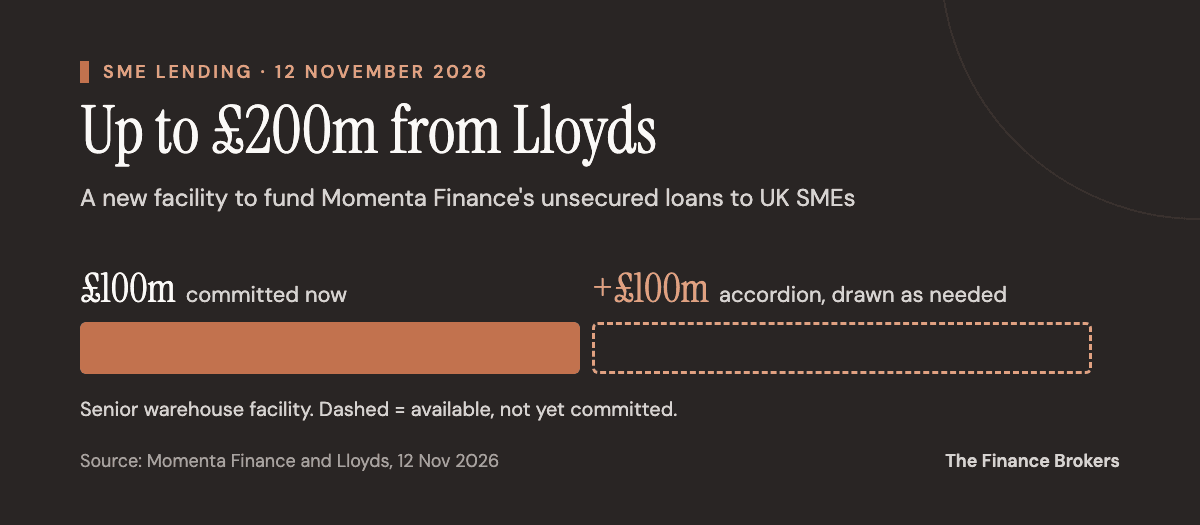
Lloyds has just put up to £200m behind unsecured loans to UK small businesses. It will not be making those loans itself.
On 12 November, Momenta Finance, a specialist lender that works through brokers, announced a senior warehouse facility from Lloyds: £100m now, with an accordion that allows a further £100m. The money funds Momenta's unsecured business loans for working capital, investment and expansion.
A fortnight ago, Lloyds' own third-quarter results showed the part of the bank that serves smaller businesses grew its lending by £0.5bn in nine months, while corporate and institutional clients took £8.7bn. Today's deal is the other half of that picture. Bank capital is still reaching small firms. More and more of it arrives through a specialist.
What Lloyds actually committed
The facility is a senior warehouse line. In plain terms, Lloyds lends to Momenta against a pool of the loans Momenta makes, and Momenta lends that money on to businesses. The initial commitment is £100m. The accordion lets Momenta draw a further £100m as its book grows, so the headline figure of £200m is a ceiling, not money already lent.
Momenta says the deal takes the facilities it has secured from banking and institutional partners since 2023 to more than £500m.
Three people put their names to it:
- Tim Boag, chief executive of Momenta Finance, said a facility of this scale "means we can back many more ambitious UK businesses through our broker partners."
- Jake Trehaeven, Momenta's capital markets director, said bringing Lloyds on board "adds real depth and diversification to our funding platform."
- Miray Muminoglu, head of the securitised products group at Lloyds, said financing established non-bank lenders "is an important part of our securitisation and specialist finance business."
That last quote is the one worth reading twice. It is a high-street bank saying, on the record, that funding other lenders is part of how it does business.
Why a bank funds a lender instead of lending
An unsecured £150,000 loan to a five-year-old engineering firm takes underwriting work: bank statements, filed accounts, a view on the directors, a personal guarantee. A specialist built around that kind of loan, fed by brokers who package the case, can often do it faster and more flexibly than a bank's own small-business team.
The bank's securitisation desk, meanwhile, is set up to lend large sums against pools of loans, with structural protection on top. So the bank provides the wholesale money and the specialist does the retail lending. Both sides play to their strengths.
We have watched this happen all year. In August, Lloyds and NatWest put £550m behind a single specialist lender, Lendco. In the last ten days alone:
- NatWest gave Capital on Tap a facility of up to £200m, partly backed by the British Business Bank's ENABLE Guarantee (9 November).
- OakNorth extended its facility to Gold Funding, a London bridging lender (11 November).
- Aldermore lifted its funding line to Kingsley Asset Finance from £6m to £9m (3 November).
It is the same shape every time: a bank lends to a lender, which lends to you. We covered the wider version of this in how global banks are funding UK specialist lenders.
What Momenta lends, and on what terms
According to Momenta's introducer product guide (dated January 2026, published through the NACFB), its unsecured business loan runs from £50,000 to £500,000 over 6 to 84 months. The headline criteria:
- A UK limited company or LLP, trading for at least two years, with turnover of at least £350,000 a year shown in filed accounts.
- A personal guarantee. At least one person with significant control must be a homeowner for loans up to £350,000, and two for £350,000 to £500,000.
- Pricing in tiers. Rates start at SONIA plus 3% for businesses trading five years or more with turnover of £500,000 or more, and at SONIA plus 7.5% for the standard tier. Loans under the government's Growth Guarantee Scheme are fixed from 15%.
- No fees for early or over-repayment, and an interest-only period of up to 12 months where it fits.
Terms change, so treat these as the guide's figures rather than a quote. The point is the shape: this is mid-sized, unsecured, broker-introduced lending to established businesses, which is exactly the space high-street banks have been slow to grow.
If the Growth Guarantee Scheme route is new to you, our explainer on the expanded Growth Guarantee Scheme covers how the 70% government guarantee works. The borrower stays fully liable either way.
What it means if you need £50,000 to £500,000
There is more unsecured capacity than the high-street numbers suggest. If your own bank has gone quiet on a working capital or expansion loan, that is not the same as the market saying no. A meaningful share of bank money for this kind of loan now sits with specialists.
The personal guarantee is the real security. "Unsecured" means no charge over property. It does not mean no recourse. Most specialist unsecured lenders, Momenta included, ask directors to guarantee the loan, and some require a homeowner. Read our guide to personal guarantees and unsecured loans before you sign one.
Price follows trading history. On Momenta's own tiers, the gap between a five-year business with £500,000 turnover and a two-year business with £350,000 is 4.5 percentage points over SONIA. That gap is worth knowing about before you apply, because three more years of filed accounts can be worth more than any negotiation.
The route matters as much as the rate. Momenta lends through brokers. Many specialist lenders do. Applying direct to several lenders creates multiple credit searches and multiple partial answers. Our step-by-step guide on how to get an unsecured business loan in the UK explains why a single packaged application usually goes further. If you are weighing whether to offer security for a better rate, secured vs unsecured business loans sets out the trade-off.
The bottom line
Lloyds' own small-business book grew by £0.5bn this year. Its securitisation desk has now committed up to £200m to a lender whose whole business is unsecured loans to small firms. Both things are true, and together they explain where small-business credit is actually coming from in 2026.
For an established business that needs £50,000 to £500,000, the practical answer is to look past your own bank's appetite and ask who funds the lenders. If you are planning a working capital or expansion loan, talk to us and we will show you what the specialist side of the market would offer, through our unsecured business loans service.