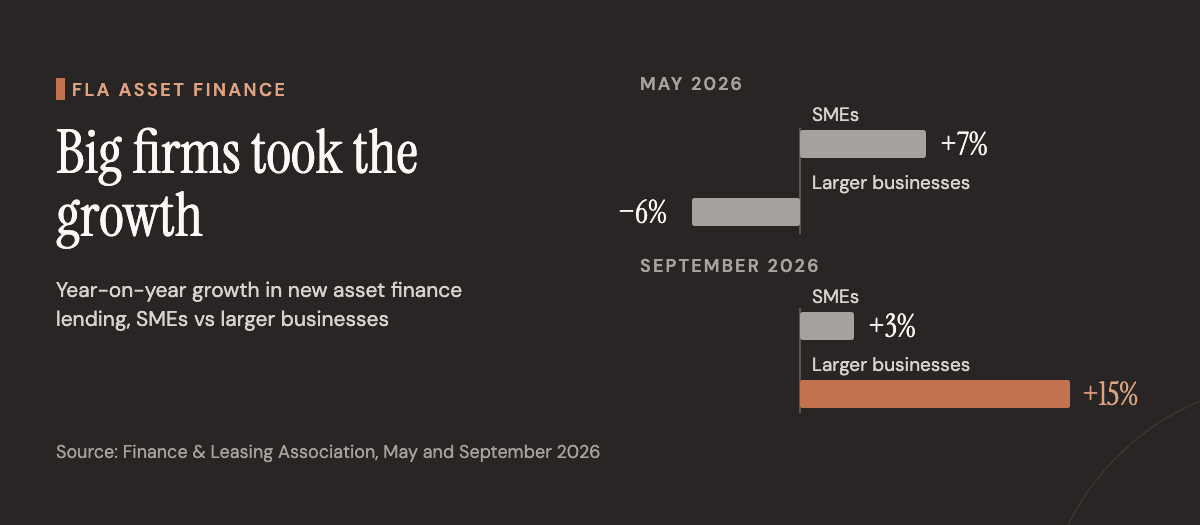
In May, small businesses were the growth story in UK asset finance. New lending to SMEs was up 7% on a year earlier while lending to larger businesses fell 6%. Four months on, the order has flipped.
According to figures the Finance & Leasing Association published this morning, asset finance new business grew 8% in September 2026 against the same month last year. Inside that, new asset finance lending to SMEs grew 3%. Lending to larger businesses grew 15%.
The market is healthy. Twelve-month lending hit a record £42.2 billion. But in September most of the extra money went to the bigger firms, and the sectors that carried the month were trucks, vans and company cars. If you run a smaller business and are planning an equipment or vehicle purchase, that split is worth understanding before you apply.
What the September figures say
The headline numbers from the FLA release, all compared with the same period a year earlier:
- September 2026: £4.2 billion of new business, up 8%
- Three months to September: £10.7 billion, up 6%
- Twelve months to September: £42.2 billion, up 6%, a record
The FLA did not publish the SME and larger-business totals in pounds, only the growth rates. So we cannot say how much of the £4.2 billion each group took. What we can say is that the rate of growth for larger businesses was five times the rate for SMEs in September, which is a reversal of the pattern the FLA reported for May.
Geraldine Kilkelly, Director of Research and Chief Economist at the FLA, described a solid quarter, with growth "driven by the vehicle finance and plant and machinery finance sectors", and added that "lending to SMEs also reached a new high". Both things are true. SME asset finance is at a record level over the year. It is simply growing more slowly than lending to bigger firms right now.
Trucks and vans carried the month
The sector detail is where the September release becomes useful for operators.
| Sector | September 2026 | Change on Sept 2025 | 12 months to Sept | Change |
|---|---|---|---|---|
| Commercial vehicle finance | £1,193m | +18% | £11,447m | +6% |
| Business car finance | £1,592m | +17% | £14,299m | +8% |
| Plant and machinery | £684m | +1% | £8,776m | +15% |
| IT equipment | £120m | −4% | £1,281m | +1% |
| Business equipment | £148m | −12% | £1,702m | −6% |
Source: FLA, 24 November 2026.
Commercial vehicle finance, which covers vans, trucks and trailers, grew 18% in September and 12% across the third quarter. That fits what the registration data has been saying. The SMMT's figures showed HGV registrations rising 7.2% in the third quarter, the first quarter of growth in two years, after a spring in which operators bought vans and deferred trucks. The replacement cycle we flagged then has now shown up in the finance numbers as well as the showroom.
Plant and machinery is the quieter story. It grew just 1% in September, but 12% over the quarter and 15% over the year, so one flat month follows a strong run rather than signalling a turn.
The weak spots are the smaller-ticket categories. Business equipment finance fell 12% and IT equipment 4%. These are the assets smaller firms tend to finance most often, which is one plausible reason the SME line grew more slowly than the total. That is our reading, not a finding the FLA states.
How the money was written
Two further lines in the release say something about where the growth came from.
By product: hire purchase and lease purchase grew 16% to £2.3 billion, while operating leasing was flat. Hire purchase is the structure most often used for vehicles and plant you intend to own at the end of the term, so it is consistent with the vehicle-led month.
By channel: finance written directly by lenders grew 8%, and sales finance arranged at the point of sale by dealers and manufacturers also grew 8%. Broker-introduced finance grew 2%. We would not read too much into one month. But it is a reminder that, for a large share of the market, the first quote a business sees is the one the dealer offers, and that quote is not always the best one available.
Why the next few months may be harder for smaller firms
Kilkelly's outlook was cautious: "economic conditions are likely to become more challenging as tighter financial conditions weigh on spending and investment decisions."
Tighter financial conditions are not abstract. The Bank of England raised Bank Rate to 4% on 5 November, and asset finance is priced off funding costs. When conditions tighten, lenders tend to favour the borrowers they find easiest to underwrite: larger businesses with longer trading records and audited accounts. September's numbers may be an early sign of that, or they may be one month of noise. Either way, a smaller business heading into 2027 with an equipment or vehicle purchase in mind should expect lenders to look harder at the application, not less hard.
What this means if you are financing equipment or vehicles
The appetite is there, especially for vehicles. An 18% rise in commercial vehicle finance means lenders are actively writing van and truck deals. If you have been holding off a fleet replacement, the market is open.
Prepare the application like a larger firm would. Up-to-date management accounts, a clear view of how the asset pays for itself, and a sensible deposit all help a smaller business compete for the same lender attention. Our guide to secured versus unsecured business loans explains why lending secured on the asset itself is usually the cheaper route for kit and vehicles.
Do not stop at the dealer's quote. Sales finance is convenient, and sometimes it is the best deal. But dealer finance is one lender's offer. Comparing it with specialist asset lenders, who often read a sector or a used vehicle better than a generalist, is the point of picking the right lender rather than the nearest one.
Think about refinancing what you already own. If cash is tight but your existing vehicles or machinery are owned outright, asset refinance can release working capital against them. It is one of the services we arrange through our asset finance team, alongside hire purchase and leasing for new kit.
The broader picture, which we set out last week in our look at where asset finance is used across the UK, is that this is a mainstream way for British businesses to pay for the things that do the work. September shows the market still growing. It also shows that growth is not shared evenly, and smaller firms may have to work a little harder for their share of it.