Momenta Finance has launched a working capital facility for SMEs: £50,000 to £500,000, up to 12 months, from 1.25% a month, interest-only, with no early repayment charges. Two weeks ago Lloyds put up to £200m behind Momenta's lending. The new product follows that deal.
The headline rate is a monthly one, which makes it easy to misread. So in this piece we do the arithmetic: what the facility actually costs on a real sum, why the "no early repayment charge" line matters more than the rate, and where it sits next to the other ways small businesses are now covering short cash gaps.
What Momenta has launched
According to The Intermediary's report of the launch on 26 November, Momenta's new Working Capital Finance has these terms:
- Size: £50,000 to £500,000
- Term: up to 12 months
- Price: rates from 1.25% per month, plus an arrangement fee
- Repayment: monthly interest-only, with the capital repaid at the end of the term, or the facility renewed
- Early repayment: no early repayment charges
Momenta says the product is built for buying inventory, managing cash flow and covering day-to-day operating costs. Chris Forrest, Momenta's chief commercial officer, put it this way: "Many good businesses are held back, not because they lack opportunities, but because their cash is tied up."
The timing is not a coincidence. On 12 November we covered Lloyds backing Momenta's SME lending with up to £200m, a senior warehouse facility of £100m committed plus a £100m accordion. The launch report links the two directly: the new product follows that facility, which increases Momenta's capacity to support more brokers and SMEs. A bigger funding line gives a specialist lender room to widen what it offers, and this launch is a direct example.
What 1.25% a month actually costs
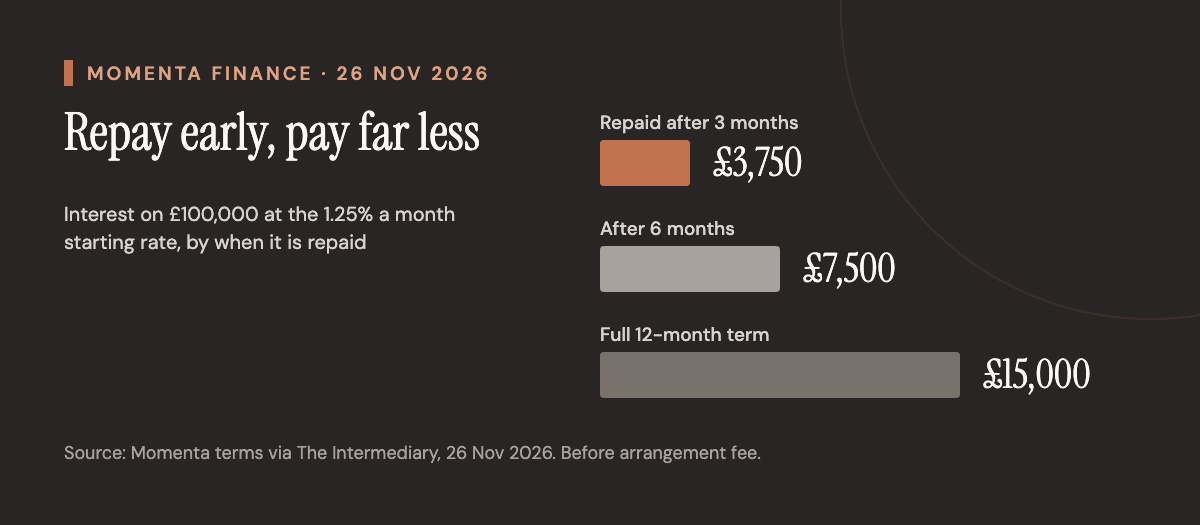
A monthly rate looks small. Here is what it means on £100,000 at the 1.25% starting rate, interest-only, before the arrangement fee (which has not been published):
| Repaid after | Interest paid |
|---|---|
| 3 months | £3,750 |
| 6 months | £7,500 |
| 12 months (full term) | £15,000 |
Each month costs £1,250 in interest. Held for the full year, that is 15% of the amount borrowed, plus the fee. That is not cheap money, and nobody should pretend it is. A secured term loan or a commercial mortgage will usually price well below that, because the lender has more protection and more time.
But the table shows the point of the product. Because there is no early repayment charge, the cost scales with how long you actually use the money. A business that draws £100,000 to buy stock in November and repays it from January sales has paid around £3,750 in interest, not £15,000. The interest-only structure also keeps monthly outgoings down while the cash is tied up, which is exactly when a business can least afford a large capital repayment.
Two caveats matter:
- "From" means from. 1.25% a month is the starting rate. Your rate depends on the lender's view of your business, so the real figure for your case may be higher.
- The arrangement fee is part of the price. On a short draw it can be a meaningful share of the total cost. Always ask for it in pounds, not just as a percentage, and add it to the interest before comparing options.
Why lenders are building the overdraft's replacement
For decades, the answer to "I need cash for stock until customers pay" was the bank overdraft. It has been fading for a long time. Allica Bank's long-run analysis of SME finance found overdrafts made up 31% of SME bank lending in 1998 and just 5% by the end of 2024.
Specialist lenders are filling the gap product by product. Momenta's launch landed a day after iwoca announced its business credit card partnership with Visa and Enfuce. Alongside that, iwoca published polling of more than 1,200 UK SME leaders which shows how owners now split their borrowing by job:
- 75% would use a card rather than a loan to cover a temporary shortfall, such as waiting for an invoice to be paid
- 83% would use a card for modest supplier payments, and 88% for everyday business expenses
- But 74% would choose a loan to take on a substantial contract that needs upfront investment, 69% to expand into new markets and 67% to buy or fit out premises
That is iwoca's own commissioned research, and iwoca sells cards, so read it with that in mind. But the pattern is clear: owners no longer want one product for everything. They want the right tool for each gap.
Which tool fits which gap
There is no single best option. The right one depends on how long the gap lasts and what is causing it.
A gap of a few weeks. A business credit card can be the cheapest route if the balance is cleared within the interest-free period. iwoca's card offers up to 42 days interest-free when repaid in full and on time. Carry the balance beyond that and the economics change quickly. We looked at what iwoca's card offers in more detail when it first appeared, in iwoca's £250k business card.
A gap of a few months, for stock or a seasonal peak. This is where a facility like Momenta's fits. Interest-only, repayable early without penalty, sized from £50,000 to £500,000. The cost is controlled by repaying as soon as the cash comes back in.
A gap caused by slow-paying customers. If the cash is sitting in your sales ledger, invoice finance releases it against the invoices themselves, and it grows as your sales grow. It often suits better than borrowing a fixed sum against the business as a whole.
A long-term investment. New premises, a big contract, expansion: this is term-loan territory, which is also where iwoca's respondents said they would reach for a loan. Our guide to what an unsecured business loan is covers the basics, and secured vs unsecured business loans explains when offering security buys a meaningfully lower rate.
Using short-term money for a long-term need is the classic mistake. A 12-month facility funding a five-year project means refinancing under pressure, on whatever terms are available that day.
What we would check before signing
If a short-term working capital facility looks like the right fit, these are the questions we ask on a client's behalf:
- What is my actual rate, and what is the arrangement fee in pounds? Compare the total cost over the period you realistically expect to use the money, not the full term.
- What happens at month 12? Renewal is an option on Momenta's product, but renewal terms are set at the time. Plan for repayment, treat renewal as a bonus.
- Is a personal guarantee required? Ask the question directly. It changes the risk you are personally carrying.
- Can I draw less than the maximum? Borrowing only what the gap needs keeps the interest down.
- Is this the cheapest route for this particular gap? A card, invoice finance or a secured facility may beat it depending on the timing and what you can offer as security.
Momenta lends through brokers, as many specialist lenders do. That matters, because the same business can receive very different offers depending on how the case is packaged and which lenders see it. Our guide on how to get an unsecured business loan in the UK explains why one well-prepared application usually goes further than several direct ones.
The bottom line
Momenta's launch is a useful addition for businesses that need a few months of breathing room on stock or cash flow. At 1.25% a month it is not cheap if you hold it for a year, but with no early repayment charge, the businesses that use it as intended, for a defined gap they can repay quickly, will pay far less than the headline full-term cost.
It is also one more sign of where SME working capital now comes from: specialist lenders, funded by the big banks, building the products the overdraft used to cover.
If you are weighing up how to fund stock, a seasonal peak or a slow-paying customer before the new year, talk to us. We will look at the whole market, including facilities like this one, and tell you which route costs least for your situation.